Happy Labor Day!


A cartoon-style charcoal grill with tall orange flames rising above the grate, cooking sausages, vegetables, and burger patties against a bright yellow background.

A Long Weekend, a Short Summer, and a Little History

Any big plans for the holiday? Maybe a cookout, a last hurrah for summer, or just one final attempt to pretend the calendar isn’t about to flip into pumpkin season. Labor Day always feels like the unofficial “summer finale,” even when the thermometer is still insisting it’s 80° and humid.

A vintage “We Can Do It!” poster featuring a woman in a blue work shirt with a rolled-up sleeve, flexing her arm and wearing a red polka‑dot bandana against a bright yellow background.Where Labor Day Actually Came From

Labor Day didn’t just appear out of thin air — it was created by the labor movement in the late 19th century and became a federal holiday in 1894. The date changes every year, but it always lands on the first Monday in September, giving us that sweet, sweet long weekend.

A Look Back at the 1800s (Spoiler: It Was Rough)

Back in the 1800s, the average American laborer worked 12‑hour days, seven days a week. And if that wasn’t enough, kids as young as five or six were working in mills, factories, and mines.

Honestly, I can’t imagine a modern 5‑year‑old doing anything for 12 hours straight except maybe watching Bluey or refusing to eat vegetables. The idea of them operating machinery? Absolutely not.

We’ve Come a Long Way, Baby  
Skewers of grilled meat and vegetables cooking over an open flame on an outdoor barbecue, with smoke rising and people gathered at a picnic table in the blurred background.

Today, the standard work week is 40 hours, shifts are typically 8 hours, and we get holidays, weekends, and actual time off. Things have definitely changed — thankfully.

So here’s to Labor Day: A celebration of the working man, the working woman, and everyone who keeps the world running.

Enjoy your cookout, your day off, and your well‑earned break.


WMEO Special Report- Ginger Cat Appreciation Day

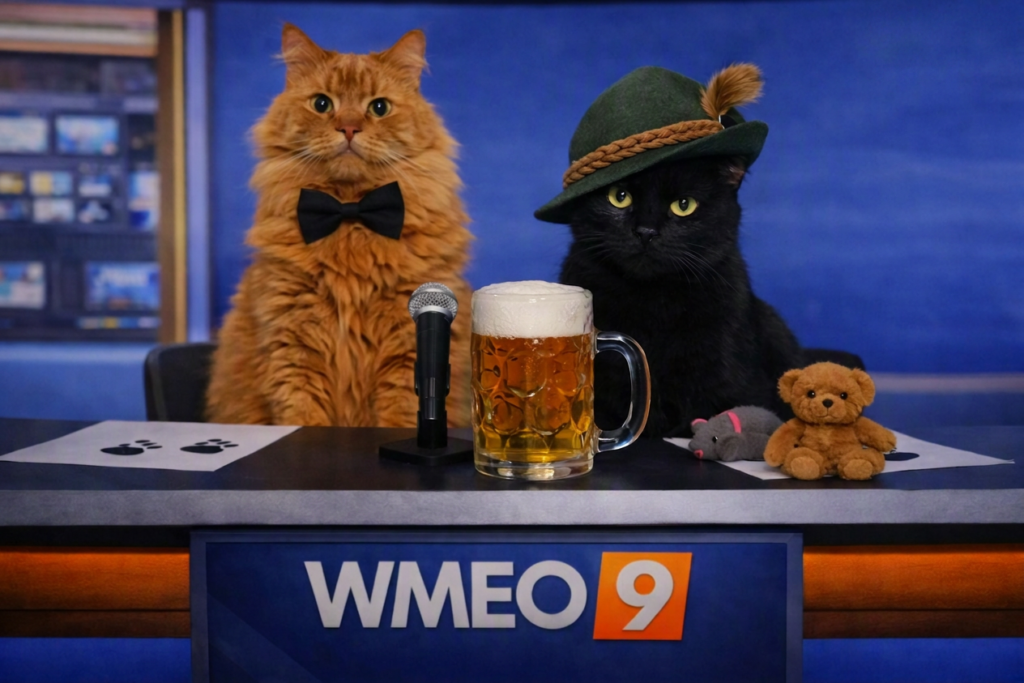
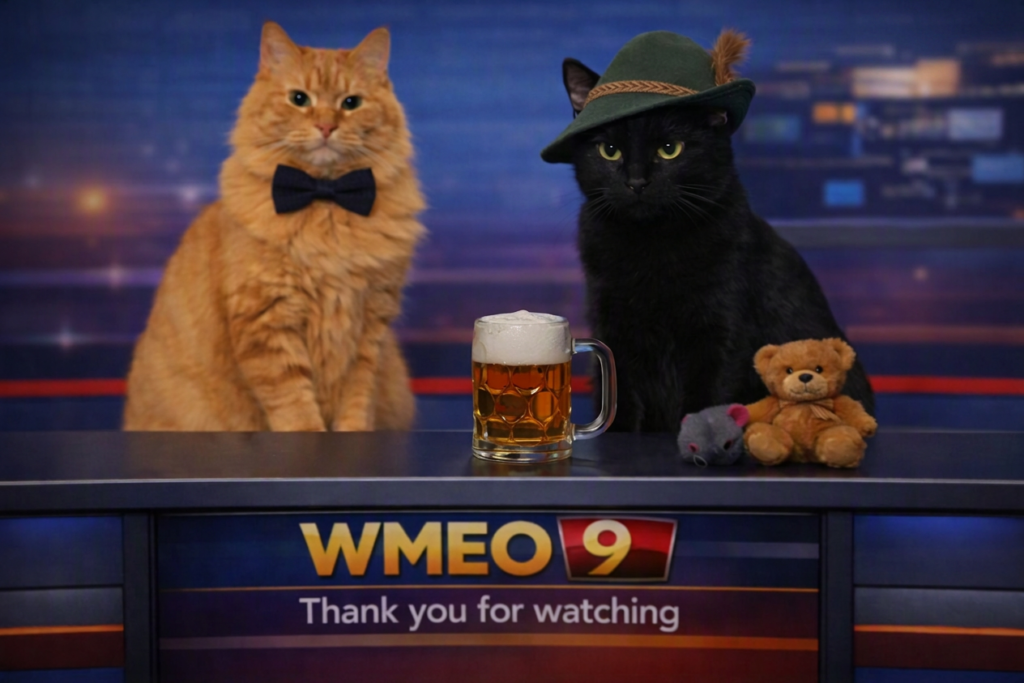
2 cats, one ornage and one black, sit at a news desk for WMEO as anchors for the station

🧡 WMEO SPECIAL REPORT

Banner Appreciation Day — Celebrating Our Ginger Gentleman

Banner (opening): Good evening, viewers. Apparently tonight’s bulletin is about… me. I’ve been informed by the WMEO newsroom that today is Ginger Cat Appreciation Day, and as the resident orange correspondent, protocol requires that I acknowledge it with dignity and professionalism.

Balboa: Dignity? Banner, you’re an orange cat. You radiate sunshine, optimism, and the belief that every lap is reserved for you. This holiday was practically invented in your honor.

Banner: I do strive to bring calm, steady reporting to WMEO. Whether it’s wildlife rescues, neighborhood happenings, or keeping Balboa from turning every segment into a cooking show, I take my role seriously.

Balboa: He’s the backbone of this operation. The whiskered anchor. The ginger glow that keeps the newsroom warm. Also, he never steals my snacks, which is a quality I deeply admire.

Banner: Thank you, Balboa. I appreciate that… I think.

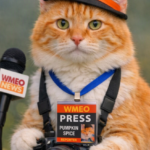
Orange long‑haired cat wearing a blue WMEO press badge while sitting outdoors on a textured surface with blurred green trees in the background.


🐾 A Tribute from the Nature Desk

Today we celebrate:

  • Banner’s unwavering professionalism
  • His gentle leadership
  • His commitment to factual reporting
  • His ability to nap anywhere, anytime, without disrupting workflow
  • His orange‑cat charm that keeps WMEO running smoothly

Fluffy orange cat sitting on top of a home office printer, looking toward the camera, with a blue wall, corkboard, and computer monitor in the background.

From the first meow of the morning briefing to the final sign‑off at night, Banner brings steadiness to every broadcast.

🎤 Balboa’s Closing Remarks

Balboa: Here’s to Banner — the ginger legend, the calm in the newsroom storm, and the only cat who can make a breaking news alert sound like a bedtime story. Happy Ginger Cat Appreciation Day, buddy.

Banner: Thank you, Balboa. And thank you to our viewers for celebrating with us.

Orange tabby cat sitting on a ledge in a whimsical indoor scene featuring a waterfall flowing from a shelf into a pond with lily pads and flowers, surrounded by framed pictures and a bright sky backdrop.

This has been a WMEO Special Report.

a black cat and an ornage cat sitting at the WMEO news desk during the sign off

We Meow. You Listen.


Summer’s End: Marshmallows, S’mores, and Sweet Debates

Two marshmallows on a wooden skewer being roasted over an open flame, turning golden brown with lightly charred edges above a bright orange campfire.

Labor Day BBQ’s and Marshmallow Questions

Here we are at Summer’s End — the last of the BBQ hurrahs. So naturally, I have questions. Important questions. Marshmallow‑based questions.

S’mores Fans vs. Marshmallow Purists

Are you all die‑hard S’mores fans, or do some of you prefer a simple, toasty marshmallow now and then?

Don’t get me wrong — I enjoy a S’mores occasionally. But they’re really sweet. I have a sweet tooth, but more than one S’mores and my stomach stages a full revolt even while my taste buds are chanting more, more, more. Marshmallows on their own, though? Those I can handle just fine.

Golden Brown or Burned to a Crisp?

If you are a marshmallow purist, what’s your style?

  • Patient golden brown
  • Burn it to a crisp and grab it before it falls off the stick

I admit I like both, but the burned, hot, bubbly ones probably win for me. ( I lack patience for that golden , brown deliciousness)

A Word About Peeps

Question three: Do you like Peeps?

You know — those pink and yellow marshmallow bunnies and chicks that only appear at Easter. I love them. I don’t stick them in the fire (I’m not a monster), but I can nosh down a whole box of those little treats.

They’re also great fun for decorating cakes. The chicks make a cute sunflower cake, and the bunnies look adorable on a pastel Easter cake.

Homemade Marshmallows: Are You Brave Enough?

Last question: Do any of you make your own marshmallows?

I’m told it’s not hard. I even saw kids make them on Kids Baking Championship — and those kids are amazing. I’ve got a recipe for homemade marshmallows, but I’ve never tried it.

Here it is if you’re feeling adventurous.

Homemade Marshmallows

Ingredients

  • Nonstick cooking spray
  • 1 cup powdered sugar
  • 3 (1/4‑oz.) packages unflavored powdered gelatin
  • 1 cup cold water
  • 1 1/2 cups granulated sugar
  • 1 cup light corn syrup
  • 1/2 tsp kosher salt
  • 2 tsp vanilla bean paste or extract
  • 2 (3.5‑oz.) dark chocolate bars, roughly chopped (optional)
  • Chocolate jimmies, for garnish (optional)

Directions

  1. Line a 9‑inch square baking pan with plastic wrap. Lightly grease with cooking spray and dust generously with powdered sugar.
  2. In a stand mixer bowl, sprinkle gelatin over 1/2 cup cold water. Whisk to combine and let bloom for 10 minutes.
  3. In a saucepan, combine sugar, corn syrup, salt, and remaining 1/2 cup water. Cook over medium‑high until dissolved, about 3 minutes. Continue cooking until the syrup reaches 240°F, about 10 minutes.
  4. Turn mixer to medium‑low and carefully drizzle in the hot syrup. Increase speed to high and beat until thick and fluffy, 10–12 minutes. Stir in vanilla.
  5. Pour mixture into prepared pan, smooth the top, and dust with powdered sugar. Let stand uncovered overnight.
  6. Lift marshmallow slab onto a cutting board. Cut into squares, dusting the knife with powdered sugar as needed. Toss pieces in powdered sugar to coat. Store up to 1 week.
  7. Optional: Melt chocolate in the microwave in 30‑second intervals.
  8. Dip marshmallows halfway into chocolate, sprinkle with jimmies, and chill until set.

Tip: If you’re dipping them in chocolate, skip dusting the side that gets dipped — the chocolate sticks better.

Recipe by Sloane Layton.


If you’re dedicated enough to try the recipe — or if you have a tried‑and‑true version of your own — let me know. I don’t think I’m quite ready to dive into this yet, but I’m cheering on anyone who is.


The Cats’ Labor Day Travel Demands Have Arrived

Labor Day Weekend: Should You Travel With Your Cats?

(A WMEO Special Report)

Labor Day weekend is creeping up, and plenty of folks are gearing up for a road trip. If you’re a cat parent, that means facing the annual dilemma: pet sitter or pack the furr‑babies and hit the highway?

Some cats are natural road warriors. Kurt and Gary? They’ll probably hop in the car, buckle their imaginary seatbelts, and enjoy the ride. The Oreo crew — Pudding, Olive, and Onyx — might be a little more dramatic about it. And Nanake? Well… he’s done cross‑country travel before, with results best described as “memorable” and “requiring emotional support snacks.”

But what about Banner and Balboa?

Two Cats, Two Very Different Travel Personalities

Banner and Balboa have never left the house since the day you brought them home. The vet doesn’t even get the privilege of seeing them in a clinic — Ross Veterinary House Calls comes to you. And even then, Balboa must be sedated or he’ll stage a full‑scale meltdown worthy of a Broadway revival.

His annual routine:

  • Receive his “calming potion”
  • Get gently escorted to the bathroom so he can’t hide in seventeen impossible places
  • Spend the next hour looking like a tiny, confused marshmallow

He’s a sweetheart, but he’s also a certified fraidy‑cat. A road trip? Absolutely not. He’d unionize before you even backed out of the driveway.

Banner, meanwhile, would probably try to take over the GPS and declare himself “Navigator Supreme.”

The Cats’ Official Labor Day Travel Demands

Since I couldn’t get a straight answer out of either of them, I asked what it would take for Banner and Balboa to agree to travel with me. They immediately produced a list — and I swear they had it ready in advance.

  • At least 16 nap breaks during transit (We’d be lucky to make it to the end of the street.)
  • Unlimited treats at all rest stops (I foresee two car‑sick kitties and one very unhappy driver.)
  • Mandatory belly rubs, pending mood (Their mood changes every 4–6 minutes.)
  • A proper travel litter box — the hotel bathtub does NOT count (Honestly, fair. The bathtub is not a sandbox, no matter how much they insist.)

They warned me that failure to comply would result in unionization, followed by a strike, followed by dramatic flopping and pointed glares. Honestly, I believe them.

So in my house, the answer is clear: I’m calling the pet sitter… or just staying home.

What about you? Are your cats road‑trip ready, or are they already drafting their own list of demands?

Why We Celebrate the 4th of July

A rectangular 4th of July cake decorated like the American flag, with blueberries and small white star-shaped frosting in the top-left corner and alternating rows of raspberries and white frosting forming the stripes. The cake sits on a wooden surface with patriotic napkins and red, white, and blue striped straws in the background.

Hooray for the Red, White, and Blue!

The 4th of July always sneaks up right when summer starts feeling real — flags on porches, parades gearing up, cookouts firing, and someone in the neighborhood already testing fireworks like they’re running quality control. It’s festive, it’s loud, and it’s very American. But behind all the fun, there’s a real story about why we celebrate this day.

The Declaration of Independence

July 4th marks the anniversary of the Continental Congress adopting the Declaration of Independence — the moment the colonies officially said, “We’re done here,” to British rule. Thomas Jefferson wrote most of it, and the delegates spent time editing and debating before approving the final version.

What Actually Happened on July 4, 1776

Here’s the twist: the vote for independence happened on July 2nd, not the 4th. John Adams even predicted July 2nd would be the holiday we celebrated every year. Only two men signed the Declaration on July 4th — John Hancock and Charles Thompson. Hancock famously signed his name large enough for King George to read without his spectacles, which is how we ended up with the phrase “put your John Hancock on it.”

The big parchment with all 56 signatures didn’t come until August 2nd.

Early Independence Day Celebrations

The very first celebrations included mock funerals for King George III. (Americans have always had a flair for dramatic symbolism.) George Washington marked the first anniversary by giving his soldiers extra rum — probably the most popular tradition of all.

The First Fireworks

By 1777, Boston and Philadelphia were lighting up the sky with cannons and fireworks. Boston, of course, claimed another “first,” because that’s just what Boston does.


How the Holiday Grew

After the War of 1812, Independence Day really took off. It became a federal holiday in 1870 and a paid one in 1941. From there, the celebrations got bigger, louder, and more delicious.

A few fun facts:

  • Three presidents died on July 4th: John Adams, Thomas Jefferson, and James Monroe.
  • Americans spend about $1.5 billion on fireworks every year.
  • Around 150 million hot dogs get eaten on the 4th.
  • Fireworks send roughly 10,000 people to the ER annually — so maybe don’t stand too close to Uncle Bob’s “custom” firework setup.

A Modern American Tradition

Today, the 4th of July is a blend of history, community, food, and things that go boom in the sky. It’s imperfect, messy, and uniquely ours — a celebration of choosing our own future.

So enjoy the parades, the parties, the cookouts, and all the red‑white‑and‑blue desserts your heart desires. Just be safe around those fireworks.

Happy 4th of July!