A Time Traveler’s Guide to the First Thanksgiving


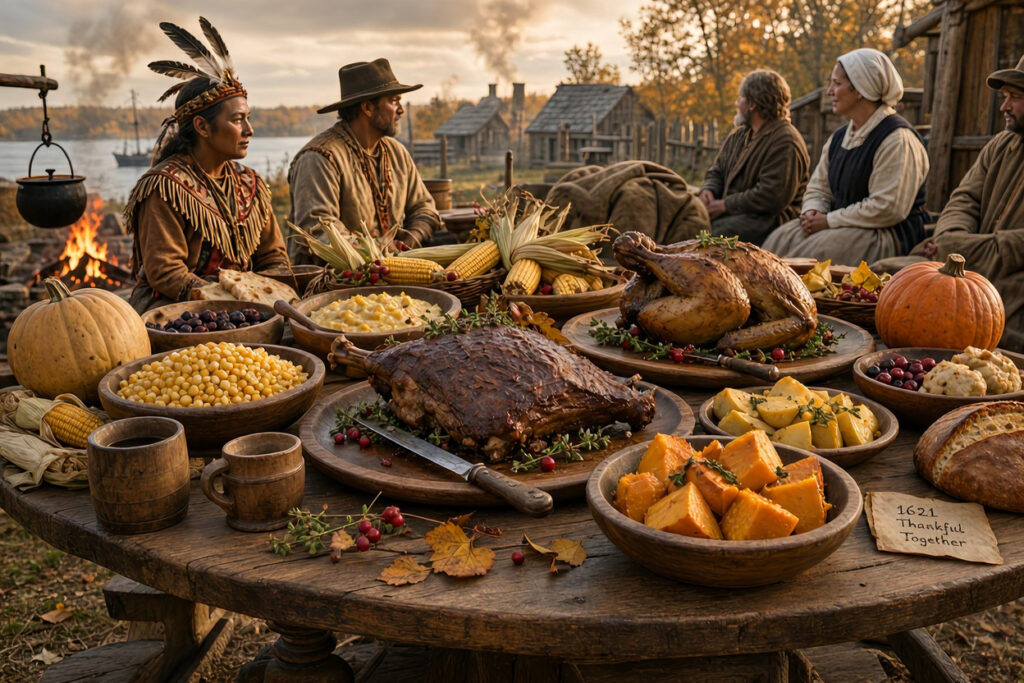
Artist's depiction of a 1621 harvest celebration in Plymouth Colony with English settlers and Native Americans gathered around a table filled with turkey, venison, corn, squash, and other seasonal foods.

A Visit to the First Thanksgiving… Sort Of

Everyone knows the story.

The Pilgrims landed at Plymouth, struggled through a difficult first winter, received help from the Wampanoag people, and celebrated the First Thanksgiving with a feast of turkey and all the trimmings.

Or did they?

The reality is a little more complicated and, if you ask me, a lot more interesting.

Let’s pretend for a moment that we’ve climbed into a time machine and traveled back to the fall of 1621 to attend that famous harvest celebration. What would we actually find?

Our first surprise would come before the meal even begins. Nobody there would call it “The First Thanksgiving.” That name came much later. To the people gathered at Plymouth Colony, it was simply a harvest celebration marking a successful growing season after a very difficult year.

And that wasn’t the only thing that looked different from the story many of us learned in school.

Where Are the Pilgrims?
A person in historical colonial-era clothing stands outdoors beside a large tree and a weathered wooden fence. The outfit includes a blue tunic, loose tan trousers, a brown cap, long socks, and leather shoes. The person is leaning against a tree stump with hands pressed together near the face. Several visitors are visible in the background along a dirt pathway in what appears to be a living history or reconstructed settlement setting.As soon as we arrive, something seems off.

Where are the black coats? The shiny buckles? The tall black hats that appear in every Thanksgiving decoration and elementary school play?

The settlers of Plymouth Colony didn’t generally dress that way. Their clothing included a variety of colors, including browns, greens, blues, grays, and reds. The famous silver buckles wouldn’t become fashionable until later.

In fact, if you were walking through Plymouth in 1621 looking for the Pilgrims, you might run into another problem.

They probably wouldn’t have called themselves Pilgrims.

Most would have thought of themselves as English settlers, colonists, or members of the Plymouth community. The term “Pilgrim” became popular much later and eventually became the name by which we remember them today.

So before we’ve even reached the feast, two familiar pieces of the Thanksgiving story have already been challenged.

Meeting the WampanoagA person wearing traditional-style regalia stands outdoors in a dry field with leafless trees in the background. The person wears a feathered headdress with red, white, and black accents, layered beaded necklaces, tan buckskin-style leggings and apron, and soft moccasin-style footwear. One hand is raised in a gesture as if speaking or demonstrating something. The ground is covered with dried grass and leaves, and the scene appears to be photographed during a cultural or historical presentation.
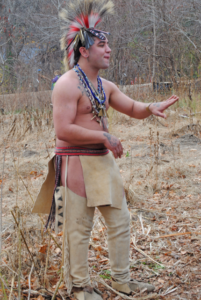
One thing that often gets lost in popular retellings is that this story wasn’t just about English settlers.

Long before the Mayflower arrived, the Wampanoag people had lived throughout the region for generations. They had their own communities, traditions, trade networks, and knowledge of the land.

The harvest celebration itself included not only the English settlers but also Massasoit and about ninety Wampanoag visitors. Far from being background figures in the story, they were an important part of the event and played a crucial role in the colony’s survival.

When I visited Plimoth Patuxet Museums years ago, I found the Wampanoag Homesite to be one of the most fascinating parts of the experience. The English village was certainly interesting, but much of it felt familiar from history books and television programs. The Wampanoag section offered a perspective I hadn’t encountered nearly as often while growing up.

But How Did Everyone Communicate?
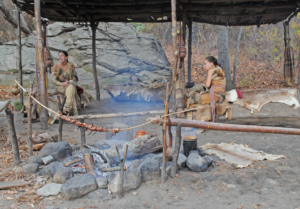
A rustic outdoor camp shelter made of wooden poles and a bark-covered roof sits beside a large stone outcrop. In the foreground, a fire burns within a circle of rocks, with a wooden spit holding roasting meat above the flames. Two people dressed in historical-style animal-hide clothing sit under the shelter among furs and handmade items. Fallen leaves cover the surrounding ground and woods, suggesting a late autumn setting.Imagine hosting a three-day celebration attended by people who don’t speak the same language.

Conversation around the table could have been a challenge.

Fortunately, there were interpreters.

One was Samoset, who had learned some English through contact with fishermen and traders along the New England coast. An even more important figure was Squanto, also known as Tisquantum, who spoke English fluently and helped bridge the language gap between the two groups.

Without people like Squanto, communication between the English settlers and the Wampanoag would have been far more difficult.

When you think about it, understanding one another may have been nearly as important as the food on the table.

What’s for Dinner?

Now we come to one of the biggest Thanksgiving myths of all.A historical reenactment of an early colonial harvest gathering takes place beside a coastal settlement. In the foreground, a wooden table is covered with roasted game birds, corn, pumpkins, cheese, and wooden bowls. Several people in period clothing stand near the table, while others approach carrying baskets of corn and pumpkins. A wooden fence, watchtower, and weathered buildings marked “Plymouth 1621” stand in the background under a cloudy sky, with the ocean visible beyond the settlement.
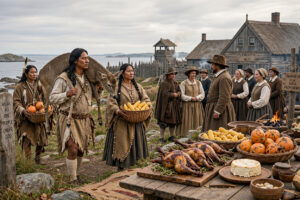
Most of us picture a massive roast turkey surrounded by stuffing, mashed potatoes, cranberry sauce, sweet potatoes, and pumpkin pie.

The truth is that historians know only part of what was served.

Contemporary accounts mention that the settlers gathered “fowl” for the celebration. That could have included turkey, but it might also have included ducks, geese, or other birds. Turkey may very well have been on the menu, but historians can’t say for certain.

What we do know is that the Wampanoag contributed deer to the gathering, making venison one of the few foods we can confidently place on the table.

Ironically, the meat most closely associated with modern Thanksgiving is less certain than the venison that many Americans never think about.

Other foods likely included seafood, corn, and seasonal produce available in the region.

As for pumpkin pie? Not yet.

There would have been pumpkins and squash, but probably not the familiar pie that appears on Thanksgiving tables today.

Experience 1621 Without a Time Machine

Of course, time travel is still a few years away, so there isn’t actually a way to attend the harvest celebration of 1621.

The next best thing might be a visit to Plimoth Patuxet Museums in Plymouth, Massachusetts.
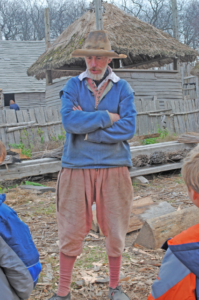
A historical interpreter stands outdoors in a reconstructed colonial-era settlement, wearing a wide-brimmed felt hat, a blue jacket, and loose knee-length trousers. The interpreter stands with arms crossed in front of a thatched-roof building and a wooden fence, speaking to a small group of visitors seated nearby. Bare trees and weathered wooden structures fill the background.The museum brings seventeenth-century New England to life through a recreated English village, a Wampanoag Homesite, educational programs, and seasonal events. Rather than simply repeating the familiar Thanksgiving story many of us learned in school, the museum encourages visitors to explore both the English and Native perspectives and discover how much of the popular story has been simplified over the centuries.

Each year, the museum also hosts harvest-themed dining experiences inspired by the foods and traditions of early New England. This year’s Harvest Feast menu includes dishes such as mussels cooked with beer and parsley, roast turkey with onion gravy, stewed squash, roast pork, fish, corn pudding, and fruit and cheese courses. While it isn’t meant to be an exact recreation of the 1621 harvest celebration, it offers visitors a taste of seventeenth-century New England foodways and a glimpse into what life may have been like in the colony.

In other words, if you’re curious about the difference between the Thanksgiving of popular imagination and the Thanksgiving historians study, there are few better places to start.

The Real Story

The more I learn about the history behind Thanksgiving, the more I realize that the real story is more interesting than theA dome-shaped Native American-style dwelling constructed from wooden poles and covered with dried reeds or cattails. The structure has a low entrance opening with a woven covering pulled aside, revealing a dark interior. Bare trees and fallen leaves surround the hut, suggesting a late autumn setting in an outdoor historical or cultural exhibit. legend.
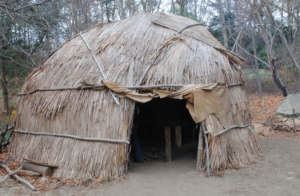
We arrived expecting Pilgrims in black hats, a giant turkey, and the Thanksgiving story we learned as children. Instead, we found English settlers in colorful clothing, Wampanoag guests who played a vital role in the colony’s survival, interpreters bridging two cultures, and a harvest celebration that looked quite different from the holiday we celebrate today.

Sometimes the legends are good. The truth, however, is often even better.

And perhaps that’s the real lesson of a visit to Plymouth: there’s always more to the story than we first imagine.

Until time travel becomes an option, a visit to Plimoth Patuxet Museums may be the closest we can come to stepping into the world of 1621.

And in a nod to Paul Harvey, I have to say it…And Now You Know The Rest Of the Story. 


Plymouth Rock: The Legend, the Letdown, and the Lovely Town Around It


The Most Overrated Tourist Attractions? Let’s Talk About Plymouth Rock

So I saw another list, but we’re not going to dig through it all. I’m just going to pick and choose a few choice comments. The list was The U.S. Tourist Attractions That People Regret Visiting the Most. As a travel enthusiast, I felt it was my duty to share a few of my thoughts.

Since I’m in Massachusetts and only a couple of towns over from Plymouth, I thought I’d chat about Plymouth Rock.

What was on the list? Well, without taking the time to bore you with details, here’s the lineup:

  1. Times Square, NYC, New York
  2. Skywalk, Grand Canyon, Arizona
  3. SeaWorld, Orlando, Florida
  4. Salem Witch Museum, Salem, Massachusetts
  5. Hollywood Walk of Fame, Los Angeles, California
  6. Broadway, Nashville, Tennessee
  7. Duval Street, Key West, Florida
  8. Pat’s King of Steaks, Philadelphia, Pennsylvania
  9. Roswell, New Mexico
  10. Ocean City Boardwalk, Ocean City, Maryland
  11. Mystery Spot, St. Ignace, Michigan
  12. Plymouth Rock, Plymouth Harbor, Massachusetts
  13. Navy Pier, Chicago, Illinois
  14. Calico Ghost Town, San Bernardino County, California
  15. World of Coca-Cola, Atlanta, Georgia
  16. Fisherman’s Wharf, San Francisco, California

So now you have the whole list—let me talk about Plymouth Rock.


Plymouth Rock: The Legend, the Letdown, and the Lovely Town Around It

As a kid, the idea of Plymouth Rock is irresistible. It’s practically mythological—the rock where the Pilgrims supposedly stepped ashore in 1620. You picture something massive, dramatic, maybe glowing with historical importance. At the very least, something you could stub your toe on.

Then you finally go see it and… well… it’s a medium-sized rock in a granite gazebo, sitting behind iron bars like it’s in time-out. You stand there thinking, This? This is the rock? And yet, thousands of people come every year to have the same moment of quiet confusion.

But here’s the twist: the story behind the rock is far more interesting than the rock itself. And Plymouth—thankfully—is full of genuinely lovely places that make the trip worthwhile.


The Real Story Behind the Rock (Which Is Better Than the Rock)

  • No Pilgrim ever mentioned a rock. Not in 1620, not in 1621, not ever. The first written reference appears more than a century later.
  • The legend began in 1741, when an elderly church elder insisted he remembered hearing from earlier generations that this was the landing spot.
  • The rock has been moved several times, and each move made things worse:
    • 1774: Townspeople tried to relocate it and accidentally split it in half.
    • 1834: The top half was hauled to the town square for display.
    • 1880: The halves were reunited at the waterfront, but not quite perfectly—hence the famous crack.
  • The “1620” carving? Added in the 1800s, long after the Pilgrims were gone.

So the rock you see today is more of a symbol than an artifact. And symbols can be powerful… even if they’re smaller than expected.


What Makes Plymouth Worth the Trip

Plymouth itself is charming, historic, and absolutely worth a visit—even if the rock leaves you shrugging.

  • Brewster Gardens — A pretty little park right off the waterfront with footbridges, flowers, and shady paths. It’s the kind of place you wander into and think, “Oh, this is lovely.”
  • The Massasoit Statue — Overlooking the harbor, honoring the Wampanoag leader who forged a peace treaty with the Pilgrims. The view from up there is one of the best in town.
  • The Mayflower II — A full-scale reproduction of the original ship. It’s surprisingly immersive, and the interpreters do a fantastic job bringing 1620 to life.
  • Plimoth Patuxet Museums — If you want the real, nuanced history—not the postcard version—this is where it lives.

Plymouth isn’t overrated. Historic Plymouth Rock is.


And Now for Something Actually Exciting: Captain John Boats

Once you’ve stared at the rock for the obligatory 30 seconds, you’re only steps away from one of the best things Plymouth has to offer: Captain John’s whale watches.

For nearly 50 years, these trips have been part of my life—breaching humpbacks, sea spray, the thrill of spotting that first tail flick. It’s the perfect contrast to the stillness of the Rock. If Plymouth Rock leaves you wanting more, Captain John’s will give you a show the Pilgrims never dreamed of.


Wrapping It Up

So yes—Plymouth Rock may be one of the most overrated attractions in America, but Plymouth itself is a gem. It’s a place where history, beauty, and the Atlantic all meet. Go for the Rock if you must… but stay for everything else. And if you time it right, you might just end your day with a whale tail against the horizon.

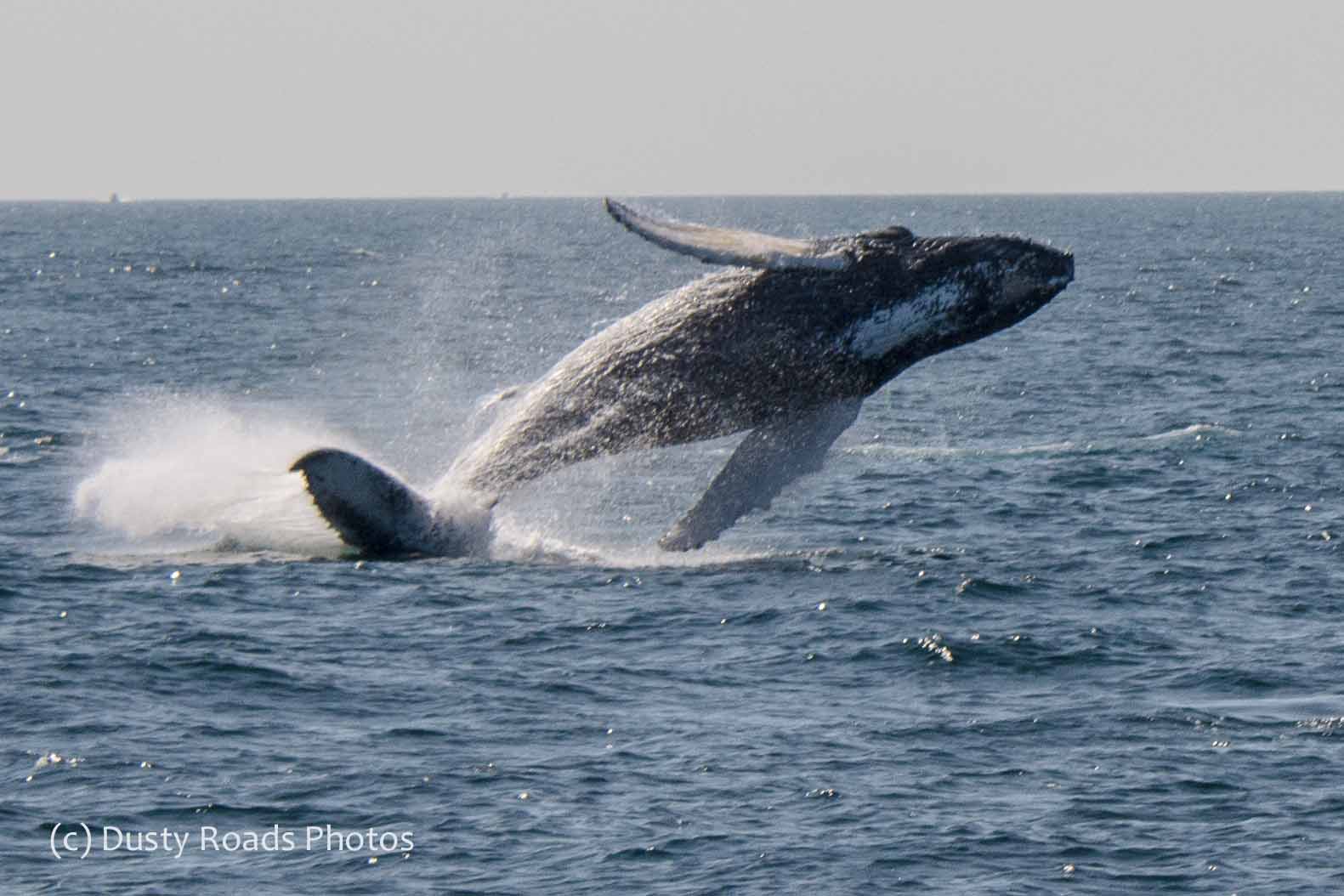
Breaching Whale


Pilgrim Memorial State Park

Pilgrim Memorial State Park

The Pilgrims, Plymouth Rock, the Mayflower…things we have heard about since we were children. That’s why Pilgrim Memorial State Park is one of the most visited Parks  in the state.  I am sure this little park makes a huge impression on young people when parents bring them along for a bit of “educational”  vacation. 

Located at 79 Water St, Plymouth, MA, the park is right on the waterfront making a visually stunning scene. From the Pilgrim cabins to the Mayflower replica (Mayflower II) this 17 acre park is the smallest state park.  It may be small but it’s mighty. Over 1 million visitors flock to this lovely park that is steeped in history. 

Plymouth Rock

This is a rock that might as well have had legs. It’s been moved and transported from location to location over the years. During the course of it’s many moves it was broken in half.  Finally to preserve the historic stone it was placed on the waterfront where it is located today. A granite portico was built to protect it from the weather and souvenir hunters who liked to chip off pieces of the stone. The current portico was built in 1921 replacing an earlier gothic revival style monument.  Whether you visit during the day or at night, this is a beautiful monument. 

The Mayflower II

Board the Mayflower II docked at the State Pier in Plymouth. It looks sturdy quietly moored in the placid harbor but think about the size of the cruise ships that ply the oceans today and then imagine spending not weeks, but months (66 days) on an ocean voyage in this tiny vessel.  The holds are dark and cramped. No air conditioning here. It makes me think of an old saying I heard once “Protect me Oh Lord for the Ocean is so big and my ship is so small”.  If you are there at the right time of the year the crew is in full 1600’s attire and prepared to tell you of life aboard ship on that fateful voyage. 

If You Go

Enjoy a Self Guided walking tour of the Park and it’s monuments

The walk is only about 1/4 mile and takes about 30 minutes

There are 9 stop on the tour including the Mayflower II and Plymouth Rock

Its a Beautiful Day on Stellwagan Banks

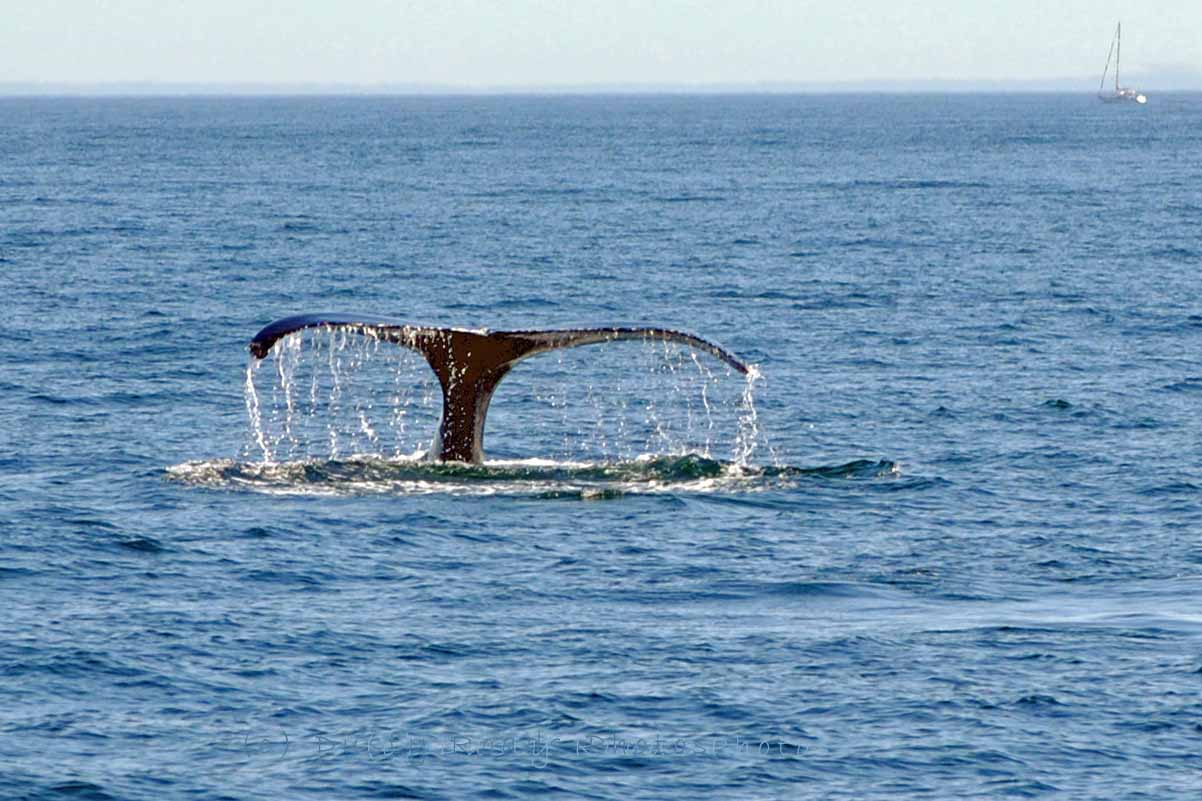
Sun, Seas and Stellwagan BanksWhale Tail

Taking advantage of  a beautiful day I climbed aboard another Captain John Boats Whale Watching Tour to Stellwagan bank. I’ve had a tough time seeing Breaching whales when I’ve gone out. They seem to come around  on every trip except the one I’m on! Very frustrating! The trips have been good. There are whales every time but not doing really exciting behaviors.

View from the BowWhere to ride? Top deck or bottom?

I’ve been riding the top deck thinking I’d get a better angle for my photos. The problem is that if I’m on the right, the whales are on the left. Ugh! It’s just the luck of the draw. Usually when the whales show up on one side, everyone runs across to that side of the boat. I’ve stopped doing that. But today I think I have a solution.

I’m King of the World

I grabbed the middle seat in the front row on deck one. This is right at the bow. I can run out to the tip of the bow and watch the whales on the right, left and front. About the only view I don’t have here is off the stern. I made myself comfortable for the hour and a half ride to Stellwagan Bank National Marine Sanctuary,

 Gurnet Light

WOW A 10- Plus Plus Plus tripWhales slpashing a boat

The first whales we found were doing “close ups” for another Whale Watching ship. There were a lot of small fishing boats in the area too. As we approached a whale did a full body breach right next to us. Of course I missed it.  I only saw the splash. The next breach practically landed on one of the fishing boats. There were flipper slaps and tail breaches and multiple body breaches! It was during all this activity that I managed to catch a full body breach. We’d only just begun and the trip was already a winner.


Breaching Whale

Captain John and the Whales

Captain John’s Whale WatchingWhale Tail

Captain John Boats lives in Plymouth, MA and sails the seas of Massachusetts Bay and Stellwagen Banks. Why, Matey? What does the Captain John do on the bay? We be lookin’ for whales. Mostly humpback whales but also finbacks and minkes. So come on board and let me tell you a “tail” of the sea.

Whale Watching in Massachusetts

Summertime on the Massachusetts coast means whales. The evening news happily reports when the first whales of the season begin to arrive along Cape Cod. The first are usually the rare right whales. We watch them from the shore. We recognize them by their distinctive wide V-shaped blow. All the while we watch we also freeze in the early spring blustery cold.

Whale TailWith Warmer Weather come the Tours

As the weather warms the Right whales move out and the Humpbacks, Finbacks and Minkes take their place. I’ve followed the whales for 43 years through good years and bad. South of Boston there are 3 main tour companies, Boston’s New England Aquarium, Captain John Boats in Plymouth and the Dolphin Fleet out of Provincetown. It doesn’t seem to matter which one you take, they all seem to end up at Stellwagen Bank within sight of each other and the Pilgrim Tower in Provincetown.

A Whale of a Trip

Last Saturday I finally had a free afternoon. I usually prefer the morning trip out of Plymouth with Captain John. I seem to have better luck on those tours but this time I couldn’t get away until the 2 pm tour. We no sooner reached the feeding grounds of Stellwagen Banks than 3 humpbacks sounded right next to the boat. They stayed close for 3-4 dives before moving out.  We had several other humpbacks cruise along with the boat and then one tried to ride our bow! It was a very active trip and the passengers were really excited.

Riding a bow wave

Rate the Trip

If this was your first trip it was a definite 10. There were lots of whales and lots of activity. For a more experienced whale watcher it might have been a bit of a let down. There were no flipper slaps, bubble net or surface feeding, or breaches but some lovely flukes…a 5. I am so spoiled!

Gurnet Light

Gurnet Light