Haunted October: Rockafellas Restaurant, Salem, Massachusetts

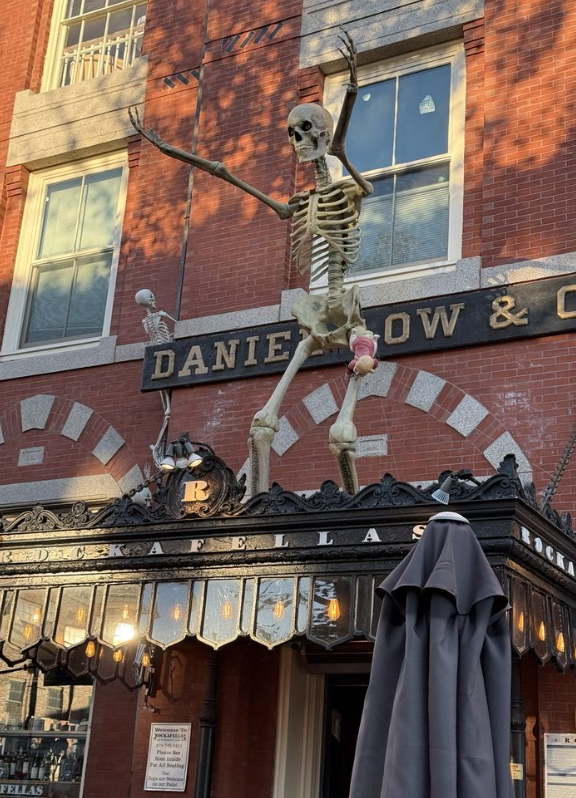
A historic brick building in Salem with a large skeleton decoration mounted above the entrance, signage reading “Daniel Low & Co.” and “Rockafellas,” and additional Halloween skeletons near the upper windows.

🎃 Welcome to Haunted October

Good evening… and welcome.

Outside, October wind drifts through Salem’s narrow streets, brushing past brick façades and stirring the last leaves on the Common. Inside this handsome Derby Square building, warm light pools across polished wood, and conversation hums softly. Yet beneath that modern glow lies a history that never quite settles.

Tonight, we step into Rockafellas, a contemporary restaurant housed within a structure whose past stretches back two centuries — and whose roots reach even deeper.

🏛️ A Meetinghouse With Shadows Behind It

A group of visitors standing near the historic Witch House in Salem, a dark wooden 17th‑century structure with steep gables, set beside a large Gothic stone building with arched windows and battlementsLong before diners filled these rooms, the site belonged to Salem’s First Church, a congregation whose earlier meetinghouses stood witness to the uneasy tensions of 1692. Within that lineage, John and Elizabeth Proctor were questioned during the Salem Witch Trials, their futures hanging by a thread as fear swept through the town.

The building standing today rose in 1826, later reshaped in Victorian Gothic style. Though its architecture changed, the memory of those earlier meetinghouses clings to the space like a faint, persistent echo. Visitors often describe a subtle shift in the air — a quiet reminder that this corner of Salem has seen more than its share of troubled history.

👻 A Presence That Doesn’t Announce Itself

Rockafellas doesn’t lean into theatrics. Its décor is modern, its atmosphere lively, its energy warm.Diners seated at a Halloween‑decorated restaurant table surrounded by oversized spider webs, hanging spiders, and life‑size skeleton figures, including one dressed like Jack Skellington in a witch hat.

Even so, certain moments give guests pause: a sudden chill, a brief hush, the feeling that someone has paused nearby. Staff speak softly about the building’s “regulars,” the ones who never appear on the reservation list.

Among them is the Lady in Blue, glimpsed in an upstairs window after closing time — a figure who vanishes the moment anyone looks twice. Footsteps drift across the second floor when no one is there. A knock sounds against a wall with no door behind it. And stories linger about Daniel Low, the jeweler who died within these walls and, some say, still keeps watch.

These aren’t dramatic hauntings. They’re whispers. Echoes. Small reminders that history rarely stays quiet in Salem.

A vibrant mural depicting a jazz club scene, featuring a woman in a flowing blue dress singing on a checkered floor, surrounded by musicians playing piano, bass, and saxophone, with two patrons seated at a table in the foreground.🕯️ Where Past and Present Share the Same Room

Rockafellas may not resemble a haunted house, but it carries the weight of a haunted place — shaped by centuries of worship, fear, tragedy, and transformation.

The witch trial lineage. The meetinghouse legacy. The quiet spirits said to linger. The Lady in Blue watching from above.

Together, they create an atmosphere that settles gently, like a familiar guest returning to a room they once knew well.

🎃 Welcome… to Haunted October

As candles flicker and the wind presses against the windows, remember: this is Salem. The past never wanders far. Sometimes it sits at the table beside you.

Welcome to Haunted October — and together, we’ll explore the myths, legends, hauntings, and mysteries of New England.

A glowing carved pumpkin with large eyes and a wide toothy grin, surrounded by other illuminated jack‑o’‑lanterns creating a warm, festive Halloween display.

To Break or Not to Break- the Great Spaghetti Debate

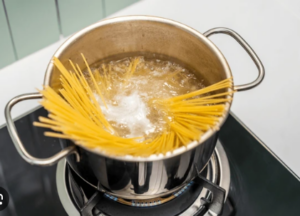
Lovely long strands of spaghetti with meat sauce. Looks good


🍝 The Great Spaghetti Myth: Why We’re Told Not to Break It (and What Really Happens in the Pot)

Every home cook has heard it at least once — usually from a cookbook, a TV chef, or a well‑meaning relative:

“Never break spaghetti.”

It’s one of those kitchen commandments that gets passed down like gospel, even though most of us have no idea why. I certainly didn’t. I just knew that if I wanted the pasta to fit in my pot, I snapped it in half and moved on with my life.

Then one day I watched a cooking show where the chef placed long, elegant strands of spaghetti into a potPot too small? Lets get to the bottom of the great debate of boiling water… and left the top half sticking straight out like a pasta bouquet. As the bottom softened, the noodles slowly slid into the pot on their own, as if obeying some ancient culinary law.

It looked dramatic. It looked professional.
It also made absolutely no sense to me.

Wouldn’t the bottom half overcook while the top half was still raw?
Turns out — yes. Yes, it would.

So let’s bust this myth properly.


🍝 Myth #1: “Don’t break spaghetti — it’s wrong.”

This one comes straight from Italian culinary tradition. In Italy, pasta shapes are treated with the same respect we give to Thanksgiving turkey or Grandma’s cast‑iron skillet. Long pasta is meant to stay long because:


  • it twirls better
  • it holds certain sauces better
  • it creates a specific eating experience

Breaking it is seen as messing with the design.
But here’s the truth: there’s no practical kitchen disaster waiting for you if you snap a noodle. It’s mostly cultural, not scientific.


🍝 Myth #2: “Let the spaghetti stick out of the pot — it will slide in evenly.”

This one is pure TV magic.

Here’s what actually happens:

  • The submerged half starts cooking immediately.
  • The exposed half stays stiff and dry.
  • The bottom softens, bends, and eventually pulls the top down.

But by the time the top half finally joins the party, the bottom has already been cooking for a minute or two. That means uneven texture unless you’re stirring constantly — which, by the way, TV chefs are doing, just off‑camera.

So no, the “half‑in, half‑out” method doesn’t create some perfect, even cook. It just looks good on screen.


✔️ So what should you do?

The real technique — the one Italian cooks actually use — is simple:

  1. Put the spaghetti in whole.
  2. Let the ends stick out for 20–30 seconds.
  3. As soon as the submerged part softens, gently bend the rest into the water.
  4. Stir early and often.

That’s it. No snapping required, no dramatic pasta fountain, no uneven cooking.


🍝 Or… you can take the modern shortcut

If you don’t want to break spaghetti and you don’t want to deal with the Leaning Tower of Pasta routine, there’s a third option:

You can now buy “Pot‑Sized Spaghetti.”

It’s literally spaghetti that’s already cut to fit a standard pot.
No snapping.
No bending.
No half‑in, half‑out noodle acrobatics.

Just drop it in and go.

Purists may clutch their pearls, but honestly? It’s brilliant for busy home cooks who just want dinner on the table without a philosophical debate about noodle length.


🍽️ The Bottom Line

You can break spaghetti if you want.
You can leave it long if you prefer.
You can even buy the pot‑sized version and skip the whole issue entirely.

But now you know the why behind the myth — and the real science behind what’s happening in the pot.

And honestly? That’s half the fun of cooking: discovering that the rules we’ve been following forever sometimes have more to do with tradition than technique.

Mangia!


The Five‑Second Rule and Other Delicious Lies We Tell Ourselves


✨ The Myths, Legends, and Laughs of Kitchen Folklore

There are a few myths and legends that sneak into everyday food handling. One that comes to mind immediately is the Five‑Second Rule. Ever heard of it? I seem to run into it constantly. I’ve even heard it mentioned in TV programs like The Simpsons—and believe it or not, Julia Child herself once scooped up dropped food on camera. She never said the rule out loud, but that moment alone helped cement it in modern kitchen culture.

The Five‑Second Rule: Convenient, Comforting… and Completely Wrong

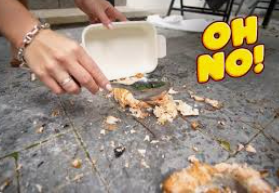
For anyone who’s never watched TV or has their head buried like an ostrich, the Five‑Second Rule is the belief that food dropped on the floor is safe to eat if you pick it up within five seconds.

Unfortunately, science has rained on that parade. Studies show bacteria can transfer to food almost instantly. How much depends on the food, the surface, and how dirty that surface is. The myth sticks around because it’s a handy excuse not to waste food—but it’s not exactly a food‑safety strategy.

Understanding the risks helps us make better choices and reminds us that hygiene matters more than wishful thinking.

The Jelly‑Side‑Down Curse

Another favorite saying is that toast always lands jelly‑side down. Don’t laugh—think about it. I always assumed the extra weight of the butter or jelly caused the flip… or maybe it’s just a breakfast version of Murphy’s Law.

But there’s actually physics behind it. Toast usually starts jelly‑side up on a plate. When it slips, it only has time to rotate about half a turn before hitting the floor—landing jelly‑side down. Not bad luck. Just gravity with a sense of humor.

The Pancake Theorem: The First One’s Always a Dud

There’s a whole plethora of kitchen sayings, but one of my favorites is the Pancake Theorem:
“The first one’s always a dud.”

As someone who struggled for years to make the perfect pancake, I can confirm this one from personal experience. I’m happy to report that with improved kitchen skills, I now make pancakes from scratch—company‑worthy ones, no less—and I’ve finally overcome the first‑pancake curse.

Why does that first pancake misbehave? A few reasons: the pan isn’t evenly heated yet, the oil hasn’t settled, and the batter is still adjusting to the temperature. So the first one comes out pale, blotchy, or shaped like a map of New Jersey. It’s folklore backed by kitchen physics.

A Final Bite

So, my friend, tuck these sayings away for a quick kitchen chuckle. Just don’t rely on the Five‑Second Rule. That’s one myth best left on the floor—preferably with the jelly‑side down.


Groundhog Day, The Legend Continues


Groundhog Day: Shadows, Legends, and One Very Busy Groundhog

If you woke up this morning and thought, Wait… is it Groundhog Day already? — you’re in good company. February sneaks up on all of us, but Punxsutawney Phil never misses his cue. Today is the day we turn our eyes to Gobbler’s Knob and wait for the world’s most famous meteorological rodent to decide our seasonal fate.

A Legend Born in the Shadows

Punxsutawney Phil has been predicting the arrival of spring since 1887 — or so the legend goes. According to the Punxsutawney Groundhog Club, Phil is not just a groundhog but the groundhog, the same one for nearly 140 years thanks to a magical “elixir of life” lovingly administered each summer. Reality tells us groundhogs live about 14 years in captivity, but the story? The story insists Phil is eternal.

And yes — officially, there has only ever been one Phil. Unofficially? Let’s just say the Inner Circle keeps those details tucked tighter than their tuxedo collars.

From Candlemas to Gobbler’s Knob

Groundhog Day’s roots stretch back to Candlemas, when Christians brought candles to be blessed for good fortune through the rest of winter. German settlers later added an animal to the tradition — originally a hedgehog.

When they arrived in America and found no hedgehogs in sight, they turned to a plump, hibernating stand‑in: the groundhog.

Cue Punxsutawney Phil, stage left.

How Phil Makes the Call

Each February 2nd, Phil emerges from his burrow after a long winter’s nap:

  • Shadow spotted: six more weeks of winter
  • No shadow: early spring on the way

The ceremony draws thousands before dawn — fireworks, music, banquets, and a crowd that treats Phil like the furry celebrity he is.


Phil’s Family & Fun Facts

Phil isn’t alone in his weather‑predicting empire. He lives with his wife, Phyllis, and in 2024 they welcomed twins, Sunny and Shadow. He’s also met presidents, appeared on Oprah, and once wore a yellow ribbon in honor of American hostages.

Why We Keep Watching

Maybe Phil’s accuracy isn’t perfect (NOAA gently reminds us of that), but Groundhog Day isn’t really about meteorology. It’s about tradition, whimsy, and the joy of believing — even for a moment — that a small creature in Pennsylvania holds the keys to spring.

Honestly? On a cold February morning in New England, that’s exactly the kind of magic we need and if Phil wants six more weeks of winter, he can come shovel my walkway and explain himself.


UPDATE

King Arthur: The Once and Future King

The Legend of King Arthur: Truth, Tale, or Internet Whimsy?

There are days when the internet feels like a treasure chest of wonders… and other days when it feels like someone dumped a medieval storybook, a history textbook, and a Disney script into a blender and hit purée. And because we all know that if it’s on the internet, it must be true, today’s journey down the rabbit hole brings us to one of the most enduring legends of all time: King Arthur.


So grab your imaginary sword, polish your virtual armor, and let’s wander through the misty halls of Camelot—courtesy of the world wide web.


A Sword, a Stone, and a Story We All Know

Most of us grew up with the classic tale: a young Arthur Pendragon pulls a sword from a stone, proving he’s the rightful king of Britain. He marries Guinevere, gathers the bravest knights around a Round Table, and rules with justice, honor, and enough chivalry to make modern etiquette books blush.

Then comes betrayal—Lancelot and Guinevere’s ill‑fated romance—and Arthur’s final journey to the mystical Isle of Avalon after being mortally wounded. It’s dramatic, tragic, and tailor‑made for Hollywood. No wonder Disney cashed in.

But where did all this actually come from?


The First “Historical” Arthur… Written 300 Years Too Late

Our earliest written mention of Arthur comes from a 9th‑century Welsh monk named Nennius, who described Arthur as a 5th‑century warrior battling Anglo‑Saxons. Inspiring, yes—but also written centuries after the fact. Imagine writing a biography of someone from the 1700s based solely on campfire stories.

That’s our first clue that things might be… flexible.


Enter Geoffrey of Monmouth: The Man Who Made Arthur a Superstar

In the 12th century, Geoffrey of Monmouth penned Historia Regum Britanniae, and suddenly Arthur wasn’t just a warrior—he was a king. This is where we first meet Merlin, Guinevere, Excalibur, and Avalon. Geoffrey’s work was wildly popular, but historians today treat it more like medieval fan‑fiction than factual record.

Then along came French writer Chrétien de Troyes, who added Lancelot and the Holy Grail, launching the entire genre of Arthurian romance. Each writer added a little more magic, a little more drama, and a lot more legend.


Camelot, Avalon, and Other Places That Might Not Exist

Camelot has been “located” in Wales, Somerset, and Winchester—depending on which historian, archaeologist, or enthusiastic blogger you ask. None of these claims have solid evidence.

Avalon, meanwhile, gets its name from the Welsh word for “apples,” which is far less mystical than the glowing, enchanted island we picture. Still, it’s said to be home to Morgan le Fay and the birthplace of Excalibur, so the internet keeps the magic alive.


So… Was King Arthur Real or Not?

The consensus among scholars is that Arthur, as we know him, is mythological—a patchwork of folklore, wishful thinking, and centuries of storytelling. There may have been a real warrior who inspired the legend, but the shining king of Camelot? That’s another matter entirely.

But that’s the beauty of legends—they grow, evolve, and enchant us, whether rooted in truth or spun from imagination.

So tell me, dear readers of Around Dusty Roads:
Do you think King Arthur was real, or is he simply one of history’s greatest myths?