Haunted October: The Tillinghast Lot, Exeter, Rhode Island

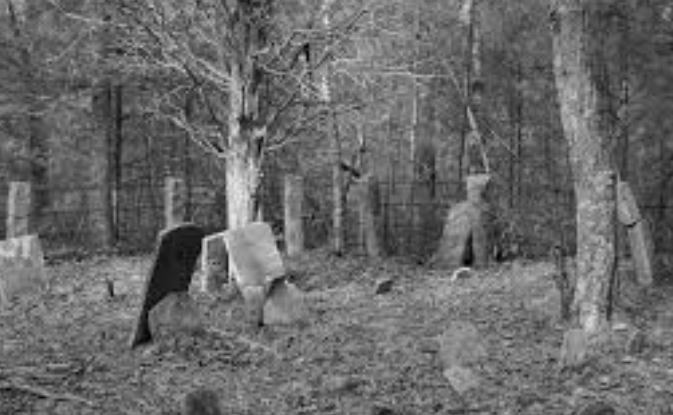
Old, overgrown cemetery in a wooded area with weathered, tilted gravestones surrounded by bare trees and fallen leaves.

A Quiet Rhode Island Cemetery With a Loud History

October sharpens the edges of New England. The mornings feel older, the woods feel closer, and even the quiet backroads seem to remember things they don’t talk about the rest of the year. Down in Exeter, tucked behind fields and stone walls, there’s a small cemetery that carries one of Rhode Island’s strangest stories — the Tillinghast Lot.

It doesn’t look like much at first. A handful of old stones, a clearing in the trees, the kind of place you’d miss if you weren’t looking for it. But in the late 1800s, this quiet patch of ground became part of a larger fear that swept through rural Rhode Island — a fear that the dead weren’t staying where they were buried.

Why Exeter Was Already on Edge

To understand why the Tillinghast deaths caused such alarm, you have to look at what was happening in Exeter at the time. Tuberculosis was ravaging families, but no one knew what it was. People wasted away slowly — pale, weak, coughing, losing weight — and when multiple members of the same family died, neighbors whispered that something supernatural was draining the life from the living.
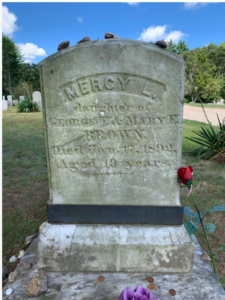
 Light gray 19th‑century gravestone with small stones placed on top and artificial red and purple flowers at its base, set in a grassy cemetery with trees and other headstones in the background.The Mercy Brown Vampire Panic

The most famous example was the Mercy Brown case, just a few miles from the Tillinghast Lot. After several members of the Brown family died, locals became convinced that one of the dead was “feeding” on the surviving son, Edwin.

In 1892, they exhumed Mercy Brown’s body. Because she had been stored in a cold crypt during winter, she hadn’t decomposed normally. Her heart still held blood. Terrified, the townspeople burned her heart and liver, mixed the ashes into a tonic, and gave it to Edwin to “break the curse.”

It became the most famous vampire panic in American history — and it happened right here in Exeter.

So when members of the Tillinghast family began dying around the same era, people didn’t see illness. They saw a pattern. They believed it could happen again.

Strange Reports From the Tillinghast Lot

Visitors to the Lot claimed the air turned cold even on warm days. Shadows moved between the stones. Footsteps followed them when no one else was there. Small, unsettling details that linger long after you’ve left.

Standing there today, you can see why the stories stuck. The ground dips in strange places. The trees crowd close, as if they’ve been listening for a long time. The stones are worn down to soft shapes, names fading into lichen and time. It’s peaceful, but not entirely. There’s a heaviness to the place — not threatening, just watchful.

A Place That Remembers More Than It ShouldWeathered metal cemetery marker lying among fallen leaves and grass, identifying a historical burial site in Exeter, Rhode Island.
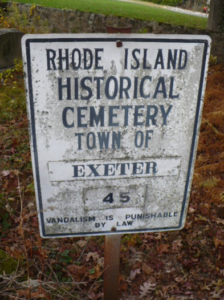
I’ve driven through Exeter more times than I can count, and there’s something about that part of Rhode Island that feels older than the map suggests. The roads curve in ways that make you slow down. The woods feel deeper. And cemeteries like the Tillinghast Lot remind you that history doesn’t always stay quiet.

If you ever find yourself near Exeter, take a moment to stop by. Walk the edge of the clearing. Read the stones. Listen to the wind moving through the trees. Just don’t go alone. Some places remember more than they should — especially in October.
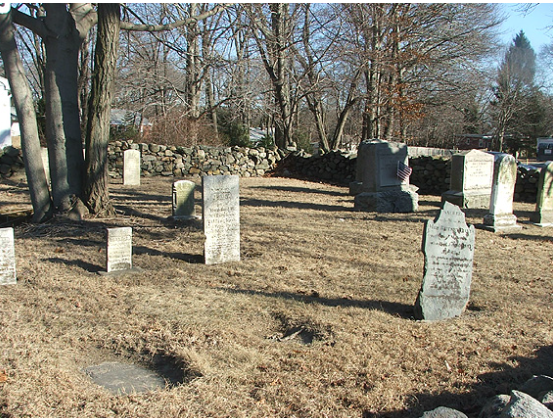
 Small historic cemetery enclosed by a low stone wall, with weathered gravestones set in dry grass and a single American flag placed beside one marker, surrounded by bare trees in a quiet late‑fall landscape.


Pumpkin Weigh‑Offs: Weight Watchers Need Not Apply

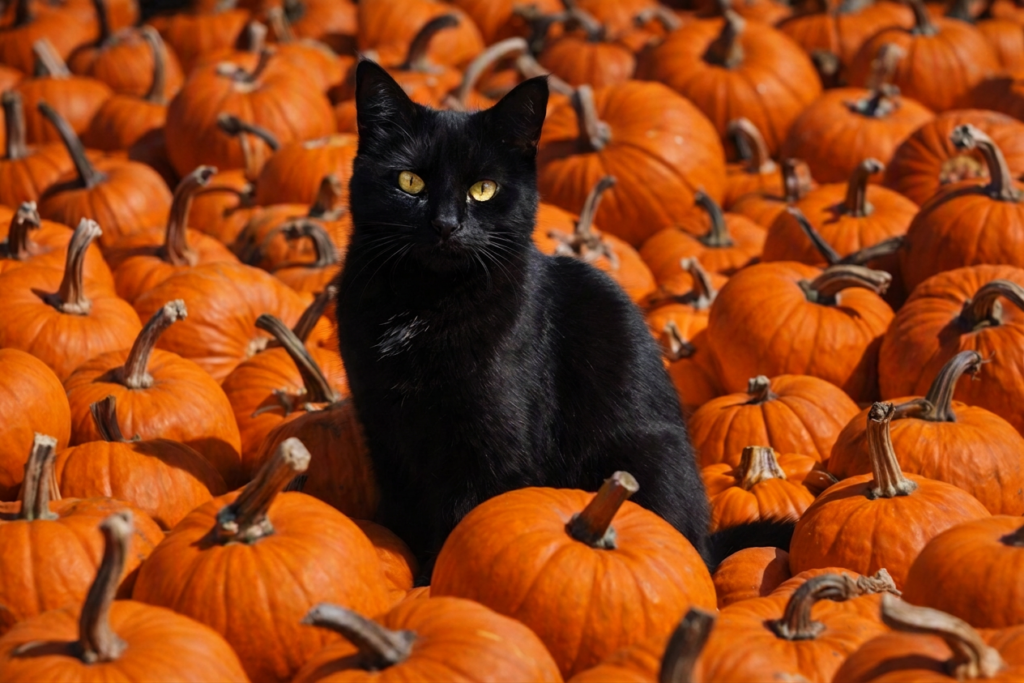
 A black cat with bright yellow eyes sits among dozens of small orange pumpkins. The pumpkins fill the entire frame, creating a vivid contrast with the cat’s dark fur.

🍂  Fall in New England Means Pumpkins

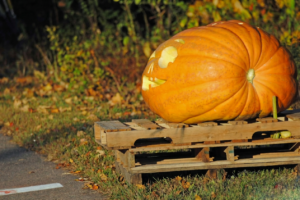
A huge carved pumpkin sits outdoors on a stack of wooden pallets. It has triangular eyes and a wide smiling jack‑o’-lantern mouth, with autumn foliage in the background.Fall in New England means pumpkins — everywhere. Big ones, little ones, carved ones, decorative ones. If Linus were around, he’d probably swear the Great Pumpkin was hiding somewhere between Route 1 and the cider stand.
Every year, growers try to outdo themselves, and every fair seems to have a pumpkin weigh‑off. But this year? We had some true giants.

🎃 Topsfield Fair: The Local Heavyweight

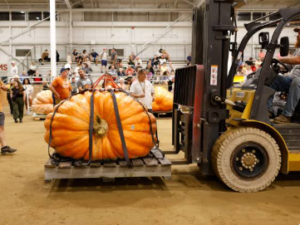
Last week at the Topsfield Fair, a true behemoth walked away with first place. The winning pumpkin weighed in at 2,598 pounds, breaking the all‑time Topsfield Fair record. That’s a lot of pies.

A massive pumpkin sits on a wooden pallet, secured with black straps, while a forklift lifts it inside an indoor event space. Several people stand around watching, indicating it’s part of a pumpkin weigh‑off at the Topsfield Fair.

🎃 Warren, RI: A New World Record

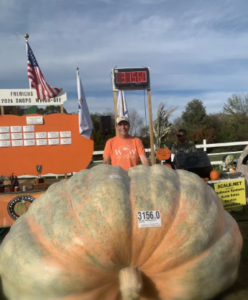
A man stands behind an enormous pumpkin weighing 3,156 pounds at an outdoor weigh‑off event. The pumpkin sits on a platform with a digital display showing its weight, and an orange event board with flags is visible in the background.And just when you thought pumpkins couldn’t get any bigger, Saturday’s New England Giant Pumpkin Weigh‑Off in Warren, RI delivered a monster.

The winning pumpkin tipped the scale at 3,156 pounds, setting not just a regional record — but a new world record.

The grower, Ron Wallace of Coventry, RI, is no stranger to pumpkin fame. In 2012, he became the first person ever to grow a pumpkin over a ton (that’s 2,000 pounds if you didn’t know). He’s now waiting for Guinness World Records to certify his newest accomplishment.

🎃 Up‑and‑Coming Growers

There are rising stars too. Take 13‑year‑old Harold Harris from Martha’s Vineyard. He raised two massive pumpkins — not 2,000‑pound giants, but impressive for any grower, let alone a teenager. His pumpkins weighed 340 pounds and 535 pounds. Not bad for someone who probably still has homework.

And in case you were wondering, that 2,598‑pound Topsfield pumpkin? It was grown by an 80‑year‑old man. Age clearly has nothing to do with pumpkin power.

🎃 What Happens to the Giants?

I don’t know what happens to these behemoths once their spotlight fades, but their smaller cousins will soon shine. The Roger Williams Zoo is preparing its annual Jack‑O‑Lantern Spectacular, with over 5,000 carved pumpkins lighting up the Wetlands Trail.

These aren’t your childhood triangle‑eyes and one‑tooth grins. These are true works of art carved by professional pumpkin artists. I went a few years ago — the skill and creativity are incredible. A far cry from my crooked little childhood jack‑o‑lanterns. A large group of carved pumpkins glows in the dark, each with a unique face ranging from cheerful to spooky. The pumpkins are arranged at different heights, creating a bright, warm display against the black background.

🎃 Enjoy the Pumpkin Season

So enjoy the New England pumpkin excitement while it lasts. It will be gone soon enough for another year. And if you see Linus, tell him the Great Pumpkin is alive and well — and currently residing in Warren, RI.

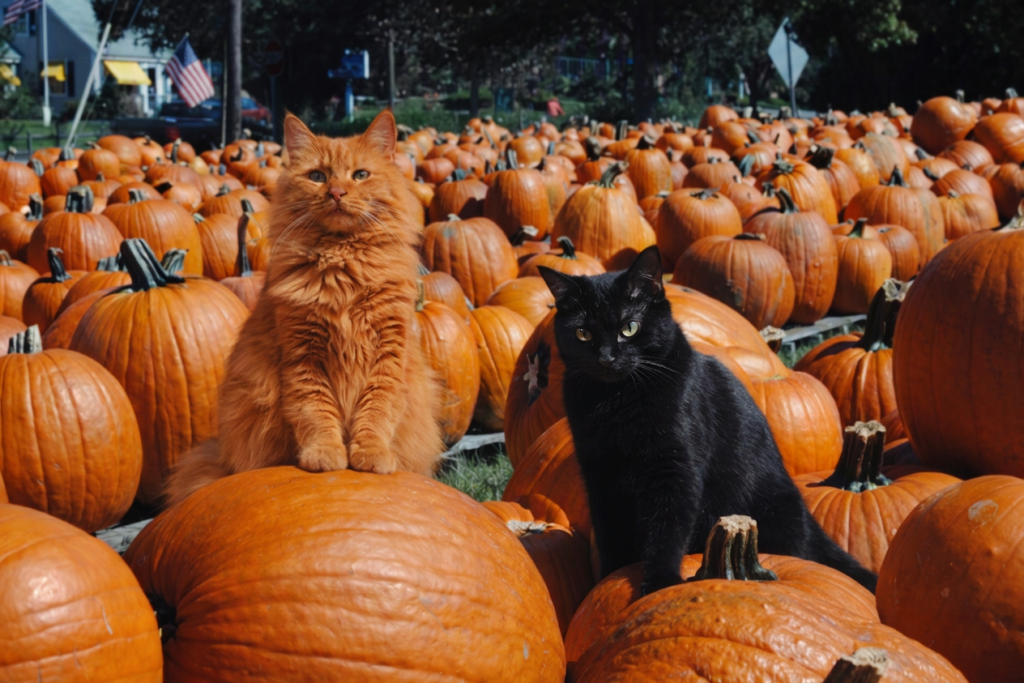
Two cats sit among a large group of pumpkins in an outdoor pumpkin patch. One cat is long‑haired and orange, the other short‑haired and black. Both rest on top of big pumpkins, with trees, people, and an American flag visible in the background.


Newport: A Story Written in Salt Air and Stone

Three sailboats race across choppy blue water, each sharply heeling in the wind with sails fully extended. A long bridge stretches across the background above a low strip of land, and the sky is bright and clear. The scene captures the speed and intensity of the America’s Cup in Newport.

Newport: Where History, Glamour, and the Atlantic All Collide

 An opulent bedroom decorated for Christmas, featuring a tall, brightly lit tree adorned with colorful ornaments. The room includes a large, elaborately draped bed and rich gold curtains, creating a warm, luxurious holiday atmosphere.

Newport didn’t become America’s summer capital overnight. In the mid‑1800s, it was still a quiet coastal town with colonial bones — whaling ships, weathered shingles, and a salty breeze that never quite left your clothes. But as industrial fortunes exploded, the country’s wealthiest families began looking for a place to escape the heat, the noise, and the social obligations of New York and Boston.

They found Newport.

At first, the arrivals were modest: wooden cottages, seaside porches, simple retreats. But modesty wasn’t a long‑term trait of the Gilded Age. By the 1870s and 1880s, the families who came to Newport weren’t just wealthy — they were dynasties. And they didn’t come to blend in. They came to build monuments.

The Migration of the Millionaires

Newport became a summer migration pattern for America’s elite:

  • The Astors, guardians of old‑money respectability
  • The Vanderbilts, railroad titans with something to prove
  • The Berwinds, coal magnates with European tastes
  • The Oelrichs, social climbers with flair
  • The Wetmores, early adopters who set the tone

They arrived with architects, landscapers, imported marble, and a determination to outdo one another. What began as “summer cottages” quickly became palaces — each one larger, grander, and more theatrical than the last.

The Rivalries

Newport’s social season was short — barely eight weeks — but the rivalries were year‑round.

Old money vs. new money. Who threw the best parties. Who had the grandest cottage.

The Breakers became the ultimate symbol — a 70‑room palace that made every other mansion look like a guest house. And Marble House, dripping in gold leaf and French opulence, was Alva Vanderbilt’s declaration that she intended to rewrite the social rules.

A Night in the Gilded AgeA horse‑drawn carriage with four brown horses approaches an ornate stone mansion as a crowd looks on. People in formal or period clothing ride in the yellow carriage, and an American flag hangs near the building’s entrance. The scene takes place on a sunny day with trees casting partial shade.

Every so often, Newport lets you step right back into that world.

I once attended the Dead of Winter Ball, held in one of the great mansions — the kind with a sweeping staircase and a ballroom built for spectacle. Guests arrived in horse‑drawn carriages, their breath visible in the cold air, just as they would have at the height of the Gilded Age. My friend Joe was my escort, and neither of us cared which mansion it was — the moment the carriage wheels crunched over the gravel, it felt like we’d slipped into another century.

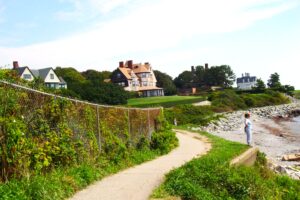
The Cliff Walk — Newport’s Backstage PassA coastal walking path curves along the shoreline, bordered by greenery and a wire fence. Large seaside homes sit on the hill above, and a person stands near the water’s edge looking out toward the ocean under a bright, peaceful sky.

I’ve walked the Cliff Walk in the summer, when the Atlantic is in a gentler mood and there’s less chance of being swept away by a rogue wave. It’s one of the best ways to see the backside of the mansions — the part the Gilded Age families never meant the public to admire, but which ended up being the most breathtaking view of all.

Drive down Bellevue Avenue and you might catch a glimpse of a mansion or two peeking out from behind high stone walls or over broad lawns. But from the Cliff Walk? It’s a different world.A grand seaside mansion rises above a wide green lawn, viewed from the Cliff Walk. The light‑colored stone building features steep gabled roofs, ornate chimneys, and arched windows under a bright, lightly clouded sky.

The mansions stand wide open to the sea, their terraces and lawns stretching right to the edge of the cliffs. The mighty Atlantic is at your feet the whole time, and the houses rise above you like silent witnesses to a century of summer seasons, scandals, rivalries, and glittering parties.

The America’s Cup — A Day I’ll Never Forget (Though I’ve Tried)

 A white sailboat with full sails moves through choppy water, carrying several people and an American flag at the stern. A lighthouse and a few shoreline buildings sit on a rocky point in the background, capturing the classic coastal setting of the America’s Cup in Newport.In the 1980s, Newport was the beating heart of the America’s Cup. For more than a century, America had dominated this iconic sailing race, and Newport was where the world came to watch sleek racing yachts slice through the Atlantic.
I’m not much of a sailor — I’d be utterly lost on a racing yacht — but I do enjoy a day on the ocean with cocktails and good company. So when a friend invited me to an America’s Cup viewing party on his boat, I jumped at the chance.

What they neglect to tell you is that attending an America’s Cup event does not mean calm seas.

The water gets kicked up into a wild, relentless chop from the wakes of dozens of spectator boats all jostling for position. I never found my sea legs. Not once. We were tossed one way, then the other, then back again like a cork in a blender.

I had a very hearty conversation with “Rachel and Ralph” before I was gently escorted to a bunk on the lower level. It was bad enough that the host offered to call the Coast Guard to take me back to land. Mortifying. But no — I stuck it out and tried to make myself as inconspicuous as possible so I wouldn’t disturb his other guests.

I wish I could say it was a highlight of my Newport years, being at the America’s Cup. But honestly? It was unforgettable for reasons best forgotten.

The Newport Tower — Mystery, Myth, and My Favorite Version of the Truth

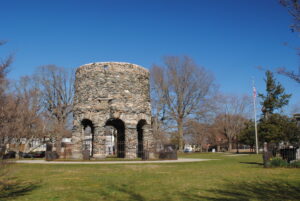
The Newport Tower stands in a grassy park, its round stone structure supported by several archways. Leafless trees surround the site, with a few buildings and a flagpole visible in the background under a bright blue sky.Back on land, there’s one more landmark that is purely Newport, and it’s the one that has always pulled me in: the Newport Tower.
For years, I heard people whisper that it was proof the Vikings made it to New England long before anyone else. They built it, they used it — for what, no one knew. That mystery was half the fun.

But now historians say it’s not Viking at all (bummer). According to them, it’s just an old stone windmill, the wooden parts long since rotted away. Practical. Sensible. Historically tidy.

And absolutely nowhere near as romantic.

Still, the tower stands there in Touro Park, weathered and stubbornly enigmatic. Even with the “official” explanation, I can’t help myself. I’d still rather think of it as the Viking Tower of Newport, a little piece of Old Norse legend tucked into a New England seaside town.

Some places are better when you let the mystery win.

Wrap‑Up

Newport is one of those rare places where every era leaves a footprint — colonial streets, Gilded Age palaces, roaring Atlantic cliffs, and the ghosts of racing yachts skimming across the bay. I’ve danced in its mansions, walked its cliffs, braved its seas, and stood in front of its mysteries.

And every time I go back, Newport feels like it’s waiting to tell me one more story.


Tropical Fish in Rhode Island?

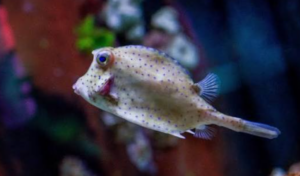
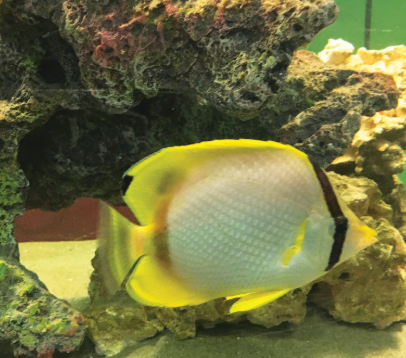
A brightly colored tropical fish with a white body, yellow fins, and bold black stripes swims near a textured coral-covered rock inside an aquarium.

🌊 A Warm‑Water Surprise in Little Rhody

Here’s a coastal New England tidbit that still amazes me. Every summer, the Gulf Stream sometimes swings close enough to the Rhode Island shoreline to deliver tropical fish into shallow coves. Yes — tropical fish. In Rhode Island!

Warm eddies peel off the Gulf Stream and drift north, carrying tiny Caribbean and Florida fish larvae with them. When one of these warm rings brushes the coast, those little travelers suddenly find themselves in New England. For a few weeks each summer, places like Jamestown’s protected coves can feel more like Key Largo than Narragansett Bay.

🌅 Beavertail: The Coastline I Did Know

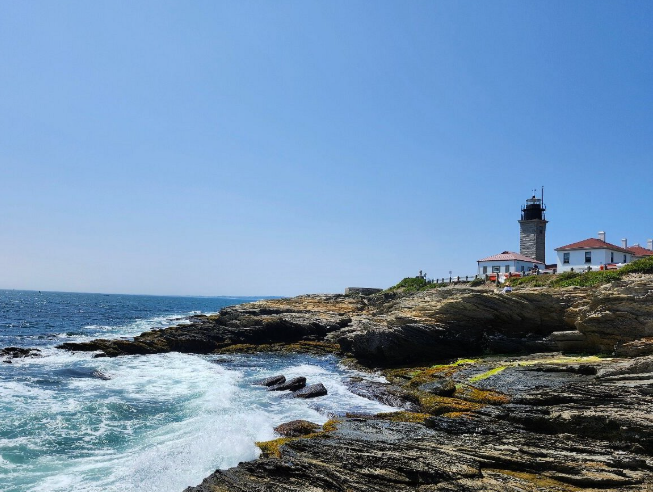
I’ve spent time at Beavertail State Park, with its dramatic cliffs, pounding surf, and that steadfast lighthouse watching over the rocks. It’s one of the most striking pieces of coastline in Rhode Island — beautiful, rugged, and loud with the sound of water hitting stone.

But Beavertail is also a reminder of why I never made that tropical‑fish dive. The shoreline there is rough, exposed, and prone to rip currents. Even as a diver, I remember looking at those rocks and thinking, Where would you even get in safely? It’s a place built for sightseeing and storm watching, not for slipping quietly beneath the surface.

That contrast — the wildness of Beavertail versus the calm, sheltered coves just a few miles away — underscores how close I came to experiencing something extraordinary.

🤿 The Dive I Never Quite Made
Back in the 1970s, when I was scuba diving, the stories sounded almost unbelievable: a shallow, easy‑entry spot in Jamestown where warm water pooled and bright tropical fish appeared out of nowhere. Some divers even collected them for home aquariums, since the fish wouldn’t survive once fall temperatures dropped.

These tiny tropical visitors even have a nickname: Gulf Stream orphans. It’s a sweet, slightly melancholy name for fish that drift hundreds of miles off course and end up in Rhode Island for a short summer stay.

I planned that dive more than once. I wanted to see it for myself — to slip into warm water in New England and find a flash of Caribbean color swimming past. But work, schedules, and life kept interfering. It became one of those small regrets that stays with you: knowing there was a pocket of warm, tropical magic hiding in Rhode Island, and I never quite made it there.


🌡️ A Rare Event That’s Becoming More Common

And here’s the part that feels almost bittersweet: it’s more common now than it was back then. As the ocean has warmed, tropical and subtropical fish are appearing farther north, more frequently, and in greater numbers. What was once a rare Gulf Stream surprise has become a regular summer occurrence.

The ocean I dove in during the 1970s is not the same ocean we swim in today.


🌴 A Brief Visit From the Tropics

For a short moment each year, the Gulf Stream reaches out and brushes New England, leaving behind a handful of tropical fish as proof — a reminder of how dynamic, surprising, and ever‑changing our coastline really is. And every time I see the Beavertail lighthouse, I think of the dive I never took, and the warm‑water visitors I never met.

Beavertail Lighthouse on a calm day


Natural Wonders of the USA- Part 2

Natural Wonders

Lets continue with our Natural Wonders List.  Next up

4. North Dakota

And guess what is the Natural Wonder for North Dakota- Theodore Roosevelt National Park. Nice to know I’m on the right track. 

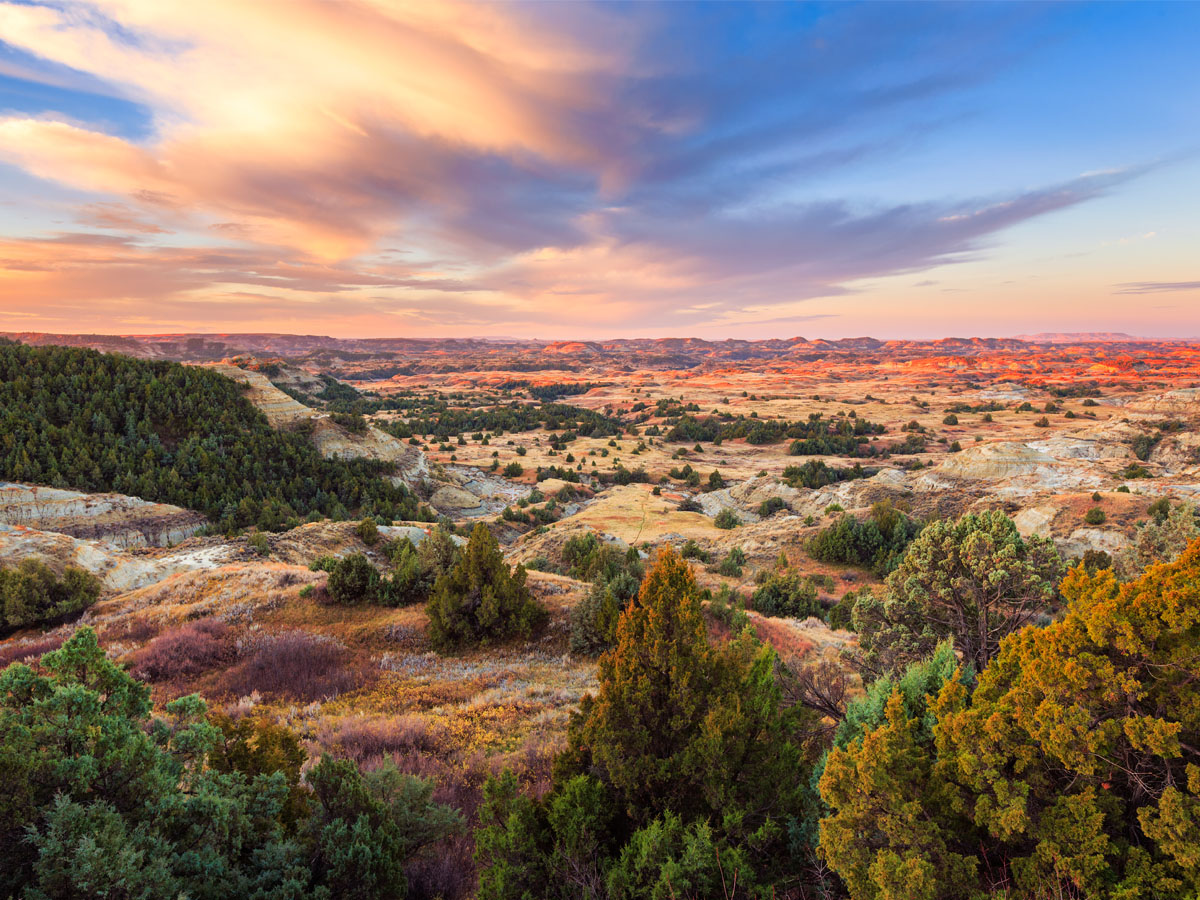
The Theodore Roosevelt National Park in the western part of North Dakota is comprised of three separate badlands which altogether stretches out over 110 square miles. Its  a popular wildlife viewing area which is my interest. So No I haven’t been to North Dakota yet and Theodore Roosevelt National Park is on my list for when I do go. 

Moving on to

5. South Dakota

The Natural Wonder in South Dakota is Custer State Park and yes, I have been there. It’s a really great state park. Not only did we see bison, lots and lots of Bison, we saw mule deer and pronghorn antelope but the most fun were the “Beggin’ Burros”. The burros are wild donkeys that live in a small section of Custer State Park along the road. They are called “begging burros” because they’ve become famous for approaching vehicles and expecting food.


Beggin Burro 2011 – Photo credit Deb Neumann

6. Delaware

Number 6 on the list is Delaware and that state’s natural wonder is Brandywine Creek. You may have heard of it because it was a battlefield in the revolutionary war.  We lost that battle but of course we all know that we went on to win the war. Now it’s part of Brandywine Creek State Park. It looks really pretty. 

7. Rhode Island

Rhode Island is another neighboring state, one that I go to often. The Natural Wonder on the list threw me at first. Then I realized it was located on Block Island.. I have been Block Island for a weekend. I was out there to photograph lighthouses. But the Natural Wonder is Mohegan Bluffs. 

Mohegan Bluff- Photo credit Deb Neumann

8. Montana

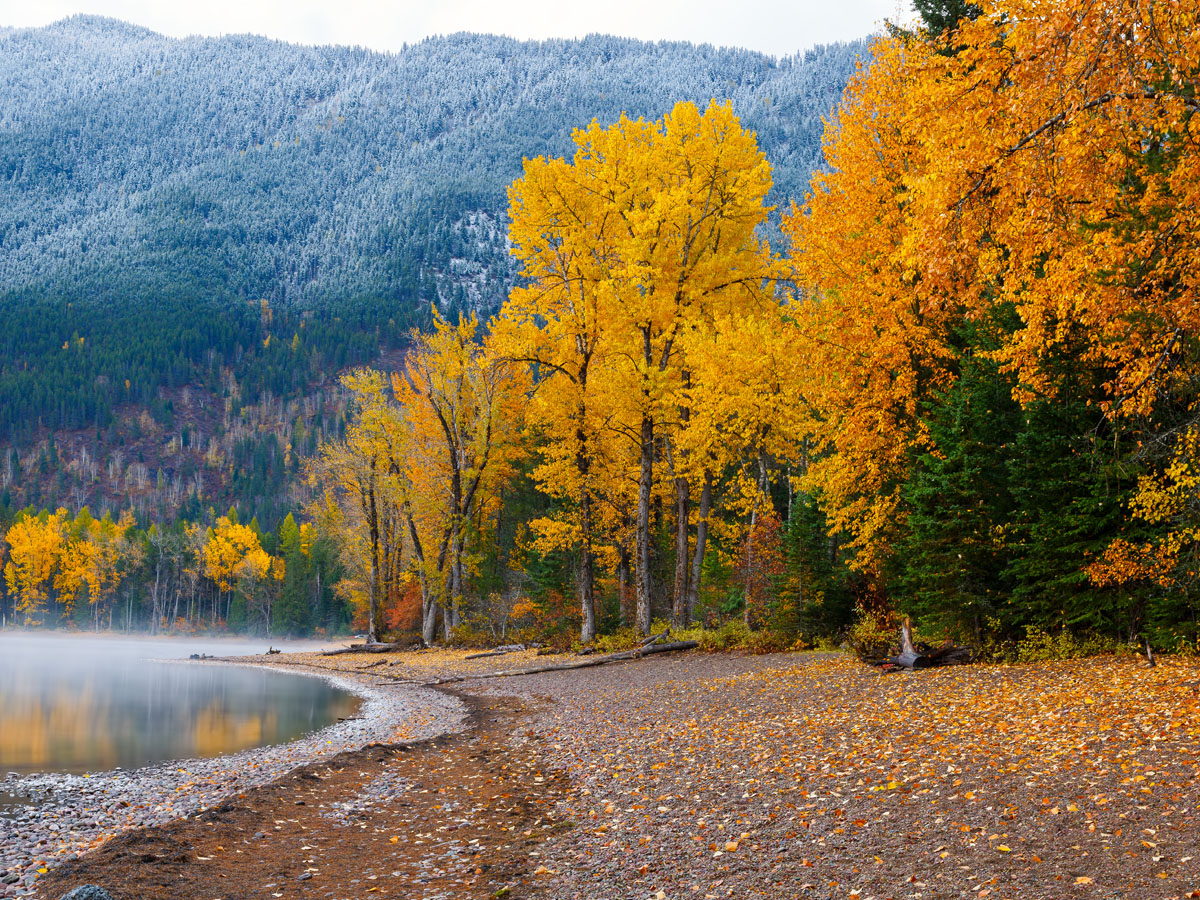
Another State I’ve yet to visit. The big thing on my list is Going to the Sun Road. Good to know that Going to the Sun Road is part of Glacier National Park so I don’t have to skip one to do the other. Although Glacier is in the name, over the last 12,000 years, the glaciers of Glacier National Park have largely disappeared. While 150 glaciers existed in the mid-19th century, only about 25 exist now. That’s sad but I saw lots of glaciers on my trip to Alaska.

I think that’s enough for this post. 3 states that I need to visit. One done and the Wonder seen. The list will be continued.