A Tale of Two Lighthouses

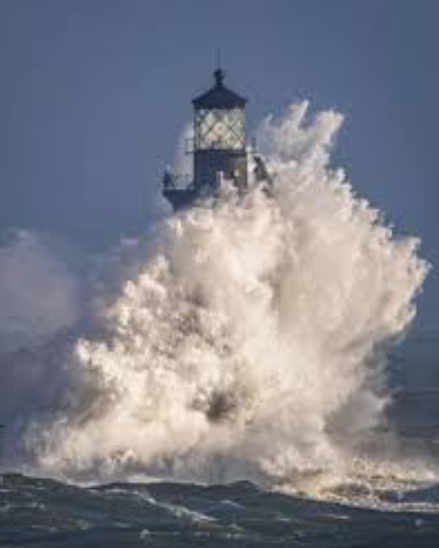
Graves light takes a pounding from the sea at the entrance to Boston Harbor's deep water channel


Graves Light: Boston Harbor’s Outer Sentinel

Lighthouses have always been the quiet guardians of the coast — part warning, part welcome, standing where the sea turns unpredictable. In my last post, Boston Light played the role of the harbor’s warm lantern, guiding ships safely home. Just a few miles away, though, another tower tells a very different story. Graves Light, perched on a scatter of ledges at the edge of the deep‑water channel, wasn’t named for sailors’ graves at all, but for Rear Admiral Thomas Graves, an early Massachusetts figure. Its job has always been the opposite of Boston Light’s: not to beckon ships inward, but to warn them away from danger.


A Lighthouse Built for the Hard Work
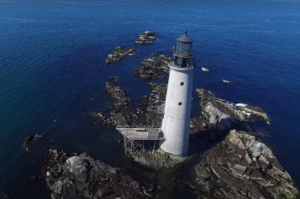
Completed in 1905, Graves Light is the tallest lighthouse in Boston Harbor and by far the most exposed. Its granite blocks were quarried in Rockport and pinned into the ledge like a stone corkscrew — because anything less would have been torn apart by the Atlantic. This tower wasn’t built for charm. It was built to take a beating.

And it still does.


Still Active — Even in Private Hands

In 2013, Graves Light made headlines when it was sold at auction for $933,888, becoming one of the most expensive lighthouse sales in U.S. history. The new owners restored the tower itself — floors, windows, dock, solar power — but the light and fog signal remain federal property.

The U.S. Coast Guard still operates:

  • the modern beacon
  • the fog horn
  • the official charted signal: Fl (2) W 12s

So yes, Graves Light is still an active aid to navigation, even though the building is privately owned. The tower belongs to people; the warning still belongs to the sea.
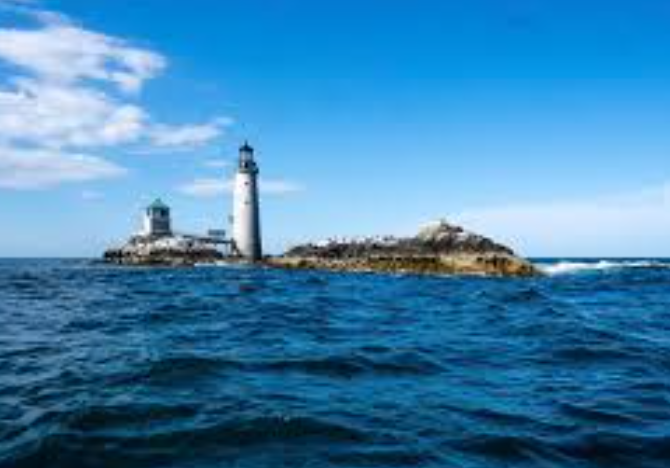

Two Lights, Two Jobs

Graves Light and Boston Light sit on opposite sides of the deep‑water channel — only about 3.5 miles apart, but doing completely different work.

  • Graves Light stands on the outer edge, flashing its stern warning:
    “Danger here — avoid the ledges.”
  • Boston Light waits farther in, offering the softer message:
    “Safe water ahead — welcome to the harbor.”

Mariners once treated them as a sequence: clear the danger, then follow the welcome home.
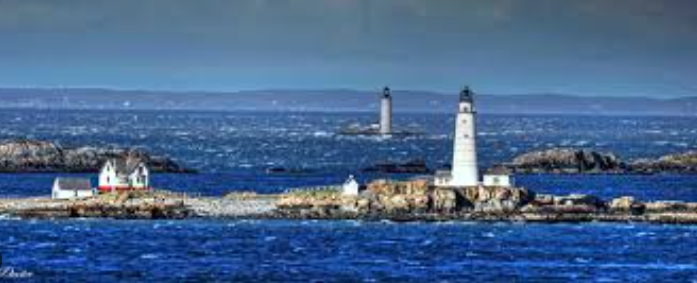
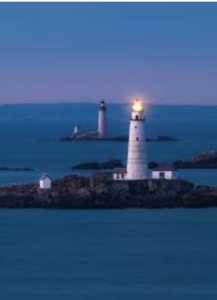
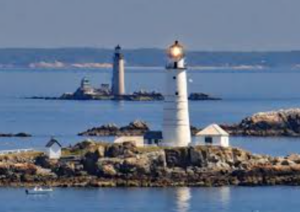
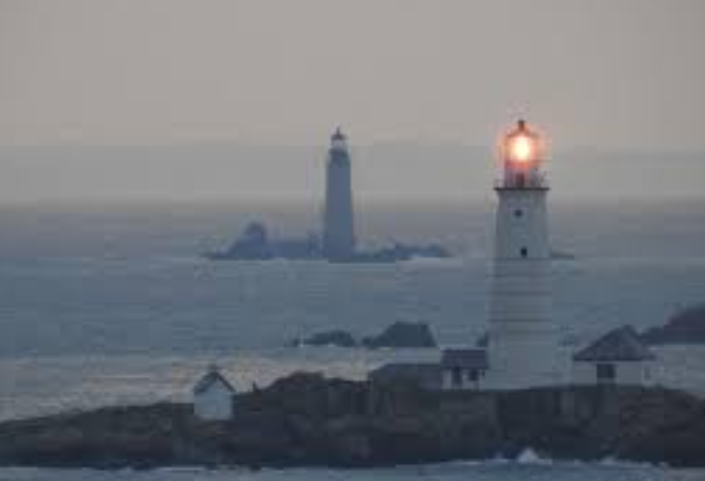
Boston Light and Graves Light, two guardians of Boston harbor


The Zoo Ship Wreck of 1938

One of the strangest events tied to Graves Light came in 1938, when the steamer City of Salisbury ran aground near the ledges in thick fog. Its cargo?
A traveling zoo shipment — monkeys, parrots, pythons, cobras, and other exotic animals.

Most survived, and newspapers gleefully reported “snakes loose in Boston Harbor.” Graves Light has seen its share of storms, but that day it witnessed a circus.


A Hollywood Cameo
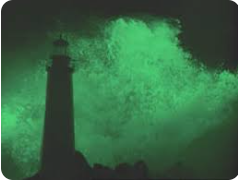
Graves Light even had a moment on the silver screen. It appears in the storm sequence of the 1948 film Portrait of Jennie, where the tower is cast as a brooding, windswept sentinel. Even if you’ve never seen the movie, it’s a fun bit of trivia — one of the few times this rugged lighthouse slipped into Hollywood’s imagination.


A Sentinel You Can Still See Today

If you take one of the harbor or lighthouse cruises, you’re almost guaranteed to see both Boston Light and Graves Light in a single sweep of the horizon. Coming out from the harbor, you first pass the civilized silhouette of Boston Light, with its keeper’s house and outbuildings tucked neatly on Little Brewster Island. And just beyond it, rising straight from the gray Atlantic, stands Graves Light — taller, starker, and far more ominous. One welcomes you in; the other warns you away. Seen together, they tell the whole story of Boston Harbor in two towers.
 

Boston Light: Still Standing, Still Shining

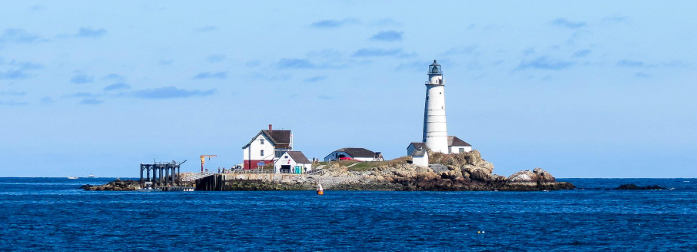
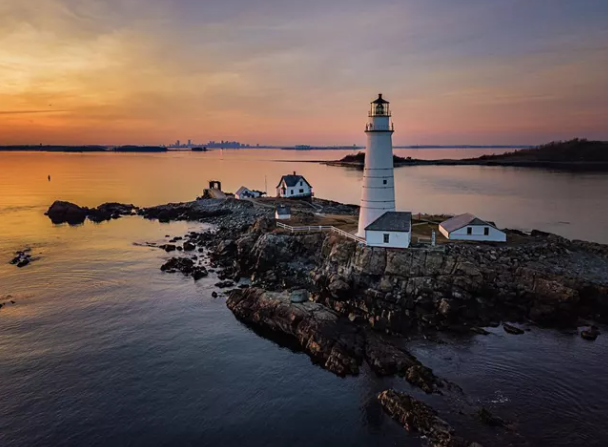
Located on Little Brewster Island, Boston Light: America’s Oldest Lighthouse is Still on Duty


Oh What a Light

(A little wink to the 1960s classic “Oh, What a Night”)

Boston Light is like an old war hero — weathered, stubborn, and full of stories it never quite shares. It has guarded the entrance to Boston Harbor for more than three centuries, and those stones have seen everything from calm seas to cannon fire.

Built in 1716, Boston Light is the oldest continually used lighthouse in the United States. Its history reaches straight back to the Revolutionary War.

The first tower stood about 60 feet high and was made from rough island stones. Workers stacked unshaped rubblestone into a tapering tower and held it together with early mortar. It wasn’t fancy, but it worked.

That original lighthouse didn’t survive the war. In 1776, British forces retreated from Boston Harbor and set explosives that destroyed the tower. (Those darn Redcoats!)  Boston rebuilt quickly. By 1783, the Commonwealth raised a new lighthouse using the island’s rubblestone once again. This version had thick 7.5‑foot walls and reached 75 feet into the air.

In 1859, the tower needed more height to hold a massive 4,000‑pound Fresnel lens. Builders added another 14 feet, giving the lighthouse the profile we recognize today.


The Modern Boston Light

Boston Light glows bright while Graves Light keeps its quiet watch beyond

The lighthouse on Little Brewster Island blends the 1783 rebuild with the 1859 expansion. It rises 89 feet (102 feet above sea level) and still contains the old rubblestone core, now reinforced with brick. Only the bottom 9 to 14 feet include stones from the original 1716 tower, but that small section connects the modern beacon to its earliest days.

Not bad for a lighthouse that once relied on candlelight.

Today, Boston Light is a National Historic Landmark. By law, it remains permanently manned, even with modern automation. The island isn’t open to the public, but several harbor cruises pass close enough for great views.

At night, the beam reaches 27 miles into the Atlantic. After 300 years, it still calls sailors home.


Graves Light

Yesterday I mentioned Graves Light that marks the North Channel into Boston Harbor. It isn’t as “pretty” as Boston light but its history is just as colorful.

dsc_4216-2-copy

The lighthouse gets it’s ghoulish names from the tiny island it’s situated upon. “The Graves” is the outermost island of the Boston Harbor Islands National recreation Area, 9 miles off shore of downtown Boston.

dsc_4211-3-copy

The lighthouse is the tallest lighthouse in the approach to the Port of Boston and until 1975 it was the most powerful lighthouse in New England. It is currently lit with a modern , solar-powered lamp that doesn’t compete with the original giant Fresnel Lens.

graves-light

The Lighthouse was built in 1905 and equipped with a first-order Fresnel lens that shown with a 350,000 candlepower beam across the harbor. That lens was removed in 1975. Although not on display at this time it remains in the possession of the Smithsonian Institution. Any classic film buffs may remember that this light was the setting for the climatic storm in the 1948 movie “Portrait if Jennie”.

 portrait-of-jennie

In recent years many lighthouses have gone up for public auction and Graves Light was no exception. In June of 2013 the lighthouse was put on the auction block. The starting bid was $26,000 but by the time the gavel dropped it had reached a record $933,888, the highest bid ever paid for  a U.S. Lighthouse.

dsc_4217-3

In 2014 the new owners began a major restoration project that has been features on the s television show, This Old house.

Graves Light is listed on the National Register of Historic Places. The lighthouse is still being used for navigational purposes and will remain so under the terms of the sale.

The lighthouse includes 2 bedrooms, a kitchen and a study but landing is difficult and entering the building requires crossing a 40 –foot ladder shown in this archival photo.

graves_1956

Still who wouldn’t want to own a real lighthouse?

Boston Light

Boston Light is a lighthouse located on Little Brewster Island in the outer Boston  Harbor.

dsc_4199-2-copy

The original lighthouse was built on this site in 1716 making it the first lighthouse to be built in what became the United States.

This first light house was held by the British during the American Revolution and subsequently burned down by the American forces, not once but twice. When the British withdrew in 1776 they blew up the tower completely destroying it.

dsc_4171-2-copy

In 1783 the new lighthouse was constructed with a 75 foot tower, the same as the original. In 1856 the tower was raised to its present height of 98 Ft. A new lantern room was added along with a 12 sided second order Fresnel Lens.

In 1998 Boston Light was automated but is still staffed by a resident Coast Guard Keeper. The current keeper is Sally Snowman who, along with volunteers from the Coast Guard Auxiliary act as interpretive tour guides for visitors.

week-3-002e-copy

The current light still uses the 2nd order Fresnel lens, one of only four left in use and the only one in Massachusetts. It flashes white every 10 seconds and is visible for 27 nautical miles.

To reach the safety of Boston Harbor, ships had to navigate the dangerous channel through numerous rocks, shoals and islands so Boston Light was an important navigational aid.

In more recent times the channel has been dredged  and larger vessels have shifted to the North Channel marked by Graves Light.

Boston Light is designated a National Historic Landmark and is the second oldest working lighthouse in the US today.

A Winter Wildlife Cruise

My Friend Nancy sent me a notice about a Winter Wildlife Cruise of Boston Harbor. There wasn’t a lot of information on the web site. In fact it didn’t even mention the date or dates. On a phone call I was told it was a one day only cruise, a special arrangement.

I wondered what Wildlife they were referring to but booked the cruise anyway. I figured it would get me out of the house. Stop my winter hibernation.

I dressed in my warmest winter coat, sweatshirt and a scarf. My upper body was warm but my legs clad in jeans left something to be desired.


bundled-up

I had to be at the pier at 10:30 to board. The cruise was scheduled to start at 11 am. Turns out this was also the day of the Woman’s March in Boston and it was rumored that 70,000 woman had RSVP’d that they would attend. It made me wonder what the traffic and parking would be like. I debated all down RT 24 if I should try the MBTA or drive. Driving won out and I arrived at the Harbor Garage at 8:30 am giving me 2 hours to kill.

dsc_4140-copy

By The time I got parked my torso was sweating bullets but my legs were still cold.  I decided to wander around the Aquarium area. Other than a few joggers or dog walkers, there weren’t too many people out and about.

It was a pretty overcast morning.

dsc_4143-copy

I met one woman walking her Lab. Pretty dog but her muzzle was getting gray. That dog dragged her over to me and started licking my hands . The owner was so apologetic but I just laughed and told her not to worry, animals like me. My “Pet Whisperer” persona strikes again!

I wandered over the the Rose Kennedy Greenway which isn’t green this time of year but took a long distance shot of the “Fish” window.

dsc_4142-copy

I also grabbed a shot of the Old state House as through it were peeking around the bigger building in front of it.

dsc_4141-copy

There were wooden benches here (the benches on the wharf were metal…cold) I did some people watching until a little after 10 AM.

dsc_4145-copy

Finally it was time to head back to get lined up for boarding.