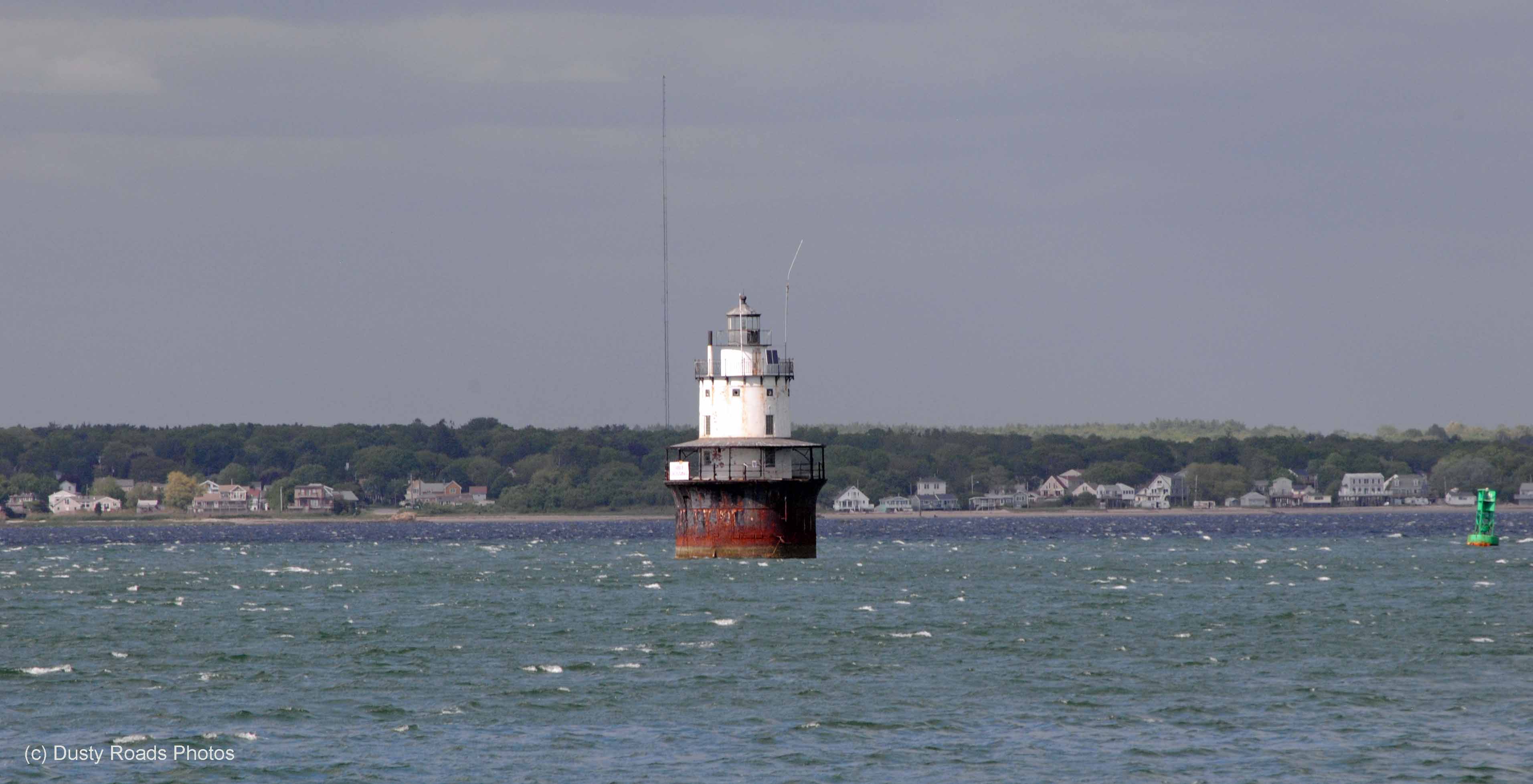
Fort Rodmen, New Bedford MA

Fort Rodmen~ Fort Tabor…you say tomato I say….well you get the idea. Whatever you want to call it, it’s the same place, at the end of Rodney French Blvd.  I first heard of the old fort from a co-worker who grew up in New Bedford. I told Jay he should be working for the Chamber of Commerce because he knows all the neat places in New Bedford and sings their praises all of the time.

Anyway, let me address the name confusion first. Construction of the fort began during the late 1850’s . The local citizens of New Bedford called it Fort Tabor after the mayor of New Bedford during that time. The army renamed the fort after Lieutenant Colonel Logan Rodman of the 38th Massachusetts Infantry, a New Bedford native. He was killed in the assault on Fort Hudson, Louisiana in the Civil War.

There really were 2 forts on this location. A placard identifies the location of the earthen works fort that was used while the stone fort was under construction. It’s amazing how small that structure was based on the outline of the foundation that has been laid out with the paving stones .

Originally this area of New Bedford was known as Clark’s Point and Clark’s Point lighthouse was built there in 1797. As the Stone Fort grew in heght it obscured the lighthouse so a 2nd lighthouse was built in the Fort itself.

When the coast guard made a move to decommission the original lighthouse in the channel, once again the town rallied together and petitioned to keep Clark’s Point Light. The town won. 🙂

In memorial to more modern wars, there  is a World War II Exercise Tiger Tank on display in the park to honor the service men killed in an exercise in preparation for D-Day.


Landing exercises were being executed in Lyme Bay, England. The area was chosen for its similarity to Utah Beach. On April 28, 1944 as a mock beach landing was being attempted 9 German E-Boats attacked the convoy which was only protected at 50% strength. It is estimated that 946 American Servicemen died in the operation. 308 from friendly fire. To this day there is only limited information available which has sparked charges of a coverup. It’s doubtful we will ever know how everyone died but here at Fort Rodman Military Reservation they will be remembered.

There is also a beautiful memorial to the Vietnam Veterans. It is filled with symbolism that is explained with a great deal of sensitivity on the descriptive placard.

One last item of interest is the Military Museum which is also on site. I confess, I didn’t take the time to go through there this time. I was interested in some of the nonmilitary aspects of the grounds.

One of the first things I noticed was a play ground that was getting lots of use as I walked by.  The land around the fort right up to the retaining walls was seeded with grass and well maintained. The paths were paved and there were benches along the paths so you could stop and stare out to sea.

As you continue around the property you come to the side with the channel and there’s the old Clark Point Light house.

 There were tables and benches and a long concrete wharf lined with streetlights. There were a couple of concrete benches on the wharf .

 The first one wasn’t bad but the one at the end was pretty disgusting. I’m not sure if the seagulls had lunch there or if human fisherman had cleaned their catch on it but it was covered with dried fish guts and blood. That was the only discordant touch in the lovely park.

There were several beaches and they were far from packed. It could have been because it was windy so not especially hot. But the rumor I heard is that even on hot days these are “forgotten” beaches and usually not too crowded.

I will definitely have to return over the summer and give you updates.

Fruitlands Museum

Moving along RT 2 I spotted a sign for Fruitlands. I had forgotten that this museum was in this area. I didn’t have time to stop today butit sure brought back memories. I visited the grounds about 10 years ago with some friends from Atlanta, Ga. As I recall it was in the fall because the trees were turning colors. It always surprises me when someone from out-of-state asks me about an attraction in my backyard and I haven’t heard of it. That’s part of the reason for this blog. My everyday travels as I learn about my own area and state as well as my “BIG” vacations.

Anyway I remember saying I would go to Fruitlands and having no idea what it was so I’d like to take just a moment of your time to tell you a little about this place. Unfortunately I have no pictures since I didn’t stop this time but that just means I will need to be descriptive.

My friends were interested in Fruitlands because it chronicled the Shaker Experience which evolved in Harvard and Shirley, MA. It all began in June of 1781 when “Mother” Ann Lee and a group of early Shaker Leaders came to the area as missionaries and decided to stay establishing a settlement.  Shaker Villages  sought to provide basic needs of food, shelter, and clothing. In order to meet these goals some commercial enterprises were developed to generate necessary capital by buying and selling goods and services to the non shaker settlements that they referred to as “the world” .

The Shaker Office at Fruitlands was built in 1794. It was moved to the Fruitlands property in 1920.

Fruitlands was the dream of Clara Endicott Sears. She wanted to preserve  a part of New England’s rich cultural history. A woman of means, this wealthy Bostonian purchased the farm that was known as Fruitlands. Bronson Alcott established a transcendental community on the property in 1841. It was not very successful and only lasted about 7 months.

You may have picked up on the name Alcott. It is the same Alcott family from Little Women. Louisa May Alcott is the 2nd daughter of Bronson Alcott. She wrote about the failed commune experience in her book Transcendental Wild Oats. The Farmhouse at Fruitlands where the Alcotts lived is open for viewing. It was declared a national historic Landmark in 1974.

You will also find the Native American Gallery which contains a  number of significant artifacts from the Plains, Northwest Coastal, Arctic and Southwest cultural areas. The gallery honors the spiritual and cultural presence of the first Americans.

The Art Gallery contains a permanent collection of over 230  nineteenth century portraits and more than 100 Hudson River School landscapes. The collection includes paintings by Albert  Bierstadt, Robert Weir, John Frederick Kensett and many others. Collections contain silhouettes, mourning pictures, textiles to name just a few.

It’s a very interesting and bucolic place. Since it’s been awhile since I’ve been there I should return and provide you with my form of visual aids…pictures!

Peace Field, The old House

I think this was my favorite part of the tour and my favorite place was the library and gardens.The Old House was a family home and unlike many historic locations it stayed in the Adams’ family until it passed in 1946 to the National Park Service creating the Adams National Historical Park.

The house was purchased sight un-seen while John and Abigail Adams were in England. Abigail remembered visiting as a child and thought it to be huge and elegant. It didn’t quite live up to her childhood remembrance. The farm was meant to be a place to spend retirement in “peace” hence the play on words of the name “Peace field”. John Adams said of the estate “It is but the farm of a patriot.”

Once again the restrictions of the museum came into play. We were invited to take all the pictures we wanted of the outside but no cameras inside. In fact, they almost didn’t allow me in because I had the DSLR and the ranger felt it was “too large” and should be left on the porch. Of course that wasn’t about to happen. When I said I would skip the tour instead he reluctantly let me come in.

I understand what he was doing. He wanted to be sure the furnishings were not touched or damaged including the wall paper on the walls. The only time we were allowed to touch anything was when we went to the 2nd floor. He gave us permission to touch the banister that went up the stairs. All of the furnishing in the Old House are original, not reproductions. there is even a copy of the Declaration of Independence framed and hanging on a wall. It was the copy that was given to John Adams as one of the original 56 signers of the document.

Since the house was not as grand as Abigail remembered it she went about expanding it, lengthening the building and raising the hight of the ceilings by lowering the floors on the addition. The is a step down when you leave the original building and move into the newer part.

Abigail added this room to entertain dignitaries and there were many that crossed her threshold including the Marquis de Lafayette.

John returned to the farm in 1801 and was joined by his son, John Quincy and his family. Charles Francis Adams, John Quincy’s son also took up residence here along with the historians of the family Henry Adams and Brooks Adams.Together this family amassed a huge library which was housed in a separate stone building next to the gardens.

The distinguished Adams’ lineage stretched from 1776 to 1946 starting with John and Abigail, then John Quincy and Louisa Catherine on to Charles Francis who married Abigail Brooks ending with  Henry Adams and Brooks Adams.

This slideshow requires JavaScript.

John Quincy Adams

The 2nd stop on the “Birthplaces” tour we visited the home right next to John Adams’ birthplace. When John married Abigail his father Deacon Adams gave the young couple a home right next door. This is where John Quincy Adams was born on July 11, 1767.

This is also where John Adams had his law firm and wrote the Massachusetts Constitution. There is a replica on display that is quite impressive. There were notable differences in building techniques between the original family home and John Adam’s birthplace. Significantly there were changes in  the hearths and kitchen areas. The leading cause of death for women in the colonial period was not childbirth but rather fire. Thier voluminous skirts would brush the coals in the fireplace and often caught fire. By the time this house was built changes had been made to the hearth area extending it and allowing the pots to be swung out from the fire to be stirred.

As mentioned in yesterday’s post young John Quincy would not stay in the house for many years as his visit to Europe with his father became an extended stay as a translator. By the time he entered Harvard in 1785 he was proficient not only in French but also  Greek, Latin, French, Dutch, and German.

Upon his graduation from Harvard in 1790 John Quincy established a law practice in Boston but was more interested in politics than law. This led to an appointment as minister to the Netherlands. From the Netherlands he went to Britain where he met and married Catherine Johnson. From Britain, John Quincy was dispatched to Prussia and did not return to the United States until 1801.

Upon his return his domestic political career really began. He was immediately elected to the Massachusetts state senate. 2 years later he was U. S. Senator. Seems  politicians have been using public office in Massachusetts as a stepping stone to the national level since the birth of our nation!

President James Madison appointed John Quincy minister to Russia. Thanks to this appointment John Quincy was able to obtain intervention by Russia into the negotiation for peace in the War of 1812 helping to bring that conflict to an end.

Next on Mr. Adams’ resume was an appointment by yet another president, James Monroe , who appointed John Quincy Secretary of State. During this time John Quincy negotiated the acquisition of Florida and defined the western boundaries of Louisiana.

In 1824 after a bitterly contested four-way presidential battle, John Quincy became the 6th president of the United States.  John Quincy’s presidency was marred by political in-fighting and a hostile congress…sound familiar. I guess some things never change.

In 1828 John Quincy was overwhelmingly defeated by Andrew Jackson making him a one term president.

Following his defeat for re-elcetion, John Quincy thought to retire to The Old House at Peace Field but his retirement was short-lived. In 1831 he was elected to the House of Representatives, where he served for eight successive terms until his death.

Adams suffered a stroke on the floor of the House of Representatives on Feb. 21, 1848. He was carried to the Speaker’s room, where he died 2 days later without regaining consciousness.

The Adams Family

A couple of posts ago when I was talking about the Ames Family and Borderland State Park I commented that they were involved in politics. I mentioned that it seems to be a Massachusetts tradition for wealthy families to delve into the political arena and I used the Kennedy dynasty as an example to make my point.

Well, I would like to adjust that a little bit. The tradition of political activism and service goes back much farther than just the Kennedy’s not to diminish what they accomplished but if you explore history a bit further you will find an amazing family that hailed from Massachusetts and I doubt their political tradition can be outdone by anyone else in any state.

Where am I going with this you ask? I went to the Adams National Historical Park in Quincy to obtain my National Park Stamp. Since I was there I took the tour of the birthplaces and the Old House at Peace field.  I’m sure we’ve all heard of John Adams, Abigail Adams and  John Quincy Adams. Samuel Adams doesn’t seem to be a part of this clan but he too was a patriot even if some folks only know his name from the brew named after him.

Anyway, I made my way to the Visitor Center with a little help from a friend from Quincy. After she pointed out the building she headed on her way. There’s a parking garage right in back of the visitor center and it was a  pretty reasonable rate  so that was where I left the car. What I didn’t know, and it isn’t advertised anywhere, is that Validated Parking is available if you present your parking ticket in the visitor center. Oops! Must remember that for next time.

The elevator down brings you right to the entrance to the building housing the Visitor Center so you never have to go outside. The Center contains exhibits, a bookstore and they had a PBS CD running about the Adams’ and their role in the Revolutionary War.

National Park Passes are accepted for the tours . The Park is open seven days a week April 19 through November 10. Two-hour guided tours leave the  visitor center  every 30 minutes. The United First Parish Church is the final resting place of both presidents and  first ladies and is next to the visitor center.

 The tour I was on was made up of all adults and most of them were older than I am so there were no jokes about “the Adams Family” da da da dum.  We did see a school group taking a tour. Those rangers were in period costume. Everyone was very respectful. The rangers that led the tours were all knowledgable and really warmed to their subject. I am sure I will mix up some of the facts and dates and family members as I am no historian so to get it absolutely right I recommend you take the tour yourself. It is pretty amazing the impact this one family had on the early history of the United States so I will try my best to share a small bit of the vast amount of information the rangers gave us.

This one family influenced events from the time of the American revolution to the Civil War and even beyond. Four generations of the Adams family tackled  some of our nation’s greatest challenges in war, politics, diplomacy, arts and letters.

Lets start with John Adams and Abigail Adams. 

As we leave the visitor center we board a trolley for the ride to the first stop, the birthplace of John Adams, 2nd President of the United States. The house is restored and most of the furnishings are reproduction but it is still fascinating to see what living conditions were like at that time. Ceilings were low and the house itself quite dark. Exterior photos are allowed but no photography inside. Don’t bother with a DSLR, a simple point and shoot is sufficient and easier to carry.

This is where John  grew up and his morals and opinions were formed. His father, Deacon John Adams farmed in summer and made shoes in winter.  Young John was expected to be a minister like his father but instead  chose to attend Harvard and study law.  It was John who in 1770 defended the British Soldiers involved in the Boston massacre because it was his belief that all men deserved to have representation. That is a cornerstone of our legal system today, the right to an attorney.

After being admitted to the Massachusetts Bar  he married Abigail Smith in 1764. That was an amazing love story. John admits that it was not love at first sight but as he grew to know Abigail he was attracted to her mind and strong opinions. Abigail was self-taught yet her writings and letters have been preserved  and demonstrate her high intelligence and quick mind. Her strength would be key for while the revolution waged around her, John was often overseas on diplomatic duty. Abigail, sitting in the little salt-box home on a farm in Quincy was front and center. Throughout the war Abigail opened her home to the refugees from the fighting.

It was Abigail who sent word to her husband of the death of their good friend , Dr. Joseph Warren, at Bunker Hill. She took their young son, John Quincy Adams with her to the top of Penn’s Hill where they were able to watch as the battle raged on Breed’s hill, that battle to later be known as The Battle of Bunker Hill.

When John Adams returned to France after a diplomatic break he took his  young son John Quincy with him. Young John was only 9 or 10 at the time and it was expected that he would gain experience from the exposure to French. In fact it became far more than an educational trip as John Quincy became a translator so at the young age of 10 he was beginning a career in service to his country that would span some 60+ years. It would be years before he would see his mother again.

As you can see, already this family is having an impact.  John Adams wrote the Massachusetts Constitution and much of what became the United States Constitution came from ideas set down in that document.

John Adams was known as a shrewd judge of character. He recognized the need to unite the 13 colonies if there was any chance of winning independence. To this end he nominated George Washington to be the Commander in chief in 1775. It would prove to be an excellent choice.

After the Revolutionary War as the new government was being launched, George Washington was elected the first president with 69 electoral votes while John Adams came in 2nd with 34 thus making him the first vice president of the United States, a position he held for both of George Washington’s 2 terms.

In the election of 1797 Washington, who believed strongly in term limits, did not run. Adams barely squeaked by Thomas Jefferson in a closely contested election. Adams 71, Jefferson 68 making John Adams the 2nd President of our new nation  and Thomas Jefferson the vice President.

Elections at the time were not quite the same as today and I would encourage anyone interested to look into it further. I am not qualified to go into the intricacies  nor do I want to turn this space, which is supposed to be about travel, into a political history lesson, but I can’t avoid some of it when I am touring presidential birthplaces! 🙂

I think I used enough words for John and Abigail. So this doesn’t become too long I will leave it here for today. Next post, John Quincy Adams.

This slideshow requires JavaScript.