Look Up! November’s Sky is full of Celestial Surprises

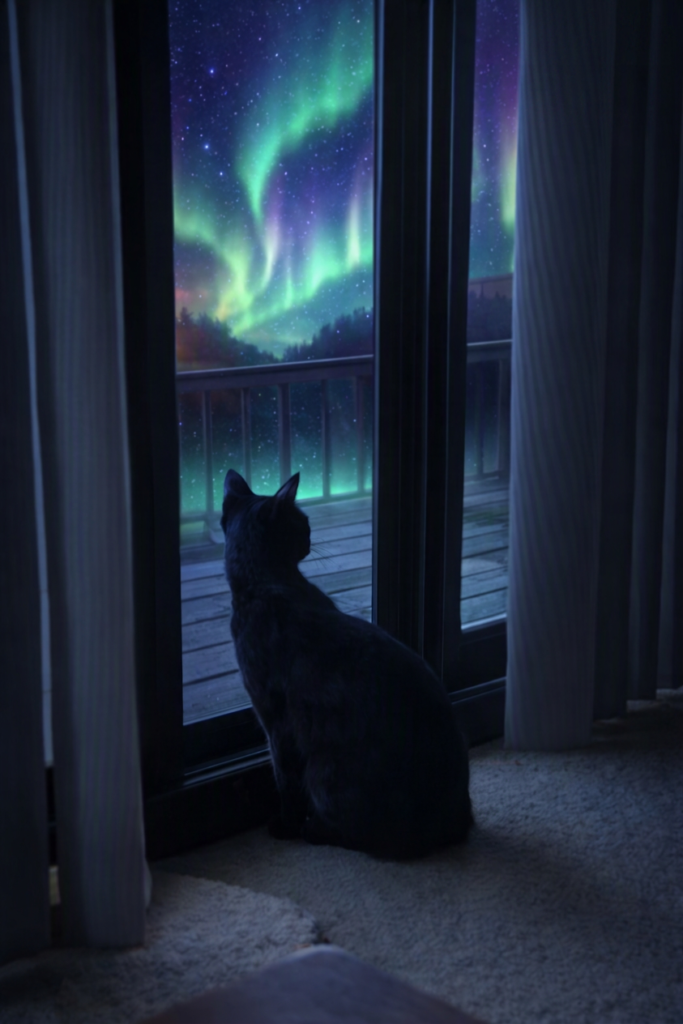
A silhouetted cat sits quietly by a sliding glass door, gazing at vivid green aurora borealis curtains dancing across a purple-blue, star-filled sky. The colorful glow reflects off the outdoor deck, while vertical blinds frame the peaceful nighttime scene.

Auroras and Meteor Showers Take Center Stage

Wow, November 2026 is shaping up to be a big month for stargazers.
Bright aurora borealis in vivid shades of green, purple, and pink stretches across the night sky above a calm lake. Dark mountain silhouettes line the distant horizon, while the colorful reflections shimmer softly on the water beneath the glowing curtains of light.On deck this month is a strong possibility of auroras in the northern states. The culprit behind the potential uptick in Northern Lights activity is a large coronal hole on the sun.

Yes, we have a hole in the sun! I’m serious, even if it sounds more like something the WMEO crew would investigate.

This hole in the sun’s corona allows charged particles from the solar wind to escape more easily. As a result, skywatchers could be treated to enhanced aurora displays.

Meanwhile, as if that’s not enough, we’ve got multiple meteor showers on tap.

Meteor Showers, Planet Pairings and a Historic Journey

The nice thing about meteor showers is that they aren’t just a one-night event. Most are active for several days or evenA dark blue night sky filled with dozens of bright meteors streaking downward in long, luminous trails. Countless stars are visible across the sky, while a dark silhouette of grass and vegetation lines the horizon at the bottom of the image. One especially bright meteor near the center illuminates the scene, creating a dramatic celestial display that resembles a meteor shower. weeks, so even if you miss the peak, you still stand a chance of catching a few shooting stars or bright fireballs.
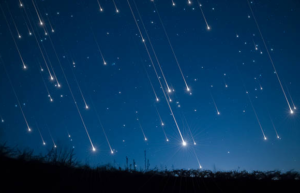
Here’s what’s on the skywatching agenda for November:

• Southern Taurids: Active September 20 to November 20. Peak Nov. 4-5. Known for slow-moving, bright fireballs.

• Northern Taurids: Active October 20 to December 10. Peak Nov. 11-12.

• Leonids: This is the big one, folks. We always hear about this one. In fact, one year I was driving on an overcast night when I noticed flashes lighting up the clouds on the horizon. At first, I thought it might be fireworks, but the flashes kept coming. Curious, I pulled over and spent nearly twenty minutes watching the sky. It turned out I was seeing the light from meteors illuminating the cloud cover. The sight reminded me of distant artillery flashes, and it’s something I’ve never forgotten. The Leonids are active from November 6-30 and peak on November 17-18. Under ideal conditions, observers may see up to 15 meteors per hour. Best viewed in the early morning hours after the moon has set. As for why I was driving around in the middle of the night, that’s a story for another day.

A Supermoon, Two Planets and Voyager’s Big Milestone
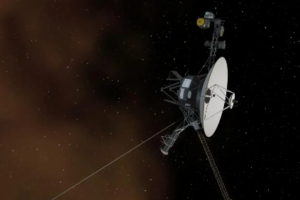
Illustration of a spacecraft in deep space with a large white dish antenna pointed outward. The probe is shown against a black star-filled background, with a faint orange-brown cloud or nebula along the left side of the image. A thin communication beam extends diagonally from the spacecraft into the distance. The spacecraft features a central instrument body, long support booms, and scientific equipment mounted above the dish, resembling a deep-space exploration probe.Moving on to the rest of the sky show Mother Nature has planned, there will be a close pairing of Mars and Jupiter along with a supermoon on November 24.

And one final note. NASA says Voyager 1 will reach a historic milestone this month. It will have traveled one light-day from Earth.

What’s a light-day, you ask?

That’s the distance light travels in 24 hours, about 16 billion miles (26 billion kilometers). Voyager 1 is expected to reach that mark on November 18, 2026.

Think about that for a moment. It’s taken Voyager 1 nearly 50 years to travel a distance that light covers in a single day.

Fifty years.

Imagine that!

So all you stargazers, November is serving up a cornucopia of celestial sights. From meteor showers and auroras to planetary pairings and a historic Voyager milestone, there’s plenty to keep your eyes pointed toward the night sky.
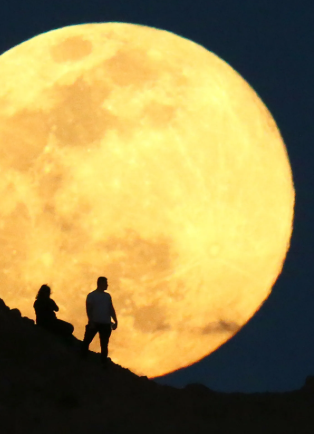
Two silhouetted figures pause on a hillside to admire a giant golden supermoon glowing against the night sky, highlighting the scale and wonder of the celestial scene.

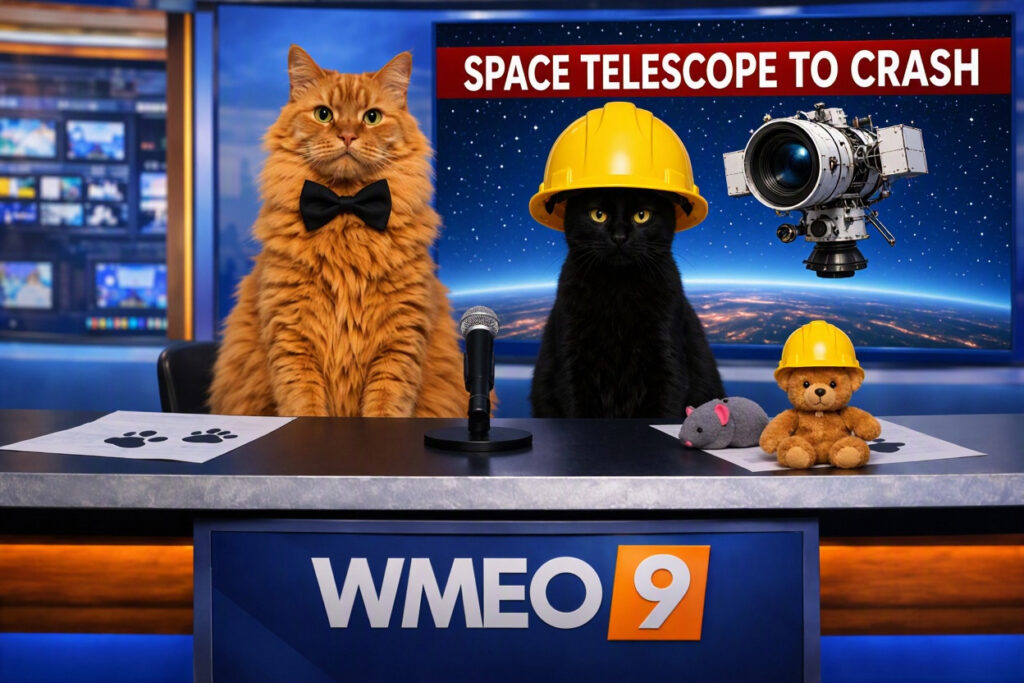
WMEO Breaking News: Space Telescope about to Crash!

WMEO News desk broadcast featuring Banner and Balboa reporting on a falling space telescope. Banner, an orange tabby cat wearing a black bow tie, sits calmly at the anchor desk while Balboa, a black cat wearing a bright yellow hard hat, sits beside him. Behind them, a large newsroom screen displays the headline “SPACE TELESCOPE TO CRASH” alongside an image of a space telescope orbiting above Earth. A microphone sits between the anchors. On the desk are papers marked with paw prints, a toy mouse, and a teddy bear wearing its own tiny yellow hard hat. The front of the desk displays the WMEO 9 logo.

WMEO News Flash: Swift’s Final Descent

A bold “BREAKING NEWS” graphic with white capital letters centered on a dynamic background of red, orange, and yellow streaks. The design conveys urgency and motion, resembling a television news alert banner.

This is WMEO 9 Breaking News            We Meow- You Listen

Banner: Good afternoon. We interrupt our regular programming for this WMEO News Flash. NASA’s Neil Gehrels Swift Observatory is expected to reenter Earth’s atmosphere any day now  after efforts to save the spacecraft failed.

Balboa: Failed.

Banner: Failed.

Balboa: That’s not my favorite word.

Banner: The Swift Observatory has spent years studying some of the most energetic events in the universe, including gamma-ray bursts, black holes, and exploding stars.

Balboa: And now it’s studying gravity.

Banner: A private robotic mission recently attempted to raise Swift into a higher orbit and extend its life.

Balboa: A noble plan.

Banner: Unfortunately, the mission was unsuccessful.

Balboa: And that’s when I ordered the hard hat.

Banner: The observatory is now expected to make an uncontrolled reentry into Earth’s atmosphere.

Balboa: “Uncontrolled” is not helping.

Banner: Experts expect much of the spacecraft to burn up during reentry.

Balboa: Much.

Banner: Much.

Balboa: Not all.

Banner: Potentially not all.

Balboa: That’s how math works, Banner.

Banner: The risk to any individual person remains extremely low.

Balboa: That’s what the telescope wants us to think.

Banner: The telescope doesn’t think.

Balboa: That’s exactly what makes it dangerous.

Banner: We now go live to Pumpkin Spice with Team WMEO’s field report.


[Cut to Pumpkin Spice aboard a ship at sea.]

Pumpkin Spice reports live from the deck of a ship during a WMEO News Flash about the expected reentry of a space telescope. The orange tabby field reporter wears an orange life jacket, a black hat decorated with autumn leaves, and a pair of binoculars while holding a WMEO-branded microphone. Behind Pumpkin Spice, blue ocean waves stretch to the horizon where several naval vessels can be seen in the distance. A large seagull flies overhead near the reporter. The scene suggests a serious maritime news assignment, despite the unusual mission of watching for a falling space telescope.

Pumpkin Spice: Thank you, Banner. I am reporting from the Atlantic Ocean, where experts believe any surviving debris would most likely land.

Balboa: MOST LIKELY.

Pumpkin Spice: Yes.

Balboa: Not definitely.

Pumpkin Spice: No.

Balboa: That’s why you’re there.

Pumpkin Spice: I still don’t understand why I’m here.

Balboa: If the telescope lands in the ocean, WMEO will have exclusive coverage.

Pumpkin Spice: How?

Balboa: You’ll point at it.

Pumpkin Spice: So far I’ve observed several waves and one suspicious seagull.

Balboa: Continue monitoring both.


[Back at the News Desk]

Banner: NASA continues to track the telescope’s descent and will refine predictions as reentry approaches.

Balboa: Good. Someone should.

Banner: NASA stresses there is no cause for alarm.

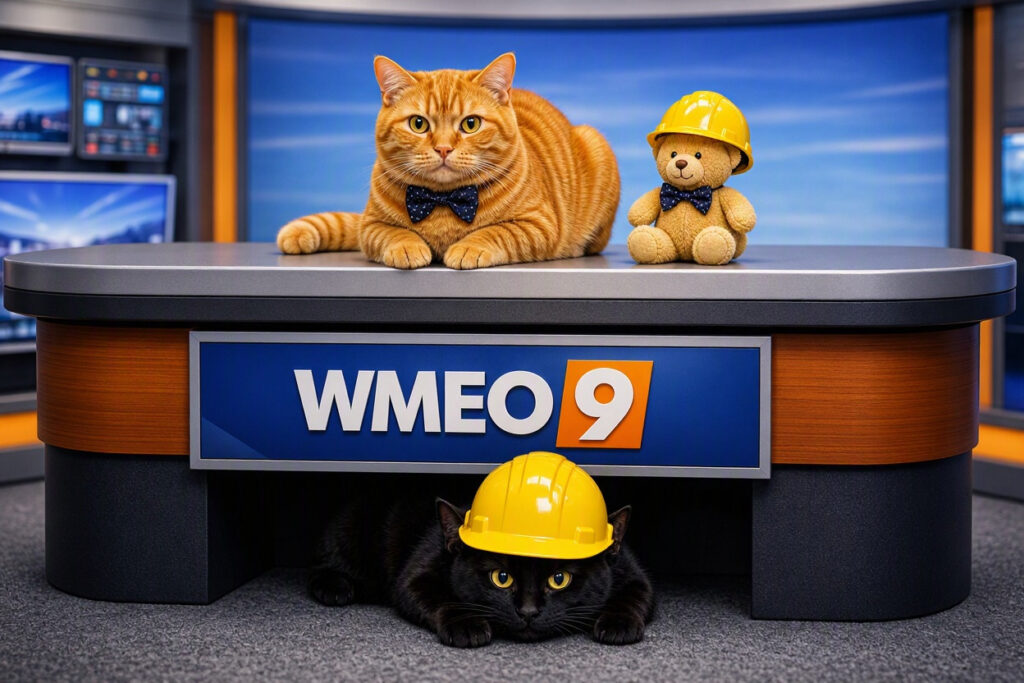
At the WMEO 9 news desk, Banner, an orange tabby cat wearing a dark bow tie, remains calmly at the anchor position while Balboa, a black cat wearing a yellow construction hard hat, hides beneath the desk with only part of his body visible. A teddy bear wearing its own yellow hard hat sits beside Banner on top of the desk. The WMEO 9 logo is displayed on the front of the anchor desk. The newsroom background features television monitors and studio lighting. The image humorously suggests that Banner is continuing the broadcast while Balboa has taken cover during a report about a falling space telescope.

Banner: Balboa, what are you doing?

Balboa: Implementing Phase Seven.

Banner: What happened to Phases One through Six?

Balboa: They failed.

Banner: What were they?

Balboa: Mostly screaming.

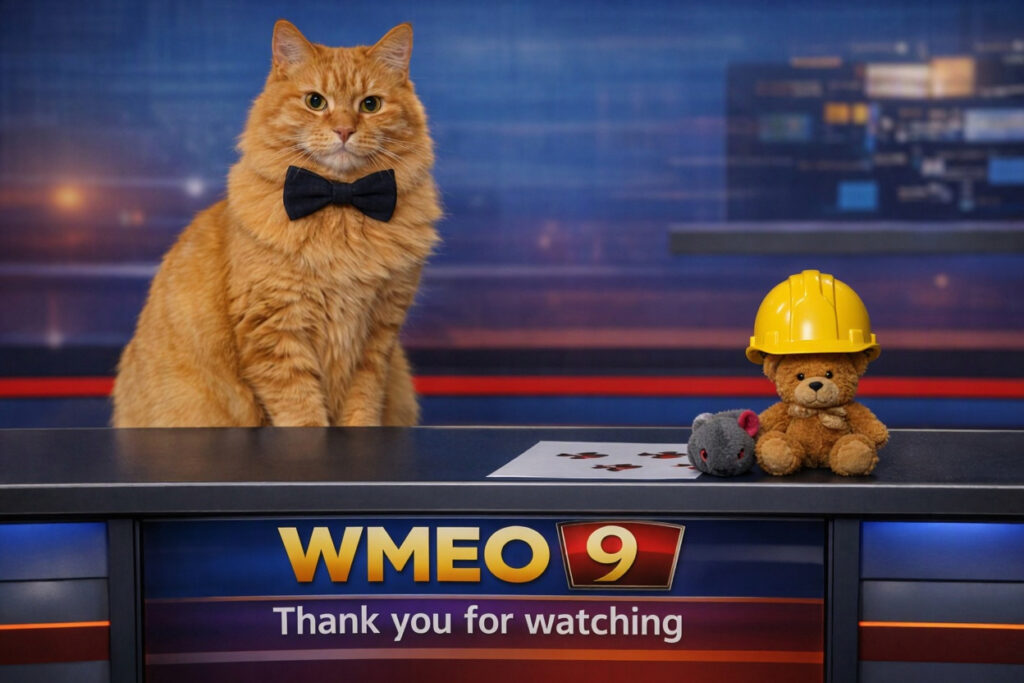
The WMEO News broadcast signs off from the newsroom desk. Banner, an orange tabby cat wearing a dark bow tie, sits behind the anchor desk. Beside Banner are a gray toy mouse and a teddy bear wearing a yellow construction hard hat. The front of the desk displays the WMEO 9 logo and the message “Thank you for watching.” Balboa is notably absent from the desk following a news report about a falling space telescope, leaving the teddy bear and toy mouse to assist Banner with the broadcast's closing moments.

Banner: For WMEO News, I’m Banner.

Balboa: (from under the desk) Stay alert. Stay safe. Watch the skies.

This Has been a WMEO 9 Breaking News Alert- Please resume your regular Scrolling


The Great American Eclipse of 2017

What did you think of the Eclipse?solar eclipse

What were you doing and where were you when the Great American Eclipse took place Monday? It was billed as a once in a lifetime event but that’s not really true. America was treated to a solar eclipse 38 years ago on February 26, 1979. The difference between then and now is that the path of totality in 1979 was the Pacific Northwest. This one is called The Great American Eclipse because it can only be seen in the US. It started over Oregon and ended near Charleston, SC.

Path of Totality

Starting around 10 am local time in Oregon it traveled across the US at an amazing 1700 mph. The whole thing was over in about 1.5 hours. Kentucky experienced most of the action with the sun blocked out for around two minutes and 41 seconds. We only got a partial eclipse here in Massachusetts but it was still very interesting. In fact I found I was much more excited when I actually saw it than in thinking about it.

partial eclipseI wish I Could Have a “Do Over”

I didn’t get excited about the eclipse until about the week before. After a mad scramble I got my hands on some glasses. But it was on the whale watch Sunday that I really figured out how I messed up. I was in the office hard at work through the whole eclipse. Well most of it anyway. I did step out for part of it. But the office is surrounded by trees so the viewing area is a bit obscured. Lots of people from other offices were watching.  I should have taken the day off and gone out on a boat trip. Talk about a wide open view!

Amazing World of Technology

I made sure that I wasn’t too left out even if I was stuck in the office. NASA, Facebook, U Tube were just a few of the online sources for viewing. I could watch the moon taking a bite out of the sun in Oregon! Isn’t technology amazing?

Next Time

The next solar eclipse that is going to cover America is April 8, 2024. April can be cloudy and chilly. No guarantee I’ll be able to get any better views then. Best to make the most of this one. I would love to see a Total eclipse now that I’ve gotten a taste of a partial. What about you?