Creamsicle Shark of Costa Rica: Nature’s Sweetest Surprise
Somewhere off the Caribbean coast of Costa Rica, nature whipped up a treat that’s part shark, part sherbet, and all spectacle. Meet the Creamsicle Shark—a nurse shark with a rare genetic twist that turned it a glowing shade of orange, like it swam straight out of a popsicle ad.

Stock photo
Catch & Release- Its still out there
Local fisherman Garvin Watson reeled in the citrus-hued creature near Tortuguero National Park, and the reaction was pure delight. “It looked like an alien,” he said, as the crew snapped photos and squealed like kids spotting a unicorn in the surf. The shark was released unharmed, but its legend is just beginning.
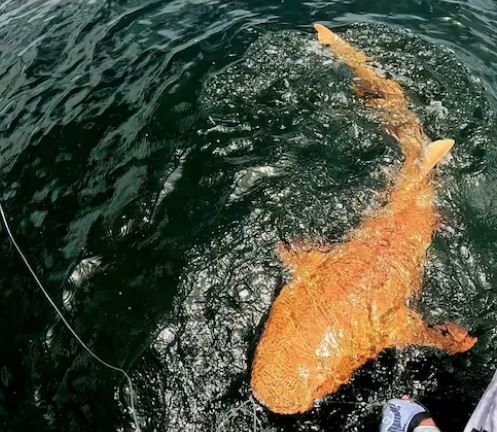
Photo Credit (Garvin Watson/Parismina Domus Dei
Scientists later confirmed this was no ordinary catch. The shark had both xanthism (a condition that boosts yellow pigmentation) and albinism, making it a one-in-a-million marvel. It’s the first documented case of xanthism in a nurse shark—proof that even the deep sea has a flair for drama.
If this creamsicle-colored wonder has you dreaming of underwater worlds, why not bring a splash of the ocean home? A well-designed aquarium can be a tranquil centerpiece, a sensory escape, and a nod to nature’s whimsy. [Affiliate link to aquariums] 🐠

Amazon
Whether you’re a marine biology buff or just love a good sea story, the Creamsicle Shark reminds us that the ocean still holds sweet surprises. And sometimes, they come in orange.
____________________________________________________________________________________________________________
 Aye Calypso, I sing to your spirit

 Evidence of Volcano Activity is Everywhere


 The Land of the Midnight Sun


 There was a Naturalist on board for the cruise through College Fjord. We’d just entered the mouth of the Fjord when they announced that we could see mountain goats on the mountain sides. Although I looked like crazy I couldn’t see anything that I could say for sure were animals of any kind. We kept watch for marine mammals like whales and porpoises but only one unidentified animal showed it’s head.