Whatever Happened to Thanksgiving Music?

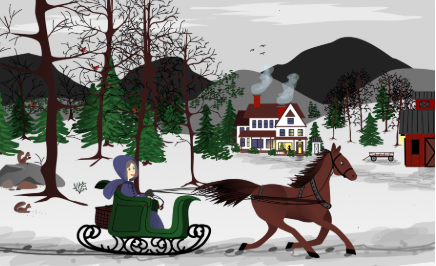
Illustrated Horse and Sleigh in a winter scene

How Thanksgiving Lost the Battle for Holiday Music

Think about the competition.

October belongs to Halloween. Between Monster Mash, The Purple People Eater, The Addams Family Theme, and Michael Jackson’s Thriller, spooky season has built a playlist that generations recognize immediately.Michael Jackson's Thriller
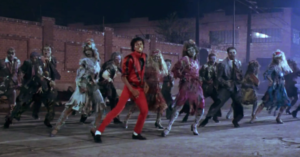
Then, almost before the Halloween candy is gone, Christmas music begins its annual takeover. Radio stations switch formats. Stores start playing holiday music. Suddenly it’s wall-to-wall Christmas songs.

Thanksgiving never really gets a chance.

It’s the middle child of the holiday season, wedged between monsters and mistletoe.

That raises an interesting question: why are there so few Thanksgiving songs?

Thanksgiving’s Most Famous Song Started as a Poem

When most people think of Thanksgiving music, one title immediately comes to mind: Over the River and Through the Wood.

What many people don’t realize is that it began as a poem rather than a song. Written by Lydia Maria Child in 1844, it was originally titled A Boy’s Thanksgiving Day.
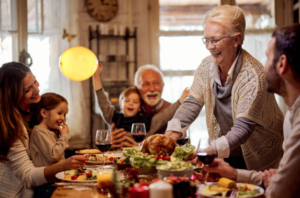
Family  around a Thanksgiving tableThe poem tells the story of a family’s journey to celebrate Thanksgiving with relatives, a tradition many Americans still share today.

There’s also a local connection. Child was born in Medford, Massachusetts, giving New England a special place in Thanksgiving musical history.

More than 180 years later, generations of children can still recite at least the opening lines.

The Thanksgiving Song That Got Away

Thanksgiving once had something else going for it.

Jingle Bells.

Today, it’s impossible to imagine the song as anything but a Christmas classic. Yet it was originally written for aHarnessed horse with bells on it tack Thanksgiving program and eventually became associated almost entirely with Christmas.
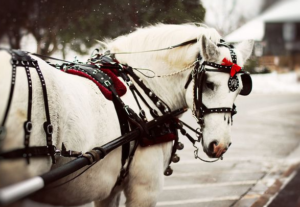
If Thanksgiving had managed to keep Jingle Bells, its musical reputation might look very different today.

Instead, Christmas claimed the song and never looked back.

Poor Thanksgiving.
peaceful winter scene with churchA Hymn Hiding in Plain Sight

Then there’s We Gather Together.

Many people probably don’t think of it as a Thanksgiving song at all. I know I didn’t. Growing up, it was simply one of the hymns we sang in church.

Yet for generations it has been closely associated with Thanksgiving celebrations and services. Its themes of gratitude and gathering with loved ones fit perfectly with the holiday.

Unlike Jingle Bells, which wandered off into Christmas territory, We Gather Together has remained quietly loyal to Thanksgiving.

Adam Sandler Saves Thanksgiving

Fast forward to 1992.

While Thanksgiving’s traditional songs focused on gratitude and family gatherings, Adam Sandler took a different approach on Saturday Night Live.

His now-famous Thanksgiving Song was unapologetically silly and centered on one of the holiday’s most beloved traditions: eating.

Lots of eating.

The song may not have the historical significance of Over the River and Through the Wood, but it has probably introduced more modern Americans to Thanksgiving music than almost anything written in the last several decades.

Why Thanksgiving Never Got a Soundtrack

Maybe the real mystery isn’t which Thanksgiving songs exist.

Maybe it’s why there aren’t more of them.

Think about the competition.

October belongs to Halloween. Between Monster Mash, The Purple People Eater, and The Addams Family Theme, spooky season has built a playlist that generations recognize immediately.

Then, almost before the Halloween candy is gone, Christmas music begins its annual takeover. Radio stations switch formats. Stores start playing holiday music. Suddenly it’s wall-to-wall Christmas songs.

Thanksgiving never really gets a chance.

It’s the middle child of the holiday season, wedged between monsters and mistletoe.

While Halloween has an entire soundtrack and Christmas has an entire industry, Thanksgiving is left with a nineteenth-century poem, a church hymn, an adopted Christmas classic, and a comedy song about turkey.

A Seat at the Table

Despite its modest collection of music, Thanksgiving still has songs worth remembering.

Whether it’s families traveling “over the river and through the wood,” congregations singing We Gather Together, or Adam Sandler celebrating turkey with his trademark humor, each represents a different part of the holiday.

So this Thanksgiving, before Jingle Bells takes over for another season, take a moment to appreciate the holiday’s small but interesting musical legacy.

Thanksgiving may never compete with Thriller, Monster Mash, or the seemingly endless catalog of Christmas music, but it has contributed a few memorable songs of its own.

After all, it’s hard to build a holiday soundtrack when you’re stuck between zombies and Santa Claus.
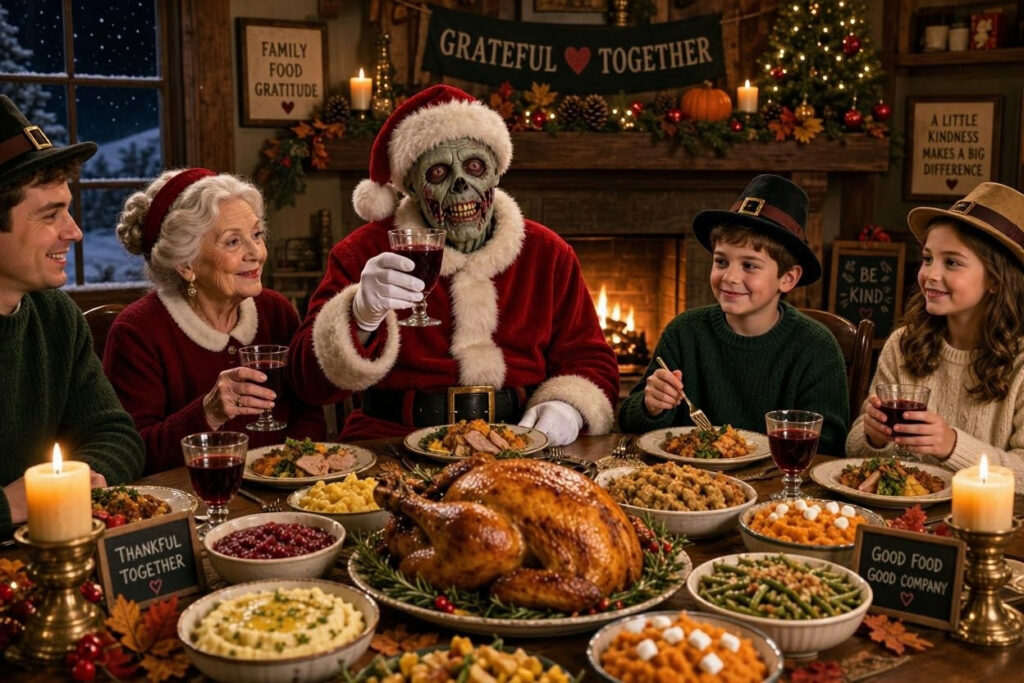
Zombie Santa Claus sits at a Thanksgiving dinner table with a family wearing pilgrim hats, surrounded by turkey, side dishes, autumn decorations, and Christmas decorations in the background.


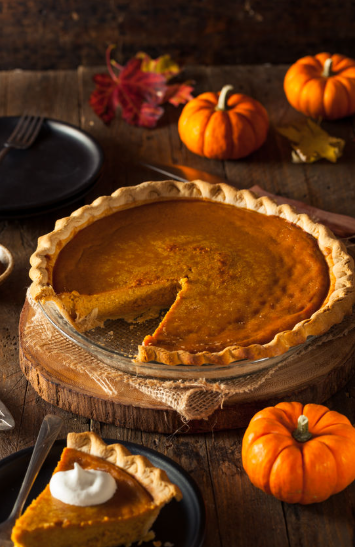
What’s Thanksgiving without Pumpkin Pie?

A homemade pumpkin pie with a flaky golden crust sits on a wooden board atop a rustic wooden table. One slice has been removed from the pie, and a separate slice topped with whipped cream rests on a dark plate in the foreground. Small orange pumpkins and colorful autumn leaves are scattered around the table, creating a warm Thanksgiving-themed scene.

Easy Pumpkin Pie

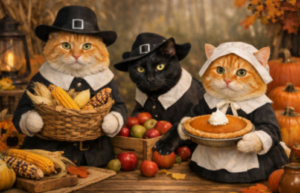
Three cats dressed in Pilgrim-style Thanksgiving clothing pose around a festive autumn display. An orange tabby cat on the left holds a basket filled with corn, a black cat in the center sits among apples, and another orange tabby cat on the right holds a pumpkin pie topped with whipped cream. Small pumpkins, ears of corn, colorful fall leaves, and rustic decorations surround the cats, creating a warm Thanksgiving harvest scene.What would Thanksgiving be without pumpkin pie?
In fact, pumpkin pie is so ingrained in our Thanksgiving traditions that in 1705, Colchester, Connecticut, canceled Thanksgiving because residents couldn’t make pies. OK, I’ll be honest, they only delayed it, but it’s more fun to say it was canceled.
Back in those days, molasses was often used as a sweetener more frequently than sugar. When early winter storms blocked molasses shipments, the town found itself facing a Thanksgiving without pie. No molasses, no pie.
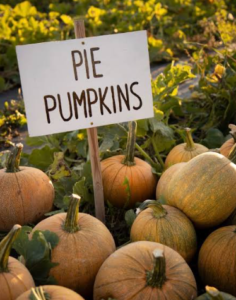
Rather than celebrate without their favorite dessert, residents voted at a town meeting to postpone Thanksgiving until a shipment of molasses arrived. Talk about taking pumpkin pie seriously!A collection of small orange pie pumpkins sits in a pumpkin patch surrounded by green leaves and vines. A white hand-lettered sign reading "PIE PUMPKINS" stands among the pumpkins, with warm sunlight illuminating the autumn harvest scene.
Fortunately, making a delicious pumpkin pie today is much easier. Unless you’re a purist who insists on making pie crust from scratch and processing a fresh pie pumpkin, this recipe comes together quickly with a handful of pantry staples. No pumpkin to peel, no molasses to track down, and no additional sugar required.
And unlike the residents of 1705 Colchester, Connecticut, you won’t have to postpone Thanksgiving dinner to make it!

Easy Pumpkin Pie

Servings: 8
Prep Time: 10 minutes
Cook Time: 46 minutes
Ready In: 56 minutes

Ingredients

  • 1 (9-inch) refrigerated pie crust (store-bought)*
  • 1 (15-ounce) can pumpkin puree (not pumpkin pie filling)
  • 1 (14-ounce) can sweetened condensed milk
  • 2 large eggs
  • 2½ teaspoons pumpkin pie spice**
  • ¼ teaspoon salt

Instructions

  1. Place the oven rack in the lowest position and preheat the oven to 425°F.
  2. Thaw the pie crust according to package directions. Unroll and fit into a pie dish. Decorate the edges if desired.
  3. In a large bowl, whisk together the pumpkin puree, sweetened condensed milk, eggs, pumpkin pie spice, and salt until smooth and well combined.
  4. Pour the filling into the prepared pie crust and gently level the surface. Place the pie on a baking sheet. If desired, cover the crust edges with aluminum foil to prevent over-browning.
  5. Bake on the lowest oven rack for 15 minutes. Without removing the pie, reduce the oven temperature to 350°F and continue baking for 35 to 40 minutes, or until the filling is nearly set and no longer jiggles when moved.
  6. Transfer to a wire rack and cool for at least 2 hours before slicing. For a chilled pie, let it stand at room temperature for 1 hour, then refrigerate for at least 2 additional hours.

Notes

  • A homemade pie crust works perfectly with this recipe. For best results, partially blind bake it first to help prevent a soggy bottom crust.
** No pumpkin pie spice? Substitute:
  • 1½ teaspoons cinnamon
  • ½ teaspoon nutmeg
  • ¼ teaspoon ginger
  • ¼ teaspoon cloves

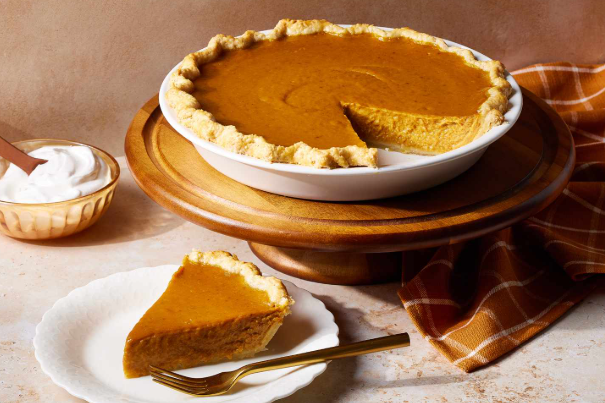
A golden-brown pumpkin pie sits on a wooden cake stand, with one slice removed to reveal the smooth orange filling. A slice of pie rests on a white plate in the foreground beside a gold-colored fork. A small bowl of whipped cream sits nearby, and a warm-toned plaid napkin adds an autumn touch to the cozy tabletop scene

Happy Thanksgiving from our kitchen to yours!

Beyond the Wilderness: Discovering Alaska’s Living Cultures


Panoramic view of a glacier flowing from a broad valley between snow-covered mountain peaks in Alaska's College Fjord. The glacier stretches toward calm blue water in the foreground, where the icy shoreline and mountain reflections create a serene winter landscape beneath a clear blue sky.

College Fjord Glaciers

Alaska Wasn’t What I Expected

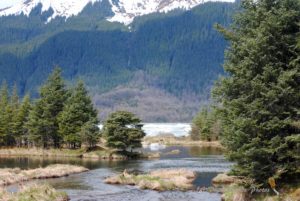
Mendenhall Lake in Alaska framed by evergreen trees, with a calm water channel winding through small grassy islands in the foreground. Snow-capped mountains rise in the background, and a pale blue glacier is visible between the trees beneath an overcast sky.What do you think of when you think of Alaska?
I’ve been trying to remember what I thought when my sister first suggested we take a vacation to Alaska. It was 13 or 14 years ago. We had to plan and book the trip well in advance, so we were probably talking about it as early as 2012.

Alaska. It’s big, and it’s far away. Maybe not as far away as Hawaii, but it certainly isn’t next door. I think of wilderness, rugged landscapes, and endless open spaces. I remember being surprised to learn how limited the road system is. Many communities can only be reached by boat or plane. Even today, Juneau remains unique as the only U.S. state capital that cannot be reached by road from the rest of North America. There is no highway connecting it to either the Alaska road system or Canada.

A First Introduction to Alaska Native Culture

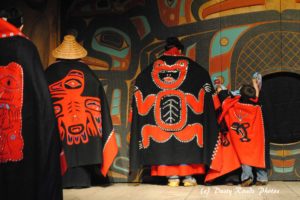
My first real introduction to Alaska Native culture came in Ketchikan. Before that trip, I hadn’t given much thought to theTlingit ceremonial robes Indigenous peoples of Alaska. Like many people, I probably associated Alaska with “Eskimos,” which doesn’t even begin to reflect the diversity of cultures that call the state home.
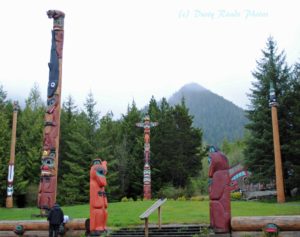
While in Ketchikan, we took a shore excursion to Saxman Native Village, a working Tlingit community. We watched a ceremonial dance performance, visited a master woodcarver, and admired beautifully carved totem poles. At the time, I thought I was learning a lot. Looking back, I realize we had barely scratched the surface.

A collection of brightly painted Indigenous-style totem poles stands in a green park surrounded by dense conifer forest. Two carved figures face each other in the foreground beside an informational sign, while a mountain peak is visible through the cloudy sky behind the trees.One of the things that surprised me was discovering just how culturally diverse Alaska really is. The state is home to many Native peoples, each with their own traditions, languages, stories, and connections to the land. These aren’t cultures preserved only in museums or history books. They continue to be part of daily life in communities throughout Alaska, where traditions are passed from one generation to the next while adapting to the modern world.
One thing I did learn was that photography can be a sensitive subject. The village we visited welcomed visitors and was very open to photographs, but that isn’t true everywhere. It’s always a good idea to ask permission before photographing people, especially if they are participating in ceremonies or wearing traditional clothing.

Visiting With Respect

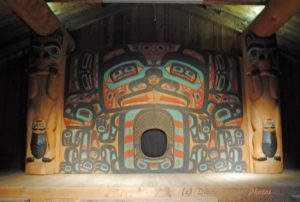
We were fortunate to have a guide during our visit to Saxman Native Village. Before we arrived, he explained the customs,Interior of the Tlingit Beaver Clan House featuring a large, colorful painted clan crest on the back wall. The design includes bold Indigenous Northwest Coast formline artwork in red, teal, black, and white surrounding a central oval doorway. Tall carved wooden posts stand on either side of the room, and exposed timber beams frame the dimly lit ceremonial space. expectations, and proper etiquette. Those insights helped us understand not only what we were seeing, but why it mattered.

It’s a privilege to visit these communities and learn about cultures that have thrived in Alaska for thousands of years. Respecting local traditions helps ensure that visitors and residents alike can share these experiences in a meaningful way.

For travelers who want a deeper understanding of Alaska’s cultures, history, and traditions, a knowledgeable local guide can provide insights that go far beyond what you’ll find in a guidebook. Guided experiences offer opportunities to ask questions, learn the stories behind what you’re seeing, and gain a greater appreciation for the people who have called Alaska home for generations. One resource worth exploring is GoWithGuide, which connects travelers with local guides for customized tours and cultural experiences throughout Alaska and destinations around the world. 


More Than Mountains and Glaciers

Alaska is beautiful and wild, filled with breathtaking landscapes, towering glaciers, and an abundance of wildlife. It’s easy to get caught up in the excitement and wonder of a place like this, and honestly, that’s part of the experience.

Large unfinished wooden eagle carving being held overhead inside a workshop. The oversized eagle figure has a smooth, light wood surface and a prominent curved beak. Exposed wooden beams, windows, and woodworking equipment are visible in the background.But while you’re admiring the scenery, I would encourage you to take a moment to look beyond the views and learn about the people who have called this remarkable land home for thousands of years. Meeting Alaska’s Native peoples, hearing their stories, and gaining a better understanding of their traditions added a whole new dimension to our trip.
Long after the glaciers, whales, and mountains fade into memory, those cultural experiences are often the ones that stay with you. They remind us that Alaska is more than a beautiful destination. It’s a living, vibrant place shaped by generations of people whose connection to the land continues today.

For me, that was one of the most enriching parts of the journey.

Affiliate Disclosure: Some of the links in this post are affiliate links. That means if you decide to make a purchase through them, I may receive a small commission at no extra cost to you. I only recommend products and services that I believe may be helpful to my readers. Thank you for your support.

Why Poppies?


Sometimes it’s nice to know the why behnd the traditions. We see the poppies. The Little paper  flowers are handed out on street corners for Memorial Day and Veterans’s Day. But they are more than a “thanks for your donation”. Here’s the Why…

https://arounddustyroads.com

🌺 Did You Know?

Many people wear a remembrance poppy to honor those who served, but the design itself also carries meaning.
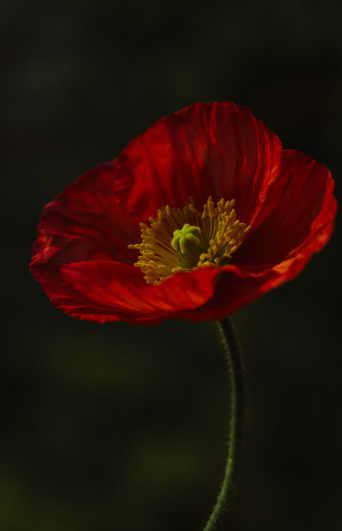
The red petals symbolize sacrifice, while the black center represents remembrance. Some people wear the leaf at the 11 o’clock position as a tribute to the 11th hour of the 11th day of the 11th month, when the guns fell silent at the end of World War I.
Whether worn at 11 o’clock, over the heart, or another way, the most important thing is remembering the men and women who served and sacrificed for our freedom.
❤️ Thank you, veterans.

May Day: The Traditions, the Mischief, and the Magic of May 1st


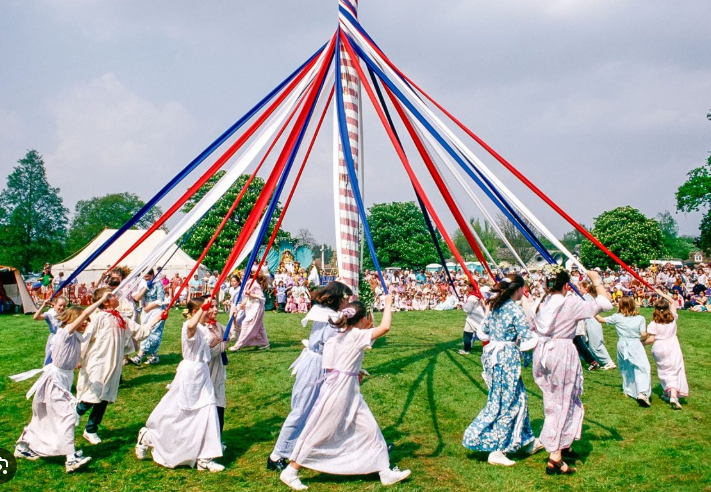
🌼“Kids holding colorful ribbons as they dance around a tall maypole on a sunny May Day, with families watching from the crowd.”

I haven’t revisited May Day for a few years — fifteen, to be exact — but who’s counting. If you’re curious (or just in the mood for a laugh), you can see that original 2011 post here. May Day.

May Day is one of those holidays everyone’s heard of, but almost no one can fully explain — which is probably why it’s so much fun to write about. Depending on who you ask, May 1st is about flowers, bonfires, maypoles, ancient goddesses, or childhood memories of weaving ribbons around a pole without tripping over your classmates. And honestly? All of those answers are right.

🌸 A Holiday Older Than… Well, Almost Everything

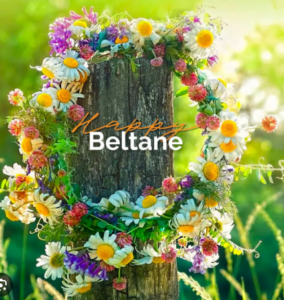
May Day goes all the way back to the ancient world. The Romans celebrated Floralia, a weeklong festival honoring Flora, the goddess of youth, spring, and flowers. When they reached the British Isles, their festival collided with the Celtic celebration of Beltane, also held on May 1st — a fire festival marking the start of summer. Over time, the two blended into what we now recognize as May Day.

🌿 “Bringing in the May”

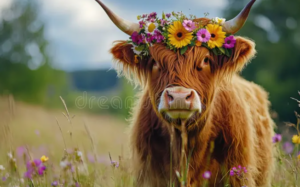
By the medieval period, May Day was the spring holiday across Europe. Villagers would wake up early to gather flowers and greenery — a tradition called “bringing in the May.” They decorated homes, barns, and even livestock with blossoms to welcome the season.

🎀 The Maypole (and the Competition to Have the Tallest One)

At the center of the festivities stood the maypole — usually a tall birch tree pulled into town by flower‑decked oxen. People danced around it holding colorful ribbons, weaving patterns as they went. Some towns even competed to see who could raise the tallest or most impressive pole.

👑 The May Queen

Many villages crowned a May Queen, a young woman chosen to preside over the day’s games, dances, and pageantry. Think of it as the original spring influencer — minus the hashtags.

🔥 Bonfires, Dew, and a Little Magic
In some regions, May Day included bonfires — a holdover from Beltane — and people believed washing your face in May morning dew would bring good luck and beauty for the year ahead. (Honestly, that one might be worth trying.)

🌼 And Then There’s New England…

Here in New England, the Puritans were not fans. When an Anglican merchant erected a maypole at Merry Mount (today’s Quincy) in 1627, the neighboring Puritans chopped it down and shipped him back to England. No sense of whimsy, those folks.

So while the Puritans may have tried to shut the whole thing down (party poopers, the lot of them), May Day survived — flowers, maypoles, mischief and all. And honestly? I think that’s worth celebrating. Even if the only dancing you do is from the coffee maker to the couch.