A Miracle Comeback Nine Years in the Making

Rustic log cabin in Rangeley, Maine surrounded by trees and summer greenery, the lakeside vacation rental where I stayed during my 2017 moose‑spotting trip.

A Quiet Cabin, an Empty Town, and a Mountain Waiting for a Miracle

A Moose heading for the treesIn 2017 I chose Rangeley for my summer vacation because I wanted to see Maine moose. And I did — moose, deer, and more quiet forest roads than I could count. But I also found a town on a beautiful lake that was struggling.

Saddleback, their ski mountain, was closed. Talk of a sale floated around like fog over the lake, but I can’t say the atmosphere was hopeful. Most people didn’t expect anything to come of it. Rangeley has plenty to offer if you love the outdoors — hiking, camping, nature photography — but in town the restaurants were either closed or empty. My cabin was beautiful, but I didn’t see many other vacationers around. It felt like a place waiting for something that might never come- a town holding its breath for a miracle.

So I’ve always wondered: What happened to Rangeley in the nine years since that visit?

Well, COVID didn’t stop the little town that could. In 2020, the sale of Saddleback finally went through — and everything changed.

The mountain woke up again

After years of false starts, Saddleback was purchased by Arctaris Impact Investors, a Boston‑based firm focused on revitalizing rural communities. And they didn’t just buy the mountain. They revived it.

More than $42 million has been invested since 2020. New lifts, new snowmaking, lodge improvements, a new T‑bar, a high‑elevation restaurant, and even a 7.5‑megawatt solar farm that produces twice the electricity the mountain uses.

It’s the kind of transformation you expect from a mega‑resort, not a once‑shuttered independent ski hill in western Maine.

Rangeley’s winter heartbeat returned

The reopening didn’t just bring skiers back — it brought life back.

Saddleback created 240+ jobs, built workforce housing, and restored the winter economy that had been fading when I visited. Restaurants filled up again. Lodges booked out. Seasonal workers could count on steady income. The town’s identity — which felt fragile in 2017 — snapped back into place.

It’s hard to overstate how much a single ski mountain can mean to a rural town. In Rangeley’s case, it meant everything.

From shuttered to #1 in the East

This is the part that still amazes me.

In 2025, SKI Magazine’s readers ranked Saddleback #1 ski resort in the East.

Number one. In the entire East. After being closed for five years.

If you wrote that in fiction, people would say it was unrealistic.

A different kind of ski mountain

What makes Saddleback’s comeback special isn’t just the money or the lifts — it’s the philosophy behind it.

They’re leaning into:

  • Independence — no mega‑pass, no corporate sameness
  • Sustainability — that solar farm is a game‑changer
  • Community — housing, childcare support, year‑round jobs
  • Authenticity — the “real ski mountain” vibe people crave

In a world where so many ski areas feel interchangeable, Saddleback is intentionally not trying to be anything but itself.

Weather still rules the game

Of course, skiing is still skiing. Warm spells still happen. Rain still happens. Gas prices still matter. Travel budgets still matter.

But Saddleback is far more resilient now than it was in 2017. Better snowmaking, better infrastructure, and a broader year‑round recreation economy give Rangeley a buffer it didn’t have before.

Looking back at that 2017 trip

When I think about that quiet summer week — empty restaurants, shuttered lifts, locals who didn’t dare hope — it makes Saddleback’s comeback feel even more remarkable. Rangeley didn’t just survive. It reinvented itself.

A comeback nine years in the making — and absolutely worth celebrating. I can honestly say that I love a happy ending! Rangely, Maine got it’s miracle. 

The Red Onion


America the Beautiful- Unique and Wonderful

America’s One‑of‑a‑Kind Wonders

Every country has its own personality — its language, its customs, its landscapes, its quirks. The United States is no different. We just forget that sometimes because we live here. We stop noticing and we stop looking. So I thought it might be fun to highlight a few things that make the USA truly unique — places and experiences you won’t find anywhere else. Let’s see how many you’ve done.

Mammoth Cave, Kentucky

Did you know the world’s longest cave system is right here in the USA? Mammoth Cave National Park stretches for more than 400 miles beneath Kentucky’s bluegrass hills. It’s not just big — it’s ancient. You can wander through massive underground chambers, squeeze through narrow passages, and walk routes first explored centuries ago. It feels like stepping into another world.

Route 66

The Mother Road turns 100 years old this year. Maybe this is the perfect time to drive the whole thing from Chicago to Santa Monica. Route 66 is pure Americana — neon signs, retro diners, roadside oddities, and nostalgia for a simpler time. Expect celebrations and events all along the way for its centennial.


Old Faithful, Yellowstone

If nature is more your style, Yellowstone is unmatched. The park has over 10,000 hydrothermal features — hot springs, mud pots, fumaroles, terraces, and of course Old Faithful. It’s the most predictable geyser on earth, erupting roughly every 90 minutes and shooting boiling water up to 184 feet into the air. It’s a natural wonder worth seeing at least once.


Four Corners Monument

This is the only place in America where you can stand in four states at once — Utah, Colorado, Arizona, and New Mexico. There’s not much to do except take the classic selfie, but it’s still fun to say you’ve been in all four at the same time.

Below Sea Level… Without Getting Wet

New Orleans offers more than Mardi Gras. Parts of the city sit below sea level, protected by levees and pumps — a precarious setup made painfully clear during Hurricane Katrina. Only a few places in the world build this boldly against the water. The Netherlands comes to mind — think of the little Dutch boy with his finger in the dike.

Bayou Bridge , City Park, New Orleans

Space Launches in Florida

Head to sunny Florida and watch rockets roar into space. Feel the ground shake, hear the thunder, and witness the sheer power of a launch. It’s one of those experiences that reminds you what humans are capable of.

The Redwood Forests of California

These giants are the tallest trees on earth — some reaching 350 feet. Many are between 500 and 2,000 years old. Imagine that. Two thousand years. They were already ancient when the first European explorers arrived.

Yes, It’s Corny

In Mitchell, South Dakota, you’ll find the Corn Palace — redesigned every year with new murals made entirely of corn. It’s quirky, it’s colorful, and yes… it’s corny. But it’s also wonderfully American.

Visit with Bison

While you’re at Yellowstone, take a moment to appreciate the wildlife — especially the bison. They roam freely and can do serious damage if you get too close, so admire from a safe distance. You can also see them in Custer State Park in South Dakota.

Getting ready to pass by

There are so many uniquely American things to do in this great country — watch a rodeo, tour an aircraft carrier, feed a wild burro a carrot, ride an airboat, marvel at Mount Rushmore, stand in the mist at Niagara Falls, or gaze into the Grand Canyon. There’s nothing quite like the Grand Canyon.

It’s our 250th anniversary. A perfect time to celebrate the sights, scenes, and culture that make America special.

Where have you been? What makes America special for you?


The Day Roswell Landed on the Map


“A glowing disc‑shaped UFO hovering in a dark, misty night sky, shining bright green beams of light onto the ground below.”

Seventy‑nine years ago today, on July 8, 1947, the Roswell Army Air Field casually announced they’d recovered a “flying disc.” Just tossed it into the news like someone found a lost hubcap in the desert.

By the next day, the Army said, “No no, wait — it was a weather balloon.” And that was the moment America collectively raised an eyebrow and said, “Sure it was.”

That tiny headline didn’t just make the local paper — it put Roswell, New Mexico on the map. Before the “crash,” it was a quiet desert town. After the “crash,” it became the Alien Capital of the World, complete with:

  • UFO museums
  • alien‑themed diners
  • green‑skinned mascots
  • and an annual festival that looks like Comic‑Con met Area 51

All because someone typed “flying disc” before their morning coffee.

The whole modern UFO craze — the sightings, the documentaries, the late‑night radio callers, the government cover‑up theories — traces back to that one moment in 1947.

And decades later, The X‑Files summed up the entire Roswell vibe with its iconic slogan:

“I want to believe.”

Roswell still does. Do you?


Everyone Loves a Parade

The giant turkey float wearing a blue top hat in the Macy’s Thanksgiving Day Parade, moving past crowds and tall city buildings.”

Massachusetts: More Parades Than You’d Expect

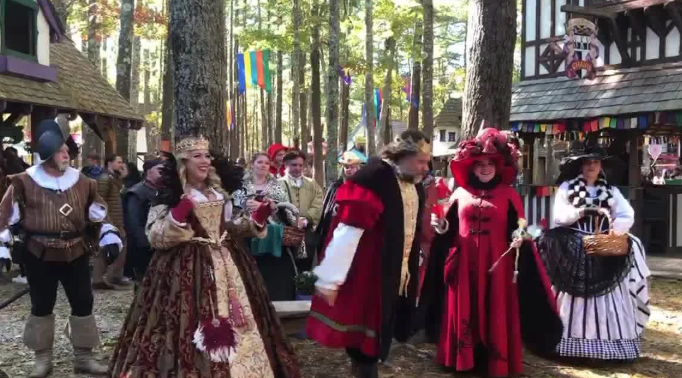
New Orleans has Mardi Gras — and truth be told, probably a parade for something every other week. They’re America’s party town for sure. But Massachusetts has more parades than you might think. We’ve got the big national ones, yes, but we’ve also got some wonderfully quirky, uniquely‑ours traditions.

A Quick Roll Call of Bay State Parades

Here are the ones that come to mind without much effort:

  1. First Night, Boston (New Year’s Eve)
  2. St. Patrick’s Day, South Boston
  3. Patriots’ Day Parade, Concord
  4. Ducklings Day Parade, Boston
  5. Memorial Day Parades, Every Town
  6. Fishtown Horribles Parade, Gloucester
  7. Fourth of July Parades, statewide
  8. Carnival Parade, Provincetown
  9. Haunted Happenings Parade, Salem
  10. America’s Hometown Thanksgiving Parade, Plymouth
  11. Christmas Eve Parade, Lynn

Championship Duck Boats: Our Modern Victory Marches

And then there are the Championship Parades — our modern‑day victory marches. The crowds gather, the duck boats roll out, and the players ride through Boston like triumphant warriors returning from battle. No chariots, but close enough.

St. Patrick’s Day: Southie’s Biggest Tradition

Boston’s St. Patrick’s Day Parade in Southie is one of the oldest and largest in the country. Bagpipes, marching bands, Irish dancers, politicians shaking hands, and half the city wearing green — it’s a celebration that feels like Boston down to its bones. If you’ve never seen South Boston on March 17, you haven’t truly experienced St. Patrick’s Day.

Patriots’ Day: A Parade You Won’t Find Anywhere Else

See that Patriots’ Day Parade? That one is truly unique. Patriots’ Day is strictly a Massachusetts holiday — and some years we even get an extra day to file our federal taxes because we’re special like that.

Ducklings Day: Boston’s Sweetest Tradition

One of the sweetest parades is the Ducklings Day Parade, celebrating the Make Way for Ducklings statue. It’s traditionally held on Mother’s Day and is pure Boston charm.

Fourth of July: Cannons, Fireworks, and Local Flavor

Everyone has a Fourth of July parade, but we go one better with the concert on the Esplanade, complete with cannons and fireworks. And up in Gloucester, they celebrate with the Fishtown Horribles Parade — a wonderfully chaotic, satirical tradition where floats poke fun at political figures, local issues, and whatever else needs a good ribbing.

Provincetown Carnival: Color, Creativity, and Community

Head to the tip of Cape Cod and you’ll find Provincetown’s Carnival Parade, a joyful celebration of diversity and creativity that the town is famous for.

Salem’s Haunted Happenings: Halloween Done Right

Rounding out the unusual lineup is Salem’s Haunted Happenings Parade. Other places may have Halloween parades, but there’s no place like Salem in late October for witches, goblins, and costumed chaos.

Plymouth’s Thanksgiving Parade: History Marches On

And while America crowds around the TV to watch the Macy’s Thanksgiving Day Parade, our own Plymouth — home of the Pilgrims and the first Thanksgiving — holds its America’s Hometown Thanksgiving Parade, a tradition all its own.

Take That, New Orleans

So yes, New Orleans may have Mardi Gras, and Disney may have a parade every time someone sneezes — but here in Massachusetts, we do things our own way. Who else has cannons on the Esplanade, championship duck boats rolling through Boston like returning warriors, and a parade for just about every season? Take that, New Orleans.


Make Way for Ducklings


Make Way for Ducklings: Boston’s Most Beloved (and Frequently Kidnapped) Family

If you’ve ever wandered through the Boston Public Garden, you’ve probably met the city’s most famous residents: Mrs. Mallard and her eight ducklings, immortalized in bronze and endlessly climbed on by children, tourists, and the occasional overly enthusiastic adult who should know better.

They’re based on the classic 1941 children’s book Make Way for Ducklings by Robert McCloskey — which, in a very Massachusetts move, has been officially declared the Commonwealth’s children’s book. Because of course it has. If we love something, we legislate it (remember the chowder?).


A Duck Family Cast in Bronze

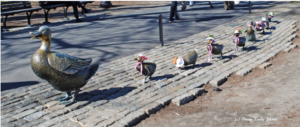
The bronze duck family was created by sculptor Nancy Schön and installed in 1987. They’re lined up in a neat little row — Mrs. Mallard in front, followed by Jack, Kack, Lack, Mack, Nack, Ouack, Pack, and Quack — and they are:

  • rubbed shiny by millions of tiny hands
  • photographed more than the average Kardashian
  • climbed on daily
  • and beloved in a way that borders on civic obsession

If you stand there long enough, you’ll see at least one toddler attempt to ride Mrs. Mallard like a Kentucky Derby contender. 

Years of tiny hands have polished them so shiny they practically glow — and honestly, that tracks. New Englanders love to touch bronze animals for good luck. It’s right up there with eating chowder on a hot day and pretending we don’t mind the weather.


Dressed for Every Occasion

People dress these ducks up more often than most folks I know change their own outfits. Depending on the season, you might find them wearing:

  • Easter bonnets
  • Patriots jerseys
  • Red Sox gear
  • Scarves in winter
  • Pride flags in June
  • Pumpkin hats in October
  • Graduation caps (because Boston has more colleges than Dunkin’ locations, and that’s saying something)

There’s no official “duck stylist,” but somehow the outfits appear like magic. It’s very Boston: no one admits to doing it, but everyone approves.

Honestly, they get dressed up more often than the average Bostonian heading to a Patriots game in January — and we’ll wear anything as long as it’s warm and vaguely team‑colored.

Make Way for Ducklings statues in the Boston Public Garden


The Great Ducknappings of Boston

Here’s the part that always makes people blink:
The ducklings get stolen. Frequently.

Not all eight at once — that would require a level of planning usually reserved for heists — but one or two at a time. Usually it’s:

  • a prank
  • a drunken college student
  • or someone who thought, “You know what my dorm room needs? A 40‑pound bronze duck.”

They almost always get returned, sometimes anonymously, sometimes by a sheepish parent dragging a guilty teenager by the elbow. The city keeps replacement molds on standby because Boston has accepted that this is simply part of life now.

It’s practically a local sport, right behind candlepin bowling and arguing about which place has the “real” clam chowder.


Why We Love Them

There’s something about these statues that hits people right in the heart. Maybe it’s nostalgia for the book. Maybe it’s the charm of a duck family marching through the Garden like they own the place. Or maybe it’s that deep New England instinct to adopt anything small, cute, and slightly chaotic — see also: our weather.

Whatever it is, the ducks are woven into Boston’s identity. They’re whimsical, sturdy, slightly chaotic, and beloved — which, come to think of it, describes the city pretty well too.