A Tale of Two Lighthouses

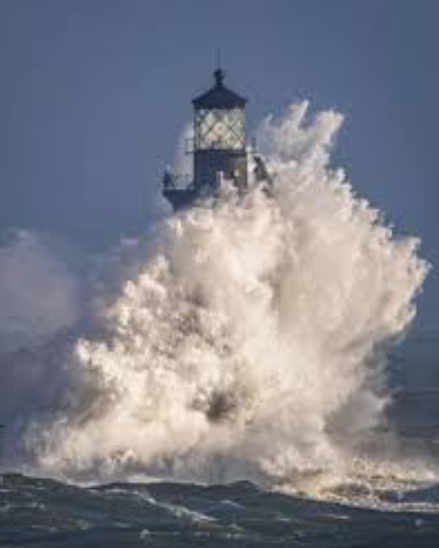
Graves light takes a pounding from the sea at the entrance to Boston Harbor's deep water channel


Graves Light: Boston Harbor’s Outer Sentinel

Lighthouses have always been the quiet guardians of the coast — part warning, part welcome, standing where the sea turns unpredictable. In my last post, Boston Light played the role of the harbor’s warm lantern, guiding ships safely home. Just a few miles away, though, another tower tells a very different story. Graves Light, perched on a scatter of ledges at the edge of the deep‑water channel, wasn’t named for sailors’ graves at all, but for Rear Admiral Thomas Graves, an early Massachusetts figure. Its job has always been the opposite of Boston Light’s: not to beckon ships inward, but to warn them away from danger.


A Lighthouse Built for the Hard Work
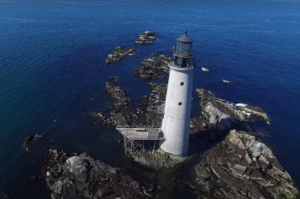
Completed in 1905, Graves Light is the tallest lighthouse in Boston Harbor and by far the most exposed. Its granite blocks were quarried in Rockport and pinned into the ledge like a stone corkscrew — because anything less would have been torn apart by the Atlantic. This tower wasn’t built for charm. It was built to take a beating.

And it still does.


Still Active — Even in Private Hands

In 2013, Graves Light made headlines when it was sold at auction for $933,888, becoming one of the most expensive lighthouse sales in U.S. history. The new owners restored the tower itself — floors, windows, dock, solar power — but the light and fog signal remain federal property.

The U.S. Coast Guard still operates:

  • the modern beacon
  • the fog horn
  • the official charted signal: Fl (2) W 12s

So yes, Graves Light is still an active aid to navigation, even though the building is privately owned. The tower belongs to people; the warning still belongs to the sea.

Two Lights, Two Jobs

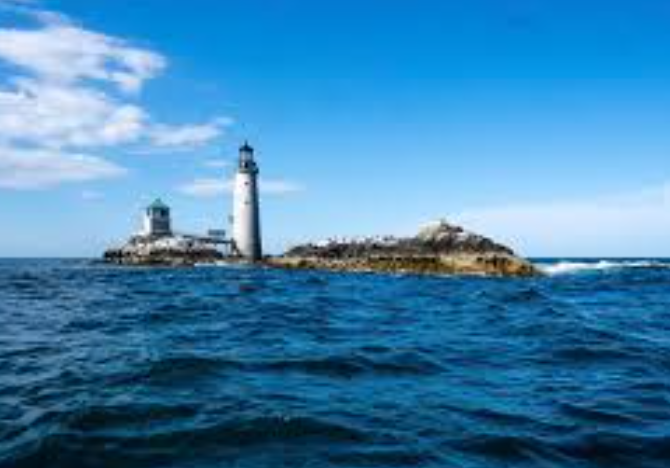
Graves Light and Boston Light sit on opposite sides of the deep‑water channel — only about 3.5 miles apart, but doing completely different work.

  • Graves Light stands on the outer edge, flashing its stern warning:
    “Danger here — avoid the ledges.”
  • Boston Light waits farther in, offering the softer message:
    “Safe water ahead — welcome to the harbor.”

Mariners once treated them as a sequence: clear the danger, then follow the welcome home.
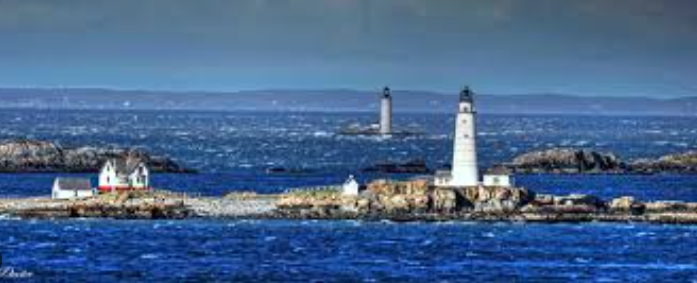
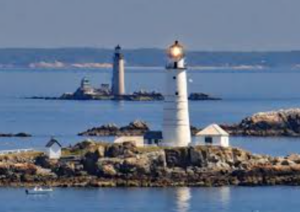
Boston Light and Graves Light, two guardians of Boston harbor


The Zoo Ship Wreck of 1938

One of the strangest events tied to Graves Light came in 1938, when the steamer City of Salisbury ran aground near the ledges in thick fog. Its cargo?
A traveling zoo shipment — monkeys, parrots, pythons, cobras, and other exotic animals.

Most survived, and newspapers gleefully reported “snakes loose in Boston Harbor.” Graves Light has seen its share of storms, but that day it witnessed a circus.


A Hollywood Cameo
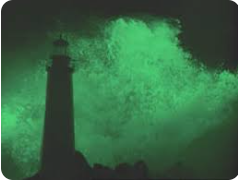
Graves Light even had a moment on the silver screen. It appears in the storm sequence of the 1948 film Portrait of Jennie, where the tower is cast as a brooding, windswept sentinel. Even if you’ve never seen the movie, it’s a fun bit of trivia — one of the few times this rugged lighthouse slipped into Hollywood’s imagination.


A Sentinel You Can Still See Today

If you take one of the harbor or lighthouse cruises, you’re almost guaranteed to see both Boston Light and Graves Light in a single sweep of the horizon. Coming out from the harbor, you first pass the civilized silhouette of Boston Light, with its keeper’s house and outbuildings tucked neatly on Little Brewster Island. And just beyond it, rising straight from the gray Atlantic, stands Graves Light — taller, starker, and far more ominous. One welcomes you in; the other warns you away. Seen together, they tell the whole story of Boston Harbor in two towers.
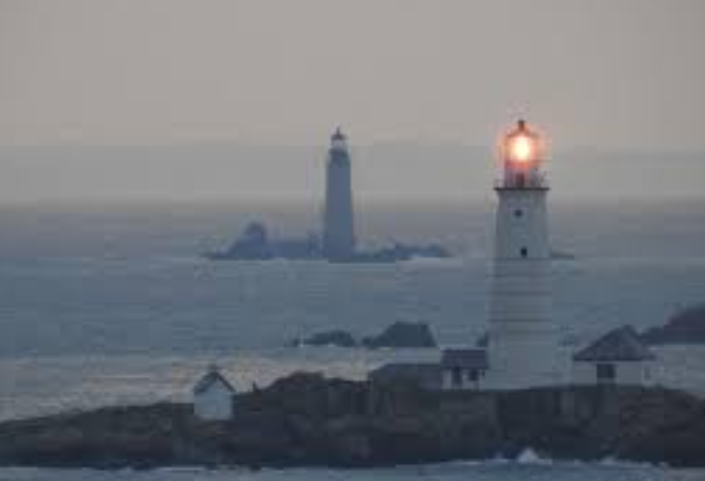


Graves Light

Yesterday I mentioned Graves Light that marks the North Channel into Boston Harbor. It isn’t as “pretty” as Boston light but its history is just as colorful.

dsc_4216-2-copy

The lighthouse gets it’s ghoulish names from the tiny island it’s situated upon. “The Graves” is the outermost island of the Boston Harbor Islands National recreation Area, 9 miles off shore of downtown Boston.

dsc_4211-3-copy

The lighthouse is the tallest lighthouse in the approach to the Port of Boston and until 1975 it was the most powerful lighthouse in New England. It is currently lit with a modern , solar-powered lamp that doesn’t compete with the original giant Fresnel Lens.

graves-light

The Lighthouse was built in 1905 and equipped with a first-order Fresnel lens that shown with a 350,000 candlepower beam across the harbor. That lens was removed in 1975. Although not on display at this time it remains in the possession of the Smithsonian Institution. Any classic film buffs may remember that this light was the setting for the climatic storm in the 1948 movie “Portrait if Jennie”.

 portrait-of-jennie

In recent years many lighthouses have gone up for public auction and Graves Light was no exception. In June of 2013 the lighthouse was put on the auction block. The starting bid was $26,000 but by the time the gavel dropped it had reached a record $933,888, the highest bid ever paid for  a U.S. Lighthouse.

dsc_4217-3

In 2014 the new owners began a major restoration project that has been features on the s television show, This Old house.

Graves Light is listed on the National Register of Historic Places. The lighthouse is still being used for navigational purposes and will remain so under the terms of the sale.

The lighthouse includes 2 bedrooms, a kitchen and a study but landing is difficult and entering the building requires crossing a 40 –foot ladder shown in this archival photo.

graves_1956

Still who wouldn’t want to own a real lighthouse?

Boston Light

Boston Light is a lighthouse located on Little Brewster Island in the outer Boston  Harbor.

dsc_4199-2-copy

The original lighthouse was built on this site in 1716 making it the first lighthouse to be built in what became the United States.

This first light house was held by the British during the American Revolution and subsequently burned down by the American forces, not once but twice. When the British withdrew in 1776 they blew up the tower completely destroying it.

dsc_4171-2-copy

In 1783 the new lighthouse was constructed with a 75 foot tower, the same as the original. In 1856 the tower was raised to its present height of 98 Ft. A new lantern room was added along with a 12 sided second order Fresnel Lens.

In 1998 Boston Light was automated but is still staffed by a resident Coast Guard Keeper. The current keeper is Sally Snowman who, along with volunteers from the Coast Guard Auxiliary act as interpretive tour guides for visitors.

week-3-002e-copy

The current light still uses the 2nd order Fresnel lens, one of only four left in use and the only one in Massachusetts. It flashes white every 10 seconds and is visible for 27 nautical miles.

To reach the safety of Boston Harbor, ships had to navigate the dangerous channel through numerous rocks, shoals and islands so Boston Light was an important navigational aid.

In more recent times the channel has been dredged  and larger vessels have shifted to the North Channel marked by Graves Light.

Boston Light is designated a National Historic Landmark and is the second oldest working lighthouse in the US today.

Into The Harbor on a Wildlife Cruise

The cruise was a “sell out”. Many of the people I spoke with had been on the cruise in previous years. They only run it one day a year and they go out rain or shine or snow.  There were National Park Rangers,  Aquarium naturalists, DCR (Department of Conservation and Recreation) employees and volunteers  to answer questions. The boat was well stocked with food and beverages in the snack bar. two decks were heated if the outdoor space got too cold. They really went all out to make  it a special day.

dsc_4145-copy

At 10:35 the loading began and by 11 am we were all ready to head out to the harbor.

dsc_4147-copy

Our first destination was Logan Airport. Logan Airport is home to some migratory snowy owls. Because of the damage they can do to a jet, the Audubon Society has a trap and release program. Snowys are trapped at Logan and released elsewhere, often at Duxbury beach.

male-snowy-owl

I was on the 2nd deck when the cry went up that a snowy owl had been spotted. Unfortunately it was too far away. I couldn’t see it with my 300 mm lens. A photographer standing next to me with a gigantic lens on his camera said he couldn’t see it either. It looked like a snow pile or a white plastic jug, just a spot against the dark gravel.

That pretty much set the tone for the trip. It would have been more accurate to call it a bird watching cruise. We saw lots of birds but they were mostly fast and small. I soon got tired of trying to photograph them and settled for just watching them.

dsc_4152-copy

The only “wildlife” we saw were some seals hauled out on the rocks. Since it was low tide they were a good distance away from us and the sun was at the wrong angle to see much. It was more the silhouette of their “banana pose” that gave them away.

dsc_4181-2-copy

It had warmed up a great deal and the sun going in and out behind the clouds. The harbor was amazingly calm for a winter day. We cruised past Boston Light into the outer harbor.

dsc_4199-2-copy

One of the volunteers explained that they almost never get to go into the outer harbor in winter. It’s just too rough but we made it all the way out to Graves Light and even there the waves were only gentle, rolling swells.

dsc_4216-2-copy

Graves was the end of the trip. We did our turn around right in front of the light house. The return trip was leisurely as we passed the various harbor Islands, Georges Island with it’s fort, Peddocks Island with it’s 4 headlands to name only 2.

Georges Island, Boston Harbor

Georges Island, Boston Harbor

Peddocks Island

Peddocks Island


It turned out to be a beautiful day for a boat ride. I may not have seen much Wildlife but I had fun all the same. I’ll watch for this next year. I wouldn’t mind a repeat.