WMEO Reports- Animal Cruelty On Cape Cod

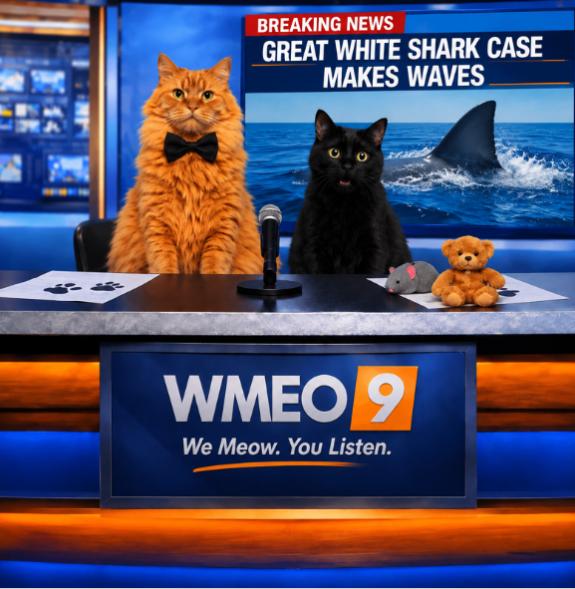
Two cats sit behind a news desk in a mock television studio. An orange long-haired cat wearing a black bow tie sits on the left, while a black cat sits on the right beside a toy mouse and a small teddy bear. A microphone stands between them on the desk. Behind the cats, a large screen displays a shark fin emerging from the ocean with the headline, “BREAKING NEWS: GREAT WHITE SHARK CASE MAKES WAVES.” The front of the desk features the WMEO 9 logo and the slogan, “We Meow. You Listen.” Blue and orange studio lighting creates the look of a professional news broadcast.

Cape Cod Great White Shark Case Makes Waves: WMEO’s Pumpkin Spice Reports Live

What happens when protected wildlife becomes the center of a criminal case… and Pumpkin Spice reports from shark-infested waters?

Banner: 

Good evening and welcome to WMEO News, where we meow, you listen.

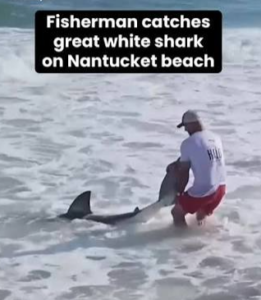
Tonight, authorities in Massachusetts have charged a New York fisherman with animal cruelty after  authorities say the fisherman illegally captured a shark named Aaron and dragged the shark onto a beach.

The defendant has pleaded not guilty and maintains the catch was accidental.

For more on this developing story, we go live to our field correspondent, Pumpkin Spice.

Pumpkin?
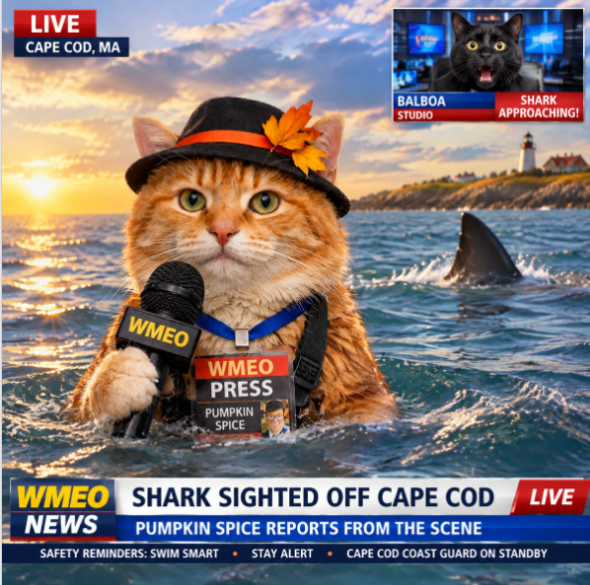
A humorous fake TV news scene shows an orange tabby cat standing chest-deep in ocean water off Cape Cod at sunset, wearing a black hat with an orange band and autumn leaf, a WMEO Press badge, and a reporter's harness while holding a microphone. A shark fin breaks the water behind the cat near a rocky shoreline and lighthouse. In the upper-right corner, an inset news feed shows a black cat in a studio labeled "Balboa" with the alert "Shark Approaching!" News graphics identify the field reporter as Pumpkin Spice, and the headline reads: "Shark Sighted Off Cape Cod - Pumpkin Spice Reports From the Scene." The image is styled as a live breaking news broadcast from WMEO News.


What Authorities Allege Happened to Aaron the Shark

Pumpkin Spice:

Thank you, Banner.

An orange and white cat wearing a black hat with an orange band and a press badge that reads “WMEO PRESS PUMPKIN SPICE REPORTER” poses as a news reporter. The cat has a blue lanyard and holds a camera, while a microphone labeled “WMEO NEWS” sits nearby. The softly blurred background suggests an outdoor setting, creating a humorous scene of a feline journalist at work.

I’m reporting live from Cape Cod, where authorities have charged a New York fisherman after investigators say a protected great white shark named Aaron was illegally captured and dragged onto a beach for photographs.

According to court documents, the incident allegedly involved bait deployed by drone and resulted in the shark being removed from the water before later being released.

Wildlife experts say great white sharks are a protected species and should generally not be treated as props for vacation pictures

Balboa Has Concerns About the Reporting Conditions

Balboa (interrupting from the studio): PUMPKIN!

SHARK!

SHARK BEHIND YOU!

GET OUT OF THE WATER!

Pumpkin Spice: Thank you, Balboa.

As I was saying, the shark involved in the case was named Aaron and authorities allege…

Balboa: NO, NOT THAT SHARK!

THE OTHER SHARK!

THE ONE SWIMMING TOWARD YOU! 

Pumpkin Spice: Balboa, I’m standing in the ocean.

Finding a shark out here is a little like finding a cat in a living room.

Balboa: THAT CAT HAS THREE HUNDRED TEETH!

Pumpkin Spice: Your point is noted.

Authorities say Aaron was a tagged research shark, making the allegations particularly concerning to marine biologists.

Balboa: PUMPKIN!

IT’S CLOSER!

I REPEAT!

THE SHARK IS CLOSER!

Pumpkin Spice: For viewers just joining us, Balboa appears to be experiencing what medical professionals refer to as “a lot.”

Balboa: THIS IS NOT A LOT!

THIS IS A SHARK!

Pumpkin Spice: The shark behind me has so far demonstrated significantly better behavior than the humans involved in this case.

Balboa: I CAN’T BELIEVE THIS IS HAPPENING.

Banner: Balboa, please allow Pumpkin to finish the report.

Balboa: FINE.

BUT I WANT IT ON RECORD THAT I’M THE ONLY ONE TAKING THE SHARK SERIOUSLY.

Pumpkin Spice: And as I was saying before being interrupted by our station’s emergency panic department, the defendant has pleaded not guilty and maintains the catch was accidental.

The case is expected to continue through the Massachusetts court system.

Meanwhile, Aaron has reportedly returned to the ocean where experts agree he belongs.

Balboa: UNLIKE YOU!

YOU DO NOT BELONG THERE!

Pumpkin Spice: Reporting live from Cape Cod, where the wildlife appears considerably calmer than my coworkers, I’m Pumpkin Spice.

Back to the studio.

Banner: Thank you, Pumpkin.

And thank you, Balboa, for whatever it is you’ve contributed this evening.

Orange tabby cat wearing a black bow tie sits upright behind a television news desk while a black cat lies face-down on papers beside him. The front of the desk displays the message, “THANK YOU FOR WATCHING WMEO NEWS.” A blurred blue newsroom backdrop with studio lights fills the background, creating a humorous end-of-broadcast scene in which one feline anchor remains professional while the other appears exhausted.

From Sand Dunes to Shark Apps

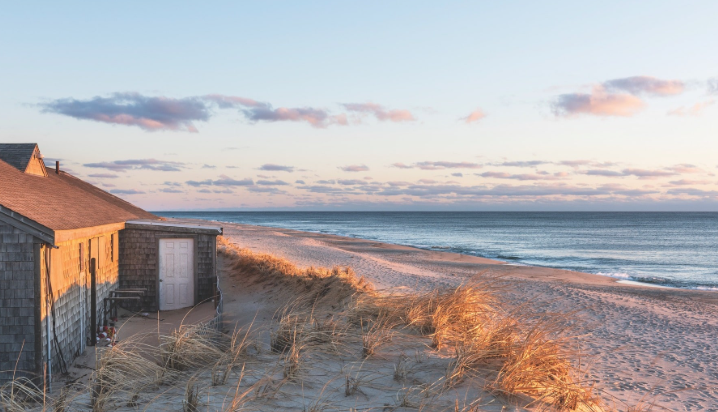
Old Cape Cod, just as Patti Page imagined it — dunes, salty air, and a quiet stretch of shoreline that still remembers how things used to be.

Old Cape Cod: From Sand Dunes to Shark Apps

If you’re fond of sand dunes and salty air,

Quaint little villages here and there…

You’re sure to fall in love with old Cape Cod.

Patti Page sang those words in 1957, and the song didn’t just become a hit — it reshaped the Cape’s identity. That gentle, dreamy portrait of a sleepy peninsula helped launch Cape Cod into the national imagination. Tourists followed, then developers, and before long those “quaint little villages” gave way to strip malls, big‑box stores, and summer traffic that can test the patience of a saint.

But one thing never changed: the beaches. Crowded or not, they’re still the Cape’s heartbeat. And if we take a little walk through time, we can see just how much this place has transformed since Patti Page made musical history.

A Peninsula Born of Ice

Cape Cod is a hooked, sandy arm stretching 65 miles into the Atlantic — the leftover handiwork of the last Ice Age. It’s narrow in some places, wide in others, bordered by Cape Cod Bay, Buzzards Bay, and the waters of Vineyard and Nantucket Sounds. For centuries, life here revolved around the sea.

Nantucket, in particular, was once the whaling capital of the world. From the late 1600s through the mid‑1800s, whaling was its lifeblood. But as regulations tightened and the industry declined, Nantucket reinvented itself as a quiet retreat for the wealthy — a transformation that still defines the island today.

Preserving the Cape

On the mainland, conservation took center stage. In 1961, the federal government created the Cape Cod National Seashore, protecting miles of shoreline from development. Monomoy National Wildlife Refuge followed, safeguarding critical habitat for birds and marine life.

Then came a turning point: In 1972, the Marine Mammal Protection Act granted federal protection to seals.

That’s when the Cape’s story took a dramatic turn.

The Return of the Great Whites

As the seal population exploded, so did interest from a very different kind of visitor. In 1975, the blockbuster Jaws gave the world a fictional taste of shark‑infused terror — but it also foreshadowed reality. Over the next few decades, great white sharks began returning to Cape waters in growing numbers, drawn by the booming seal colonies.

The shift became undeniable on September 15, 2018, when Arthur Medici, a 26‑year‑old from Revere, was fatally attacked while boogie boarding at Newcomb Hollow Beach. It was the first deadly shark attack in Massachusetts since 1936, and it marked the beginning of what many now call the new Cape Cod.

Today, great whites are summer regulars. We have:

  • Spotter planes and research boats
  • Electronic shark‑detection buoys
  • Beach warnings near seal haul‑outs
  • And yes — an app for that. The Sharktivity app lets you track shark sightings in real time.

Even whale‑watch boats report seeing sharks, and whenever a whale carcass washes ashore, you can bet the great whites will arrive shortly after.

And they’re not alone. In 2025, a fisherman off Mashpee reported the Cape’s first confirmed tiger shark sighting. Offshore charter captains share videos of sharks stealing fish right off the line. There’s even shark cage diving now — something once associated only with South Africa or Australia.

A Personal Note: The Cape’s Own Shark Celebrity
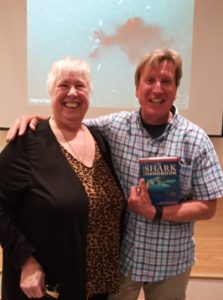
The Cape has its own celebrity in Dr. Greg Skomal, author, marine biologist, and the face of modern shark research in Massachusetts. He’s been a champion of the great white’s return and a pioneer in tagging and tracking them. You’ve probably seen him on Discovery Channel’s Shark Week, leaning over the bow of a boat with a tagging pole in hand.

I’ve had the privilege of meeting him and hearing several of his presentations. He’s charming, funny, and completely approachable — the kind of scientist who makes you feel like you’re part of the adventure. The sharks couldn’t ask for a better advocate.

Is This Still “Old Cape Cod”?

Somehow, the Cape feels less like Patti Page’s quiet seaside escape and more like a place where nature has reclaimed its throne. The dunes and salty air are still here, but the cast of characters has changed. Tourists still flock to the beaches — but so do apex predators.

Cape Cod isn’t sleepy anymore. It’s wild, unpredictable, and very much alive.

And maybe that’s part of its magic.


Orange You Glad It’s a Shark?


Creamsicle Shark of Costa Rica: Nature’s Sweetest Surprise

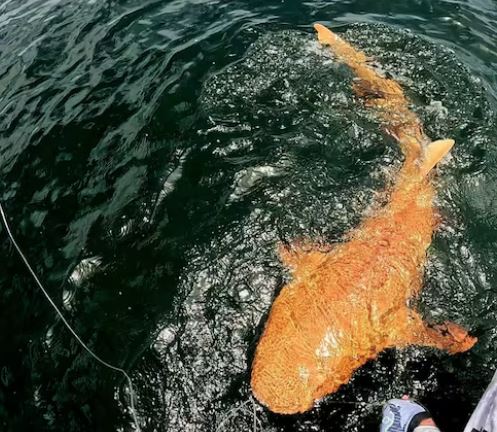
Somewhere off the Caribbean coast of Costa Rica, nature whipped up a treat that’s part shark, part sherbet, and all spectacle. Meet the Creamsicle Shark—a nurse shark with a rare genetic twist that turned it a glowing shade of orange, like it swam straight out of a popsicle ad.

NATIONAL CREAMSICLE DAY - August 14, 2026 - National Today

Stock photo

Catch & Release- Its still out there

Local fisherman Garvin Watson reeled in the citrus-hued creature near Tortuguero National Park, and the reaction was pure delight. “It looked like an alien,” he said, as the crew snapped photos and squealed like kids spotting a unicorn in the surf. The shark was released unharmed, but its legend is just beginning.

Photo Credit (Garvin Watson/Parismina Domus Dei

Scientists later confirmed this was no ordinary catch. The shark had both xanthism (a condition that boosts yellow pigmentation) and albinism, making it a one-in-a-million marvel. It’s the first documented case of xanthism in a nurse shark—proof that even the deep sea has a flair for drama.

If this creamsicle-colored wonder has you dreaming of underwater worlds, why not bring a splash of the ocean home? A well-designed aquarium can be a tranquil centerpiece, a sensory escape, and a nod to nature’s whimsy. [Affiliate link to aquariums] 🐠

Amazon

Whether you’re a marine biology buff or just love a good sea story, the Creamsicle Shark reminds us that the ocean still holds sweet surprises. And sometimes, they come in orange.

____________________________________________________________________________________________________________

Affiliate Disclosure: Some of the links in this post are affiliate links, which means I may earn a small commission if you make a purchase—at no extra cost to you. I only recommend products I genuinely love and think you’ll enjoy too. Thanks for supporting Around Dusty Roads and helping keep the storytelling flowing

Sharks, Seals, and Sea Serpents


🦈 Cape Cod’s August Secrets: Sharks, Seals, and Sea Serpents

August on Cape Cod is a paradox—sun-drenched beaches and salt-kissed breezes above, and a world of mystery swirling just beneath the waves. While vacationers flock to the shore for lobster rolls and lighthouses, the Atlantic is busy hosting its own seasonal spectacle. Let’s dive into the secrets that stir beneath the surface.


Chatham Fish Market Aug 2011- photo credit Deb Neumann

🐟 The Real Stars of Summer: Seals and Sharks

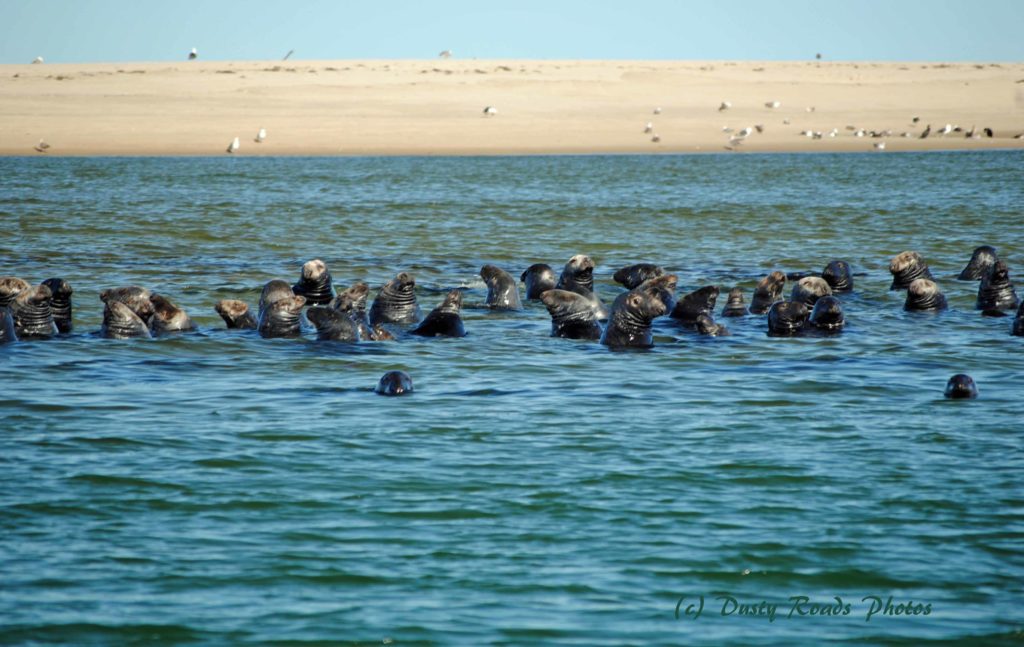
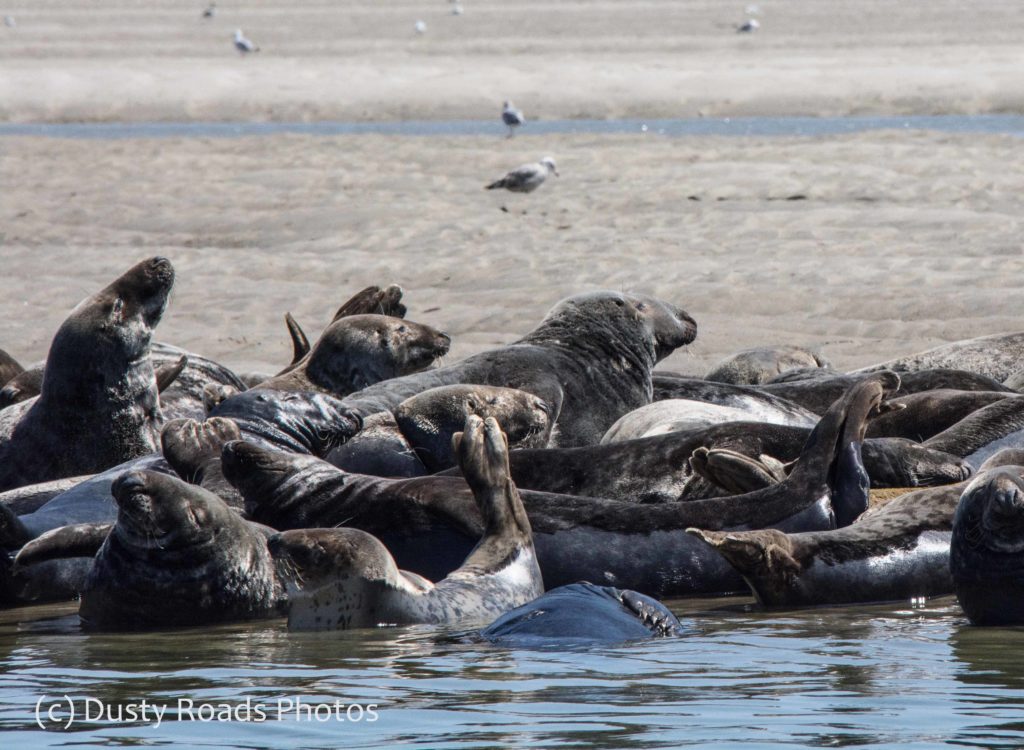
Cape Cod’s seal population booms in late summer, especially around Monomoy Island and Chatham. These sleek swimmers lounge like sunbathers on sandbars, drawing both admiration and attention—from above and below.

Pile of seals

Seals of Monomoy Island photo credit Deb Neumann

Enter the great white sharks.

Extreme close up of Great White Shark looking directly at camera smiling Extreme close up of Great White Shark looking directly at camera smiling young great white shark stock pictures, royalty-free photos & images

Photo credit internet

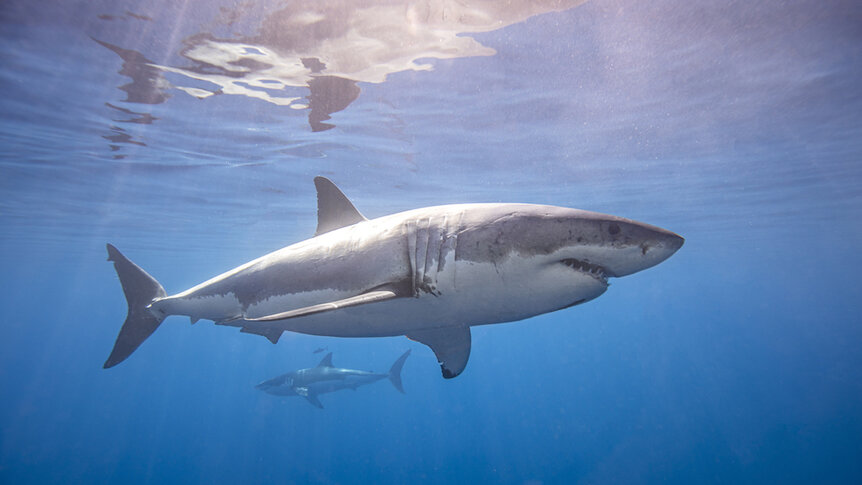
August is peak season for these apex predators, who follow the seal buffet with precision. Thanks to tagging efforts by the Atlantic White Shark Conservancy, we now know just how active these visitors are. Shark sightings have become so common that beachgoers check tracking apps as often as the weather.

A book about Cape Cod sharks and Greg Skomal's career ...

Dr. Greg Skomel tagging a great white- photo internet


But fear not—shark safety protocols are strong, and most encounters are nothing more than a fin in the distance.

shark2.jpg

Paddleboarder and shark 7/4/25 Cape Cod – photo credit Madeline Cronin


Still, there’s something thrilling about knowing you’re sharing the sea with legends.


🌊 The Lore Beneath: Sea Serpents and Saltwater Whispers

Long before GPS and GoPros, Cape Codders told tales of serpentine creatures gliding through the fog. From the 1800s onward, reports of undulating beasts off Provincetown and Nantucket stirred imaginations. Some described them as eel-like with horse heads; others swore they saw coils the size of schooners.

Are they misidentified whales? Overzealous oarfish? Or something more cryptic?

A 'sea serpent' is seen lurking off Cape Cod. But some have ...

Meanwhile off Cape Cod

While science leans toward skepticism, the stories persist—passed down like seashells from one generation to the next. And isn’t that part of the magic? That the sea still holds secrets we haven’t quite solved.

🐚 August’s Invitation

Cape Cod in August is more than a postcard—it’s a living story. Whether you’re scanning the horizon for dorsal fins, watching seals bob like buoys, or wondering what might lurk in the deep, this month invites curiosity.

So pack your binoculars, your sunscreen, and maybe a pinch of imagination. The coast is calling—and it has stories to tell.

photo credit Deb Neumann


Jaws Turns 50—And Contender Takes the Crown

🦈 Jaws Turns 50: Meet Contender, the Real-Life Ocean Giant


Fifty years ago, Jaws sank its teeth into the public imagination, turning the great white shark into a symbol of fear and fascination. Today, as we celebrate the cinematic legend’s golden anniversary, a new marine marvel is stealing the spotlight—not from Hollywood, but from the depths of the Atlantic.

📣 Enter Contender: The Atlantic’s King of Sharks

Earlier this year, a behemoth was tagged off the Florida-Georgia coast that’s making Jaws look almost modest. Named Contender, this great white shark is officially the largest ever tagged in the North Atlantic. Here are the jaw-dropping stats:

  • Length: 13 feet, 9 inches
  • Weight: 1,653 pounds
  • Age: Estimated at 32 years old
  • Tagged: January 17, 2025, roughly 45 miles offshore

North Carolina coast: Great white shark 'Contender' heads to ...

Contender was named by OCEARCH, the marine research group responsible for tagging him, after one of their longtime partners—Contender Boats—whose vessels support these vital expeditions.

🗺️ His Journey: From the Deep to Our Doorstep

Since being tagged, Contender has taken quite the tour:

  • He swam south to Vero Beach, Florida, before making a turn north
  • Passed through Cape Hatteras, North Carolina
  • Most recently, he’s been cruising near Nantucket, Massachusetts, between Nantucket Shoals and Georges Bank

Contender: Largest Known Male Great White Shark in the North ...

Contender’s movements are tracked via a SPOT tag, a high-tech device that sends a signal every time his dorsal fin breaches the surface, letting researchers and enthusiasts follow his oceanic adventure in real time.

🔬 Beyond the Bite: The Science Behind the Tag

OCEARCH scientists aren’t just tracking Contender for thrills. They’re collecting data to unlock secrets about:

  • Shark migration patterns
  • Breeding behaviors and reproductive health
  • Long-term oceanic ecosystem impacts

Contender’s tag is expected to deliver insights for five years, offering a rare peek into the life of one of the ocean’s most elusive and majestic creatures.

Record-Breaking Great White Shark Found Off Florida Coast ...

🎥 From Fiction to Fact

The film Jaws was inspired by real sightings and fears, but the anniversary serves as a perfect moment to shift from fear to fascination.  Sharks like Contender remind us that the ocean isn’t just home to legends—it’s home to living marvels that deserve our awe, curiosity, and protection.

Curious to see where Contender swims next? Track him live on the OCEARCH Shark Tracker.