🌑 The Black Cat Paradox


🐾 Whiskers of Legend: Cats in Folklore and Myth

They slink through shadows, curl into sunbeams, and stare into souls with eyes that seem to remember something ancient. Cats have long held a place not just in our homes, but in our stories—woven into the myths and mysteries of cultures across the world. From divine protectors to spectral companions, here are some of the most enchanting legends surrounding our feline friends.

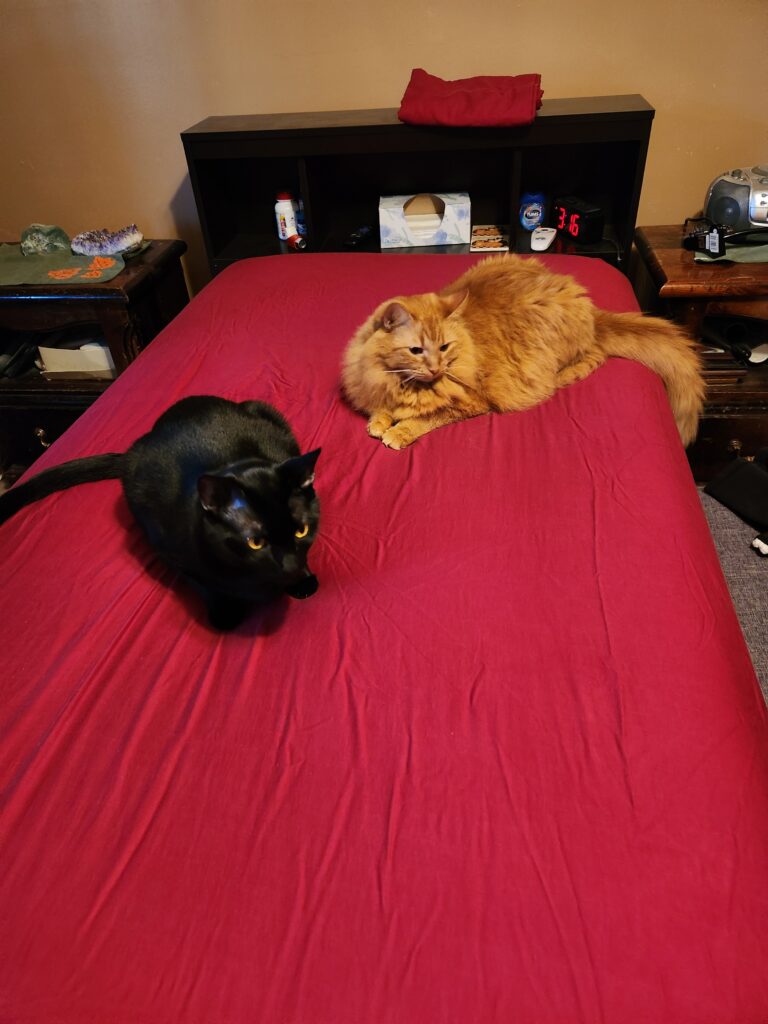
Balboa – Photo credit Deb Neumann

☘️ Nine Lives and Irish Luck

The idea that cats have nine lives is more than just a comforting cliché—it’s a whisper from the past. In Irish folklore, cats were believed to possess supernatural resilience. Some tales speak of the Cat Sídhe, a spectral black feline said to haunt the Scottish Highlands and Irish moors. It was no ordinary cat—it could steal souls before they passed to the otherworld, unless distracted by music or riddles.

The CAT NIGHTS begin! 🐱 A rather obscure old Irish legend said that a witch could turn herself into a cat eight times, but on the ninth time (August 17), she couldn’t regain her human form.

Perhaps this eerie ability to dance between worlds gave rise to the notion of nine lives: a creature too clever, too slippery, to be claimed by death just once.

🐱 Bastet: Egypt’s Divine Guardian

In ancient Egypt, cats weren’t just pets—they were sacred. Bastet, the feline goddess of home, fertility, and protection, was often depicted with the head of a lioness or domestic cat. Bastet guarded  households from evil spirits and disease, and her presence was so revered that harming a cat—even accidentally—was punishable by death. Egyptians believed cats had a spiritual connection to the divine, and their graceful movements were seen as echoes of Bastet’s own celestial dance.

242 Cat Goddess Bastet Stock Photos - Free & Royalty-Free ...

🧙‍♀️ Witches and Familiars

During Europe’s witch trials, cats—especially black ones—were cast in a darker light. They were said to be witches’ familiars, magical companions that aided in spellwork and mischief. Some believed witches could even transform into cats to roam unnoticed. This fear led to centuries of superstition, where a black cat crossing your path was considered a bad omen. Yet in other cultures, black cats were symbols of prosperity and protection. In Japan, they’re thought to bring good luck, especially to single women seeking love.

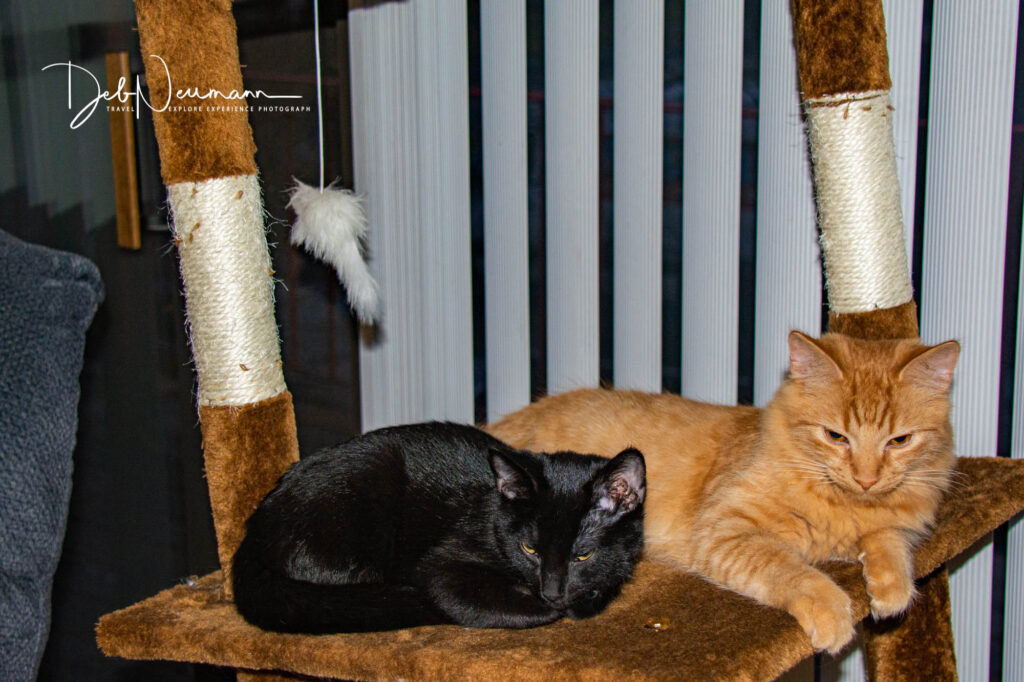
Black Cat Stare photo credit Deb Neumann

🌑 The Black Cat Paradox

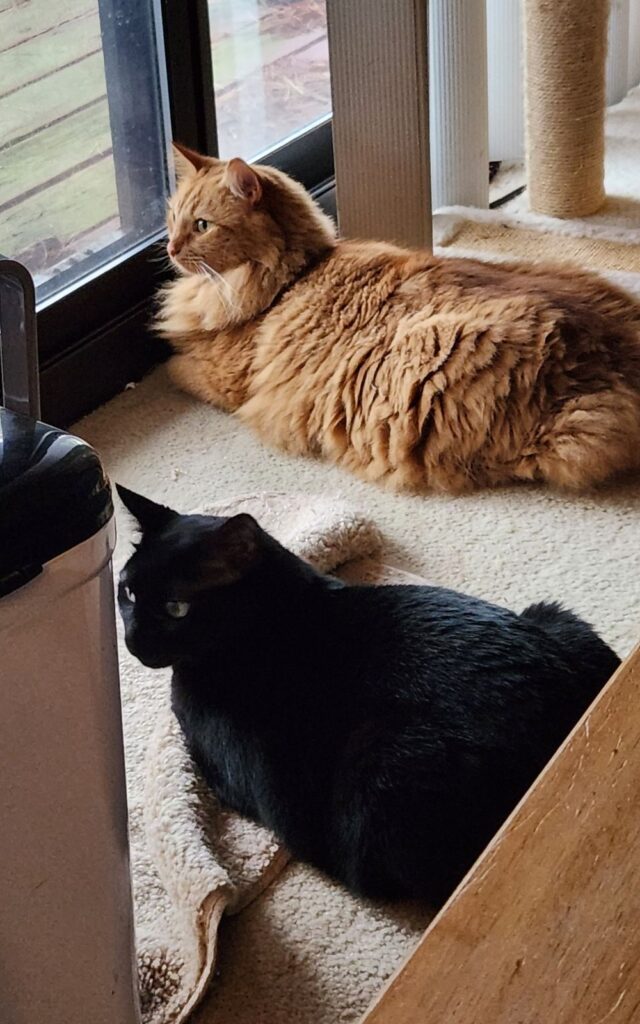
Is the black cat a harbinger of doom or a guardian of fortune? It depends on where you ask. In Celtic lore, black cats were often seen as guardians of hidden treasure. In Scottish tradition, a strange black cat arriving at your doorstep was a sign of prosperity. But in medieval Europe, they were feared as agents of the devil. Today, black cats still straddle the line between superstition and affection—misunderstood, mysterious, and utterly magnetic.


Whether lounging in sunbeams or prowling through moonlight, cats remain creatures of contradiction—both wild and domestic, feared and adored. Their legends remind us that magic often wears whiskers and walks softly on velvet paws.

Have you ever had a cat that felt just a little too wise? Share your stories below—I’d love to hear about the feline folklore in your life. 🐾✨


Your Cat is proof that you are loved by forces beyond your understanding… (Edgar Cayce)


Blep- photo credit Deb Neumann

🐾 Happy 117th Birthday, Cartoons!

🐾 Happy 117th Birthday, Cartoons! A Wild Tribute to Our Animated Ancestors

Today marks 117 years since the first cartoon blinked its way onto the screen—and honestly, it’s hard to imagine a world without animated animals teaching us life lessons, falling off cliffs, and bouncing back with nothing but a band-aid and a witty comeback.

Let’s rewind to 1908, when Émile Cohl’s Fantasmagorie danced into existence. It was a surreal, scribbly spectacle—like watching a doodle come to life after too much coffee and not enough sleep. No color, no sound, just pure chaotic charm. And thus, the cartoon was born.

File:Fantasmagorie (Cohl).GIF - Wikipedia

🦝 Nature’s Original Animators

Before cartoons, nature had its own animation studio. Ever watched a squirrel try to carry a baguette twice its size? Or a raccoon dramatically rinse its food like it’s prepping for a Michelin-starred meal? These are the original slapstick comedians. Cartoons just gave them a voice—and occasionally, pants.

Chipmunk with stuffed cheeks

August 2017 – photo credit Deb Neumann

In fact, if you squint at a hummingbird long enough, you’ll swear it’s animated. The flurry of wings, the impossible hover, the dramatic zoom-ins on nectar—it’s basically Looney Tunes with feathers.

2017 – phots credit Deb Neumann


🎨 From Flipbooks to Streaming Binge-fests

Looney Tunes - Wile E. Coyote' Cardboard Cutouts ...

Wile E, Coyote

Cartoons have evolved from jittery line drawings to full-blown cinematic universes. But the heart of it remains the same: exaggerated expressions, improbable physics, and a deep commitment to making us laugh, cry, and question the laws of gravity.

Whether it’s a wisecracking meerkat, a lovesick skunk, or a sponge who lives in a pineapple (under the sea, no less), cartoons remind us that storytelling doesn’t need realism—it needs rhythm, heart, and a dash of absurdity.


Cape Cod Seal- August 2013 photo credit Deb Neumann

🌿 Why Cartoons Still Matter on Around Dusty Roads

Here at Around Dusty Roads, we celebrate the whimsical, the wild, and the wonderfully weird. Cartoons are kindred spirits—bold, expressive, and unafraid to leap off cliffs in pursuit of a punchline. They teach us that imagination is a survival skill, and that sometimes, the best way to understand the world is through a talking animal with impeccable comedic timing.

So today, raise a toast (or a carrot, Bugs-style) to 117 years of animated antics. May your day be filled with laughter, loony logic, and maybe a raccoon reenacting Fantasmagorie in your backyard.


15,300+ Cartoon Raccoon Stock Photos, Pictures & Royalty ...

World Lizard Day & Balboa’s Birthday Bash

🦎 World Lizard Day & Balboa’s Birthday Bash

Today is Balboa’s 5th Birthday! 🎉

Balboa – photo credit Deb Neumann

Happy Birthday, sweet boy—love you bunches. You’re sharing your special day with World Lizard Day, which might not be your idea of a party theme, but I couldn’t resist celebrating these scaly wonders.

Florida Iguana – photo credit Deb Neumann

I might be a little weird, but I genuinely like lizards. They fascinate me. I especially adore those tiny lizards I see everywhere when I visit Florida. I believe they’re called Anoles—there are brown ones and green ones, and I think they’re seriously cute. They dart around like little garden ninjas.

It's not easy being a green anole | | islandernews.com

Photo- Internet


Then there are the Iguanas. Bigger, bolder, and a bit intimidating. They come in vibrant shades of green and orange, lounging like royalty on sidewalks and rooftops.

So in honor of World Lizard Day (and Balboa’s birthday, of course), here are some fun and fascinating facts about lizards that might just make you see them in a whole new light. I may find them interesting, but don’t worry—I’m not about to bring one home as a pet.

Jurassic World Evolution Dilophosaurus Compatibility | Jurassic 2025 World  Evolution Dinosaur Skins


🌿 12 Lizard Facts to Make You Smile (or Squirm)

  1. Tail Tricks
    Many lizards can detach their tails to escape predators. The tail keeps twitching while the lizard makes a clean getaway—like a magic act with a dramatic exit.
  2. Color-Changing Cuties
    Green Anoles can shift from green to brown depending on mood, temperature, or stress. They’re like tiny, scaly mood rings.
  3. Built-In Motion Sensor
    Iguanas have a “third eye” on top of their heads called a parietal eye. It doesn’t see images but detects light and movement—perfect for spotting sneaky predators.
  4. Push-Up Power Moves
    Lizards often do push-ups or head bobs to show dominance or attract mates. It’s like their version of flexing at the gym.
  5. Water Walkers
    The Basilisk lizard can run across water using its speed and wide feet. It’s nicknamed the “Jesus Lizard” for this miraculous feat.
  6. Tongue-Tasting the Air
    Like snakes, lizards use their tongues to “taste” the air and detect scents. It’s their way of sniffing out dinner or danger.
  7. Sun Worshippers
    Being cold-blooded, lizards bask in the sun to warm up and energize. You’ll often find them stretched out on rocks like tiny solar panels.
  8. Natural Pest Control
    Lizards love munching on insects like mosquitoes, flies, and ants. They’re nature’s pest patrol—no chemicals required.
  9. Miniature Dragons
    Draco lizards can glide between trees using wing-like ribs. They’re real-life dragonlets soaring through the forest canopy.
  10. Ancient Survivors
    Lizards have been around for over 200 million years. They’ve outlived dinosaurs and still strut their stuff across the globe.
  11. Venomous but Chill
    The Gila monster and Mexican beaded lizard are venomous, but they’re slow-moving and rarely aggressive. Just don’t poke them.
  12. All-Female Wonder Lizards
    Some whiptail lizard species reproduce without males through parthenogenesis. No dates, no drama—just cloning themselves like pros.

So here’s to Balboa,

Balboa’s Stare – photo credit Deb Neumann

to lizards, and to the wild, wonderful world we share with creatures great and small. Whether they’re sunbathing on a Florida fence or gliding through jungle trees, lizards remind us that nature is endlessly inventive—and occasionally adorable.

green iguana- photo credit Deb Neumann


The Majesty of Elk


🦌 The Majesty of Elk: A Wildlife Dream Fulfilled

For those who’ve followed my adventures for a while, you know that wildlife photography is one of my greatest joys. There’s something magical about spotting animals in their natural habitat—no fences, no enclosures, just raw, untamed beauty. And among the creatures I’ve longed to see, elk have always held a special place in my heart.

lunch of yummy berries

cinnamon colored black bear- but not Elk Wyoming 2017= photo credit Deb Neumann

🌾 The Elusive Elk

My quest to find elk in the wild has taken me across the country. In South Dakota, I encountered prairie dogs, wild horses, and sweeping landscapes that felt like scenes from a nature documentary. Locals assured me elk were nearby, but they always seemed to be just out of reach—like shadows slipping through the trees.

prairie dog with flower- Photo credit Deb Neumann

In 2014, I ventured into the mountains of Tennessee and North Carolina. There, I finally spotted some elk, but the experience was bittersweet. The herds were tagged and monitored, their movements restricted. They looked subdued, almost domesticated. I had imagined proud, wild creatures echoing their haunting bugle calls through the valleys—but the silence was deafening.

North Carolina 2014- photo credit Deb Neumann

🍁 A Journey to Jackson Hole

I began to think I’d need to travel all the way to Banff National Park in Canada to find the elk I’d dreamed of. But in October 2017, I made my way to Jackson Hole, Wyoming—just in time for the great elk migration.

Elk Migration

Elk Herd Outside Jackson Hole 2017- Photo credit Deb Neumann

Although I missed the rut and the iconic bugling calls, I was in the right place at the right time. The elk were moving south from Yellowstone to the National Elk Refuge near Jackson Hole. And that’s when it happened.

👑 A Vision Realized

I finally saw them—my majestic elk. Towering bulls with massive antlers escorted graceful females across golden meadows. The herds were vast, the energy palpable. These elk were everything I had imagined: wild, proud, and breathtakingly beautiful.

A pair of Bull elk

Elk Bulls Oversee the Herd Wyoming 2017 – photo credit Deb Neumann

It was a moment years in the making, and one I’ll never forget.

Antler Arch in Town Sq. Jackson WY

Elk Horn Arch Jackson Hole- photo credit Deb Neumann


Celebrating International Cat Day

🐾 Paws Across the Globe: Celebrating International Cat Day

I just found out it’s International Cat Day! 

Every August 8th, cat lovers unite in a chorus of purrs and whiskers to celebrate International Cat Day—a day devoted to honoring our feline companions and raising awareness about their welfare. Whether curled up on a windowsill or ruling the roost with a flick of the tail, cats have long enchanted us with their mysterious charm.

Banner & Balboa photo credit Deb Neumann

But some places take this devotion to a whole new level. Let’s journey to two of the world’s most iconic cat-loving destinations: Aoshima Island in Japan and Ernest Hemingway’s home in Key West, Florida.


🇯🇵 Aoshima: Japan’s Whispering Island of Cats

Nestled in the Seto Inland Sea, Aoshima—often called Cat Island—is a tranquil fishing village where cats outnumber humans nearly 6 to 1. Originally brought in to control mice threatening silkworm farms, the cats stayed, multiplied, and became the island’s unofficial ambassadors.

  • 🚫 Dogs are not allowed, making it a true feline sanctuary.
  • 🐟 Fishermen feed the cats scraps from their catch, and locals believe cats bring good luck.
  • ⛩️ A small cat shrine honors a feline who died in a rockfall, symbolizing the islanders’ reverence.

Visitors arrive by ferry, greeted by a sea of curious eyes and twitching tails. There are no hotels or restaurants—just cats, ocean breezes, and a sense of timeless serenity.


Aoshima, Japan's Cat Island: A Visitor's Guide - Catster

Aoshima, Japan’s Cat Island- Photo Shutterstock

Explore more about Aoshima here.


🇺🇸 Hemingway’s Key West: Six-Toed Legends

Thousands of miles away, in sun-drenched Key West, the Ernest Hemingway Home & Museum is home to nearly 60 polydactyl cats—descendants of Hemingway’s beloved six-toed feline, Snow White, gifted by a ship’s captain.

  • 🐾 These cats carry the polydactyl gene, giving them mitten-like paws.
  • 🏛️ They roam freely through Hemingway’s historic home and gardens.
  • 🎭 Each cat is named after a famous person—just as Hemingway did.

The cats are as much a part of the museum’s legacy as the Nobel Prize-winning author himself. Visitors often come for the literature but stay for the lounging legends with extra toes.


Ernest Hemingway's Cats - the best part of the Florida Keys?

One of Hemmingway’s polydactyl cats- stock photo

Learn more about the Hemingway cats here.


🌍 Why We Celebrate

International Cat Day isn’t just about pampering our pets—it’s a call to action. With over 600 million cats worldwide, many face challenges like homelessness, illness, and neglect. This day encourages:

  • 🏠 Adoption and fostering
  • 💰 Donations to shelters
  • 🧠 Education about feline behavior and care

Whether you’re cuddling your own cat, sharing photos online, or dreaming of a visit to Cat Island or Key West, today is a reminder of the joy and mystery cats bring to our lives.

Banner- photo Credit Deb Neumann


🐱 Final Purrs

From the quiet shores of Aoshima to the literary halls of Hemingway’s home, cats have carved out corners of the world where they are cherished, celebrated, and even worshipped. On International Cat Day, we honor not just their presence—but their power to soothe, inspire, and connect us across cultures.

So go ahead—spoil your cat a little extra today. Somewhere, a six-toed Hemingway cat is doing the same.

Balboa- photo credit Deb Neumann