The Invasive Creatures of Suburbia


The mongoose may be cute but he is an invasice species in Hawaii

Every Place Has Its Own “Wildlife”

Every place has its invasive species.
Florida has pythons.
Hawaii has the mongoose.
Australia… well, Australia has everything and then some.

And if you’re lucky enough not to share your ZIP code with an actual invasive species, you still have the local wildlife: deer tiptoeing through the gardens, skunks waddling with bad intentions, coyotes trotting around like they’re late for a meeting, maybe even a badger or two if the universe is feeling spicy. Then there are the cute ones — chipmunks stuffing their faces, squirrels plotting whatever squirrels plot, and of course the rogue turkey who thinks he owns the cul‑de‑sac.

I have all of that.
But I also have something… extra.


Meet My Personal Invasive Species

I have Toolman Tim on steroids.

While other invasive species creep in quietly, mine announces himself with the subtlety of a jet engine. If he’s home, something is running. Always. Leaf blower, lawn mower, wood chipper, snow blower, chainsaw — I’m convinced he has a generator just to power the rest of his equipment.

He takes immaculate care of his home, I’ll give him that. His lawn looks like it’s auditioning for a golf tournament. His shrubs are trimmed with military precision. His driveway is so clean you could perform surgery on it.

But the noise.
The noise.


Summer Dreams vs. Suburban Reality

Summer arrives and I think, Ah, fresh air, maybe I’ll open the slider and sit on the deck.

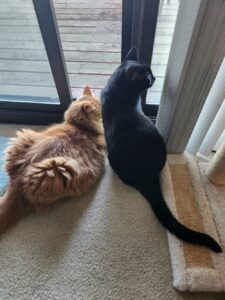
Banner and Balboa hear the slider open and immediately assume the world is ending. Instead of watching the world go by like normal cats, they scatter like I’ve just announced a fireworks show in the living room.

Meanwhile, my neighbor hears the same warm breeze and thinks, What if I ran every motorized object I own… in alphabetical order?

Our landscapers come once a week, roaring through like a NASCAR pit crew. If my neighbor and the landscapers ever coordinated schedules, we’d get one big burst of chaos and then peace. But no. They operate like they’re on alternating shifts, ensuring continuous, rolling noise pollution from dawn to dusk. It’s like living next to a construction site that never actually builds anything — just revs, blows, grinds, and growls for the sheer joy of it.

I swear the birds have started wearing tiny earplugs.
Banner and Balboa would too if they had opposable thumbs.


A Little Loud, But Harmless

And yet, I can’t be mad. He’s not rude. He’s not messy. He’s not blasting music at 2 a.m. He’s just… enthusiastic. Overly. Mechanically. Enthusiastically.

Still, if the state ever updates its list of invasive species, I might submit a nomination. Because while the deer nibble, the squirrels plot, and the turkey struts around like he pays the mortgage, my neighbor is the only creature in the ecosystem who seems powered entirely by gasoline and adrenaline.

Sunflower and butterfly 2018

Some people attract birds.
Some attract butterflies.
Apparently, I attract the suburban equivalent of Tim “More Power!” Taylor — and trust me, he lives by that motto every single day.


Old North Church: Lanterns, Legends, and a Cat Named Prince

One if by Land and 2 if by sea the Steeple of the old North church proudly overlooks Bosotn Harbor


Old North Church: A Guided Tour by Prince, Feline of

Photo Credit Sherrie Kling

Distinction

Greetings, humans.
I am Prince, former resident, unofficial greeter, and rightful overseer of Old North Church in Boston. Yes, that Old North Church — the one with the lanterns, the Revolution, the teenagers ringing bells, and the crypt full of people who, frankly, should have picked warmer accommodations.

Please keep your hands and snacks inside the tour at all times.


First, the Lanterns (My Steeple, My Rules)

You may have heard the story:
“One if by land, two if by sea.”
Two lanterns hung in the steeple on April 18, 1775, signaling that the British were coming by water.

Very dramatic. Very historic.
Personally, I would have added a third lantern to indicate “bring treats,” but no one asked me.

Still, it’s a good story, and the humans seem proud of it, so I allow it.


The Crypt: 1,100 Humans, Zero Cats

Beneath the church lies a crypt with more than 1,100 burials. It’s dim, atmospheric, and full of history.

I used to stroll past the entrance, tail high, as visitors whispered things like:

“Do you feel that chill?”
“Yes, that’s me. I’m majestic.”

The crypt tours are fascinating — if you enjoy early American history, architecture, or the feeling that someone from 1772 might be judging your footwear.


Paul Revere: Bell‑Ringer, Horse Enthusiast, Not a Cat

Before he became the midnight‑riding icon of American lore, Paul Revere was a teenage bell ringer here. Imagine a young Revere hauling on ropes, sweating, learning rhythm, and absolutely not noticing the very handsome cat supervising from the balcony.

Humans love this detail.
I prefer to think of it as “the time Paul Revere worked for me.”


My Reign at Old North

I lived here in the 19th century, adored by parishioners, tourists, and anyone with a lap. I attended services, greeted guests, and patrolled the pews with the dignity of a creature who knows he is the most important thing in the room.

Some say I “acted like I owned the place.”
I say: acted?


Why You Should Visit (According to a Cat Who Knows Things)

Old North Church is one of those rare places where history feels alive — lanterns, crypts, bells, legends — all wrapped in the charm of a building that has seen centuries of stories.

And if you listen closely, you might still hear echoes of:

  • Revere’s bells
  • Footsteps in the crypt
  • And the faint, regal purr of a cat named Prince, supervising from somewhere just out of sight

Closing Thoughts from Your Feline Guide

Come visit. Explore the crypt. Climb the bell tower. Stand where the lanterns shone.
And when you do, remember:
I walked these halls first.

Boston Transit-First in the Nation, Last to Arrive

Getting around Boston- the elevated orange line of Bostons' MBTA


Boston Transit: The System We Love to Hate

Proudly Delayed Since 1897

Let me tell you a story about a man named Charlie — yes, that Charlie, the poor soul doomed to ride the MTA forever because Boston raised the fare by a nickel. And honestly, if you’ve ever waited for a Green Line train that was “arriving now” for 14 straight minutes, you know Charlie’s still out there somewhere, circling the city like a transit ghost. But here’s the twist: long before Charlie got trapped in fare‑hike purgatory, Boston actually built the first subway in the entire United States. That’s right — we were pioneers. Visionaries. Transit trailblazers. And somehow, 127 years later, we’re still proudly delayed, occasionally on fire, and held together by tunnels older than most of our cemeteries.


Before the Subway: Boston’s First Commute (Bring a Rowboat)

Boston’s transit story actually begins way before subways, delays, and “signal issues.” It starts in 1631, when Thomas Williams launched the first chartered transit service in America — a ferry shuttling people into what was then a tiny peninsula. Walking from Chelsea took two days and at least one meltdown, so the ferry was a hit. Congratulations, Boston: we invented public transit and the first commuter complaint.


1700s: Walking, Carriages, and the First Stagecoach

By the 1700s, Boston had grown to a whopping 800 acres — basically the size of a modern Costco parking lot. Most people still walked everywhere, while the wealthy bounced around in horse‑drawn carriages, which were essentially Uber Black with worse suspension. In 1793, the first stagecoach line opened between Boston and Cambridge. Slow, uncomfortable, and probably smelling like wet wool, it was a perfect preview of the Red Line.


1800s: The Omnibus Era (Hold Onto Your Spine)

The 1800s brought the omnibus, a horse‑drawn bus that rattled over Boston’s cobblestones like a shopping cart with a grudge. Reliable? Sure. Comfortable? Absolutely not.

Relief arrived in 1856 with the first horsecar on rails, gliding from Central Square to Bowdoin Square and avoiding the potholes that made every other street feel like a chiropractic emergency.

But by the late 1800s, Boston was already drowning in traffic. Tremont Street was so jammed that locals joked you could get across town faster by walking across the roofs of stalled streetcars. Honestly? Still true.


1897: The First Subway in America (And We Still Use It)

Then came the big moment:
In 1897, Boston opened the Tremont Street Subway — the first subway in the United States.

And here’s the wild part: even after the Big Dig ripped the city open like a lobster tail, we’re still using some of those original tunnels under the Boston Common. If you’ve ever wondered why the Green Line feels like it’s traveling through history… it literally is.


Mid‑1900s: Politics, Campaign Songs, and Poor Charlie

By the mid‑1900s, politics had taken the wheel (hold on tight). Charlie’s famous song? It was actually a 1949 mayoral campaign jingle. Only in Boston would a political ad become a folk classic and a transit trauma.

From there, the T passed through more commissions, budgets, repairs, and “temporary fixes” than anyone can count. If you’ve ever waited 27 minutes for a train that was “2 minutes away,” you’ve felt the legacy.


Today: Still First, Still Trying, Still Delayed

Today, the MBTA serves over a million riders a day across subways, buses, ferries, and commuter rail. It is heroic, chaotic, historic, and occasionally held together by zip ties.

But hey — we were the first.
And we’re still moving… eventually… after this brief delay… due to a disabled train at Government Center… and a signal issue at Alewife… and a mysterious “track problem” they won’t explain.

For more details on the history of the first subway in the country, follow the link here.


Final Stop: Let’s Bring Charlie Home

So join me in this noble cause: let’s finally rescue Charlie. Check your pockets, check your CharlieCard balance, and if you see him on the Green Line, hand him a fare and set him free. Boston owes him that much.


Saratoga: From Mineral Springs to Racing Royalty

The iconic entrance to Saratoga Race Course, complete with jockey statues and the flowered fountain that signals you’ve arrived at racing season.

Growing Up North of Saratoga — Where the Springs Smelled Like Rust and Trouble

I grew up just north of Saratoga, in the quieter world of Bolton Landing — close enough to feel the pull of the big summer scene, far enough away to keep our own identity. Saratoga was a big deal in my youth. The crowds, the buzz, the racing, the whole ritual of it. And of course, the smell.

Before I ever cared about who was closing on the outside, Saratoga meant mineral springs, bathhouses, and that unmistakable tang of iron and carbonation rising from the ground. People came to “take the waters,” to stroll the grand hotels, to sip from springs that tasted like everything from crisp seltzer to rusty nails.

I’ll be honest: I always thought Saratoga stunk. That sulfur‑metal smell hit you long before you ever saw the water. Some people swore it was healing; I just wanted to get upwind.

But Saratoga didn’t stay just a spa town. As the crowds arrived for the waters, they wanted entertainment — and the entertainment they wanted was horses. By the 1860s, racing had taken root, and the town evolved into something bigger: a place where the elegance of the spa era met the electricity of the racetrack. Health, history, horses wasn’t just a slogan; it was the rhythm of the region I grew up in. And somewhere in that mix, the seeds of my own love for horse racing were planted.


How the Triple Crown Actually Became the Triple Crown

The Races Existed Long Before Anyone Connected Them

Gallant Fox Triple Crown Winner

We talk about the Triple Crown today like it’s some ancient, sacred tradition, but the truth is far messier — and much more interesting.

  • Belmont Stakes: first run in 1867
  • Preakness Stakes: first run in 1873
  • Kentucky Derby: first run in 1875

For decades, they were just three important races on the calendar. No one thought of them as a set. No one talked about a sweep. No one whispered the words “Triple Crown.”

That didn’t happen until the 1930s, when a sportswriter used the phrase after Gallant Fox won all three in 1930. Only then did the idea catch fire. Before that, a horse who won all three was simply… a horse who won three big races.

The Schedule Wasn’t Always Set in Stone

Even after the Triple Crown became “a thing,” the races weren’t always run in the same order or on the same timeline. The spacing we think of as traditional — Derby in early May, Preakness two weeks later, Belmont three weeks after that — is really a mid‑20th‑century standard, not a sacred commandment.

Which brings us to today’s debate.


Why This Year’s Triple Crown Conversation Is Different

Golden Tempo comes from behind to win the Kentucky Derby

Golden Tempo, Napoleon Solo, and a Missing Middle Jewel

Napoleon Solo wins the Preakness

This year’s storyline took a sharp turn right after the roses were handed out. There will be no Triple Crown in 2026. The Kentucky Derby winner, Golden Tempo, did not run in the Preakness — leaving the second jewel wide open for Napoleon Solo (yes, like The Man from U.N.C.L.E.) to swoop in and take Baltimore.

With no sweep on the line, the conversation shifted from “Who will win all three?” to “Should the series itself change?”

The Modern Debate: Is Two Weeks Too Short?

Trainers say today’s horses need more recovery time.
Traditionalists say the tight spacing is the whole point — the test of stamina, grit, and resilience that makes the Triple Crown so rare.

Some want the Preakness pushed back to three or even four weeks after the Derby.
Others argue that changing the spacing would rewrite the very identity of the series.

Either way, the debate is louder than ever, and it’s rolling straight toward the Belmont Stakes in June, even if the crown itself is already out of reach.


Closing Thoughts: A Bolton Landing Kid With Saratoga in Her Bones

Even though I didn’t grow up in Saratoga, it loomed large from my little perch in Bolton Landing — close enough to feel the excitement, close enough to know when something big was happening, and definitely close enough to smell those springs whether I wanted to or not. I may not have loved the scent, but the place itself worked its way into me anyway. Those early trips south planted the seeds for a lifelong fascination with horse racing — a fascination that still pulls me back every spring, every Derby, every Preakness, every Belmont. Even now, all these years later, Saratoga remains a big deal in my world… smell and all.

See You June 6 in Saratoga for The Belmont Stakes!


Today Is Memorial Day

Today is Memorial Day.

A day of remembrance, a day to pause, and a day to say thank you — not for service, but for sacrifice.

So while you enjoy your day off and that first cookout of the summer, please remember that today, Memorial Day,  is the day we honor all those who didn’t come home. This is the cost of freedom. This is why we stop, reflect, and acknowledge the men and women who gave their lives wearing the uniform of the United States.

In Flanders fields the poppies blow Between the crosses, row on row

To the fallen, and to the families who carry their memory, I say: Thank you for the ultimate sacrifice. You are the reason we are free today.