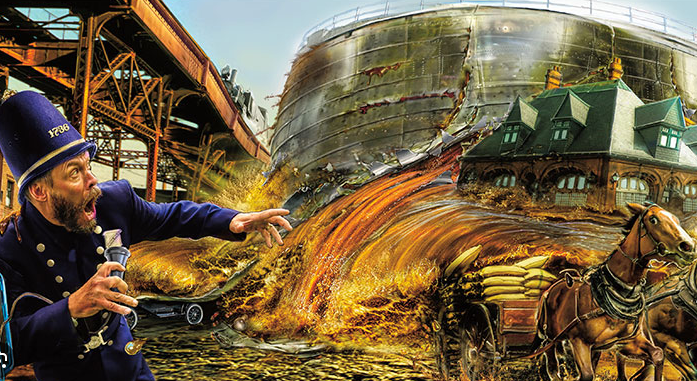
Boston never does things like the rest of the world. From our wicked different slang to our stubborn pride, we always have to put our own spin on things. Even our disasters can’t be normal. Could we have just had the ocean flood in? After all, half the city is built on landfill. But no — we had to do everyone one better. We flooded our streets with… molasses.
The Great Molasses Flood — Boston’s Stickiest Disaster
 Molasses — that thick, sticky, gooey goodness that makes muffins, cookies, baked beans, and BBQ possible. We drizzle it, bake with it, stir it into sauces. It’s comforting. Old‑fashioned. Harmless.
But did you know it can also be deadly?
No, it’s not poison. It’s sticky. Too sticky. Now imagine being buried under a massive wave of the stuff. Not funny. Nothing humorous about that. Yet it really happened — right here in New England.
In 1919, Boston faced one of the strangest disasters in American history: The Great Molasses Flood. By the time it was over, 21 people had died and about 150 were injured. And the story behind it is even wilder than the headline.
A Disaster Waiting to Happen
The giant molasses tank in Boston’s North End belonged to the United States Industrial Alcohol Company (USIA). It stood 50 feet tall and 90 feet across, holding more than 2 million gallons of molasses. From the day it went up, it leaked. Locals even joked that kids scraped molasses off the sides with sticks.
USIA knew the tank had problems. Instead of fixing the leaks, the company painted the tank brown to hide them. Workers reported groaning metal and bulging seams, but management brushed off every warning.
January 15, 1919 — The Day the Tank Burst
The day of the disaster felt unusually warm for January, warm enough to thin the molasses inside the tank. Around 12:40 p.m., the tank finally gave way with a roar that echoed through the neighborhood.
A 25‑foot‑high wave of molasses rushed through the streets at 35 miles per hour. Horses, wagons, buildings, and people were swept up instantly. The force of the wave even knocked a firehouse off its foundation.
Rescuers later described the scene as “drowning in brown glue.”
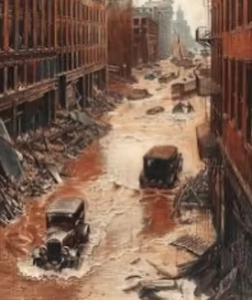
The Aftermath
 Cleanup dragged on for months. Crews used saltwater, sand, and firehoses to break up the sticky mess. For decades afterward, people swore the North End smelled like molasses on hot days.
The Fight for Justice
The Great Molasses Flood wasn’t just a freak accident — it resulted from corporate negligence. USIA had received multiple warnings about the tank’s structural integrity and ignored them. When survivors sued, the company tried to blame anarchists, claiming someone had sabotaged the tank.
The truth came out during six years of litigation and 3,000 witness testimonies. Eventually, a court‑appointed auditor ruled in favor of the victims. USIA paid $628,000 in settlements, the equivalent of about $11 million today. The tank never went back up.
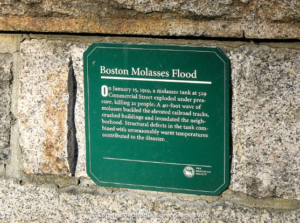
Today, the site is a small park near the Boston waterfront. Almost nothing there marks what happened. You could walk right over the spot where the tank stood and never know the neighborhood was once buried in molasses.
Why This Story Sticks With Us
The whole thing sounds like something out of Ripley’s Believe It or Not — and it has appeared there. It’s been featured on TV, in books, and in documentaries. Yet no matter how many times you hear it, the story still feels unbelievable.
A flood… of molasses?
And yet it happened. Sometimes the strangest stories in New England history are the ones that turn out to be absolutely true.