To Break or Not to Break- the Great Spaghetti Debate

Lovely long strands of spaghetti with meat sauce. Looks good


🍝 The Great Spaghetti Myth: Why We’re Told Not to Break It (and What Really Happens in the Pot)

Every home cook has heard it at least once — usually from a cookbook, a TV chef, or a well‑meaning relative:

“Never break spaghetti.”

It’s one of those kitchen commandments that gets passed down like gospel, even though most of us have no idea why. I certainly didn’t. I just knew that if I wanted the pasta to fit in my pot, I snapped it in half and moved on with my life.

Then one day I watched a cooking show where the chef placed long, elegant strands of spaghetti into a potPot too small? Lets get to the bottom of the great debate of boiling water… and left the top half sticking straight out like a pasta bouquet. As the bottom softened, the noodles slowly slid into the pot on their own, as if obeying some ancient culinary law.

It looked dramatic. It looked professional.
It also made absolutely no sense to me.

Wouldn’t the bottom half overcook while the top half was still raw?
Turns out — yes. Yes, it would.

So let’s bust this myth properly.


🍝 Myth #1: “Don’t break spaghetti — it’s wrong.”

This one comes straight from Italian culinary tradition. In Italy, pasta shapes are treated with the same respect we give to Thanksgiving turkey or Grandma’s cast‑iron skillet. Long pasta is meant to stay long because:

  • it twirls better
  • it holds certain sauces better
  • it creates a specific eating experience

Breaking it is seen as messing with the design.
But here’s the truth: there’s no practical kitchen disaster waiting for you if you snap a noodle. It’s mostly cultural, not scientific.


🍝 Myth #2: “Let the spaghetti stick out of the pot — it will slide in evenly.”

This one is pure TV magic.

Here’s what actually happens:

  • The submerged half starts cooking immediately.
  • The exposed half stays stiff and dry.
  • The bottom softens, bends, and eventually pulls the top down.

But by the time the top half finally joins the party, the bottom has already been cooking for a minute or two. That means uneven texture unless you’re stirring constantly — which, by the way, TV chefs are doing, just off‑camera.

So no, the “half‑in, half‑out” method doesn’t create some perfect, even cook. It just looks good on screen.


✔️ So what should you do?

The real technique — the one Italian cooks actually use — is simple:

  1. Put the spaghetti in whole.
  2. Let the ends stick out for 20–30 seconds.
  3. As soon as the submerged part softens, gently bend the rest into the water.
  4. Stir early and often.

That’s it. No snapping required, no dramatic pasta fountain, no uneven cooking.


🍝 Or… you can take the modern shortcut

If you don’t want to break spaghetti and you don’t want to deal with the Leaning Tower of Pasta routine, there’s a third option:

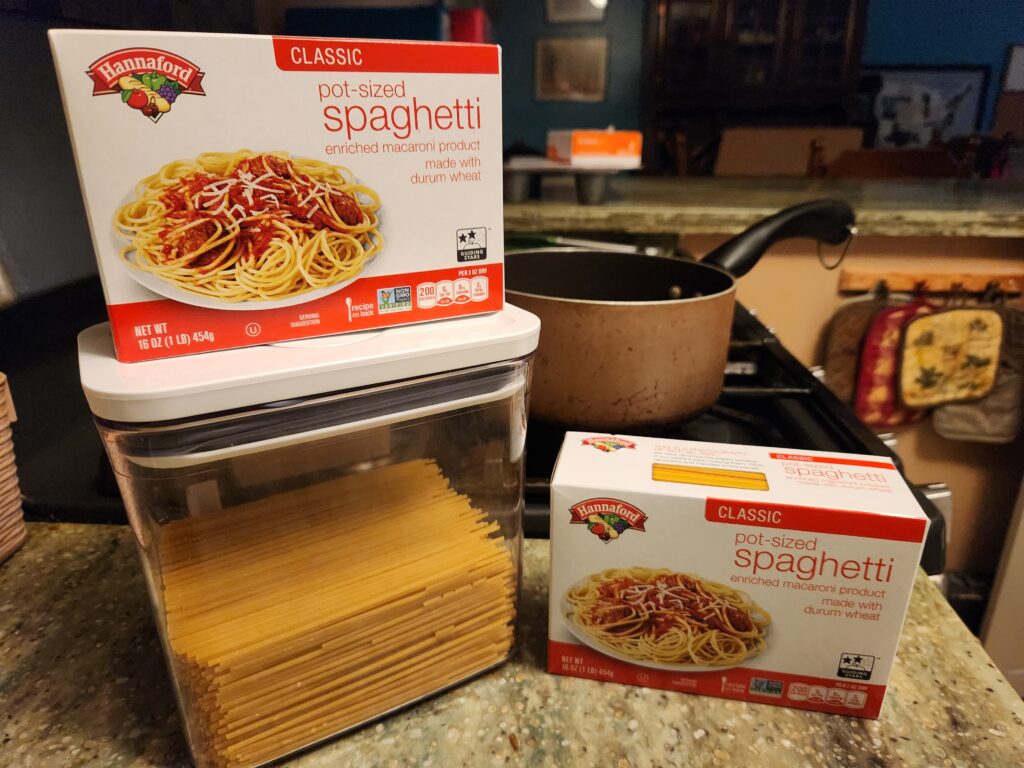
You can now buy “Pot‑Sized Spaghetti.”

It’s literally spaghetti that’s already cut to fit a standard pot.
No snapping.
No bending.
No half‑in, half‑out noodle acrobatics.

Just drop it in and go.

Purists may clutch their pearls, but honestly? It’s brilliant for busy home cooks who just want dinner on the table without a philosophical debate about noodle length.


🍽️ The Bottom Line

You can break spaghetti if you want.
You can leave it long if you prefer.
You can even buy the pot‑sized version and skip the whole issue entirely.

But now you know the why behind the myth — and the real science behind what’s happening in the pot.

And honestly? That’s half the fun of cooking: discovering that the rules we’ve been following forever sometimes have more to do with tradition than technique.

Mangia!


S’mores Mini Cookie Cups- No Campfire Required

S'mores cookie cups are a weet treat when an outdoor fire isn't an option


Aren't these little S'mores cookie cups cuteS’mores Mini Cookie Cups

Aren’t these the cutest little pies? Once again, I’m falling for a world in miniature. These don’t require any real baking skill—at least not much—and honestly, I only got caught up in them because they were adorable. Turns out they’re pretty tasty too.

These little beauties are S’mores Mini Cookie Cups. There are a couple of versions floating around out there, so let me share mine first. Then we can talk about the alternative.

My Version

All you need are:

  • Mini graham cracker shells
  • Mini marshmallows
  • A Hershey bar
  • Refrigerated chocolate chip cookie dough

Start with a layer of mini marshmallows in the graham cracker shell.
Add a couple pieces of chocolate.
Squish a small ball of cookie dough flat and place it over the top to make a little “crust.”

Bake in a 350° oven for 15–18 minutes, and voilà—a mini s’mores cookie cup.

Tip: Place them on a sheet of foil. Marshmallows can leak out the sides, and if they do, you’ll have a sticky mess. The foil makes cleanup a breeze.

The Alternative Version

Then there’s the version that skips the graham cracker crust. Personally, that ruins the s’mores vibe for me, but to each their own.

For this one, press enough cookie dough into a mini muffin cup to form a little “cup.” Add marshmallows and chocolate, leaving the top open. Bake at 350° until the cookie cup is done. When they come out, top with another marshmallow and pop them under the broiler for 1–2 minutes to toast.

A Word of Warning

The only real stipulation for either variation is that you have to like sweet. These are sweet. I’ve always avoided traditional s’mores because they’re too sugary for me, but these were so cute I had to try them. They’re easy to put together and definitely satisfy a craving for something indulgent.

Your Turn

Okay, s’mores fans, time to sound off. Are you Team Graham Crust or waving the flag for Team Cookie Cup today?


Dusty’s Smothered Pork Chops


My Long‑Time Favorite Pork Chop Recipe

Smothered pork chops surrounded by gravy. Of course it's in a cast iron skillet

A Little Backstory

Recently I shared two new pork chop recipes — Rediscovering Pork Chops and Pork Chops Take 2.
Now I’m down to the last of the chops, which means there’s room for one more recipe before I take a break. I actually have another new one waiting in the wings, but that will have to wait for my next pork chop run.

Today’s recipe is my long‑time favorite. It goes all the way back to the 1970s, when I’d just gotten my first professional (non‑waitress!) job. One of my coworkers told me he always made his pork chops in a skillet with Campbell’s Golden Mushroom soup. He insisted it had to be Golden Mushroom — not Cream of Mushroom.

I tried it, loved it, and over the years it evolved into the version I make today. It’s still simple, still comforting, and still one of my go‑to meals.


Dusty’s Smothered Chops

Ingredients

  • 4 thick‑cut, boneless center‑cut pork chops
  • 2 cans Campbell’s Golden Mushroom Soup
  • 2 cans sliced potatoes
  • 1 small can sliced mushrooms (optional)
  • Salt and pepper to taste

Directions

  1. Heat a large skillet over medium‑high heat and add a light skim of oil (about 2 Tbsp).
    (I love a cast iron skillet for this.)
  2. Generously salt and pepper both sides of the chops. Add them to the hot pan and sear for color — about 2 minutes per side.
    Do not cook through.
  3. Transfer the chops to your slow cooker and pour in the soup. Add the sliced potatoes and the optional mushrooms, then stir gently to combine.
  4. Set to Low and cook for 6–8 hours.

Notes

  • Your chops will come out melt‑in‑your‑mouth tender.
  • The Golden Mushroom soup makes a wonderful gravy.
  • Add the optional mushrooms if you like a little extra.

Golden Mushroom vs. Cream of Mushroom

Why Golden Mushroom?

Golden Mushroom soup acts more like a flavor concentrate than a creamy base.
It melts into the pan juices and creates a rich, savory gravy that clings beautifully to pork chops — especially when you brown them first.

Can You Substitute Cream of Mushroom?

Not unless you want an entirely different vibe.

  • Cream of Mushroom makes the dish creamy and mild.
  • Golden Mushroom makes it bold, savory, and deeply seasoned.

In my own words… Yummy!


Wrapping Up

So that’s it — the last of this pork chop run. I’m all out for now, but I’m sure we’ll circle back another time.

How do you cook pork chops in your home? I’d love to know.


The Kitchen Declutter Adventure , Week 2

Excellent progress on the bathroom. It truly took just 30 minutes a day — even with Banner and Balboa “helping.” All that’s left is to sweep out the bottom of the vanity and I can call Week 1 wrapped.


  • The Vanity Corner

Week 2: Kitchen & Pantry — The Real Test Begins

My decluttering adventure continues.

As you may recall, AARP claims you can declutter your entire home in 30 days. I’m testing that theory, one week at a time. Week 1 went surprisingly well — and yes, it really did take less than 30 minutes a day. It helped that I redecorated the bathroom a couple of years ago, so I wasn’t dealing with 20 years of fossilized lotions. Plus, I had Banner’s “help” with the medicine cabinet and Balboa’s supervision from the over‑the‑toilet storage shelves.

Somewhere in the middle of all this, my browser crashed. Not the computer — just the browser — but it slowed me down enough that I ended up “decluttering” my hard drive instead of my home. That saga deserves its own post.

But onward. Week 2 is Kitchen and Pantry, and the rules remain the same: no more than 30 minutes a day.

My tiny kitchen where culinary magic happens

My tiny kitchen where culinary magic happens

AARP suggests tackling the junk drawer on a weekday and getting rid of duplicates. Cabinets are also weekday tasks, except for the “big ones.” In my tiny kitchen, I’m not entirely sure what qualifies as a big cabinet, but the bottom line is clear: declutter them all.

Not a junk drawer, mostly confused

This is where things get emotional.

The mugs.

The Mug Cabinet

I have souvenir mugs from trips, funny mugs, mugs with pictures, mugs that remind me of people, places, and moments. One of the tasks this week is to thin those out and make room on the shelf. The rule is simple: if you don’t use it, out it goes. The rule is also cruel.

At least I can say one cabinet is already in good shape. The under‑sink cabinet is practically a showpiece at this point — I’ve been cleaning it out for the past year. Can I count that as “one down”? I’m counting it.

Pots, pans and baking essentials, all necessary for my culinary adventures

Pots, pans and baking essentials

Of course, Banner and Balboa will be deeply involved in this week’s work. They love the under‑sink cabinet. They’ve both figured out how to open the door even though it’s on a spring. I always know when they’re in there because I hear the rhythmic thud… thud… thud of the door swinging shut behind them.

The spice cabinet

So here we go. The clock is ticking, the mugs are trembling, and Week 2 begins. Can we get the kitchen back to it’s former glory? Let’s find out.

Counter Clutter


Pork Chops, Take Two: The Marinade Edition

Pork Chop experiments continue in Dusty's test kitchen


Overnight Soy & Worcestershire Pork Chops

Can success strike twice in Dusty’s Test Kitchen? Let’s find out.

It was another busy day in Dusty’s Test Kitchen, and yes — the pork‑chop experiments continue. My first attempt, Rediscovering Pork Chops: A Cast Iron Success Story, turned out so well that I had to try again. Could I repeat the magic?

This recipe is a little more involved than the last one, mostly because it needs an overnight marinade. But once the cooking starts, everything moves fast and easy.


Ingredients

Marinade

  • ½ cup soy sauce
  • ÂĽ cup Worcestershire sauce
  • 2 tbsp olive oil
  • 1 tsp paprika
  • 1 tsp garlic powder
  • 1 tsp onion powder
  • ½ tsp black pepper
  • ½ tsp salt (optional, depending on your soy sauce)
  • Optional: 1 tbsp brown sugar
  • Optional: ½ tsp ginger powder

Finishing

  • 3–4 tbsp butter, cut into pats
  • Optional: 2 smashed garlic cloves or a few thyme sprigs

Instructions

1. Marinate Overnight

  1. Whisk all marinade ingredients together.
  2. Add pork chops and coat well.
  3. Refrigerate 8–24 hours.
  4. Remove from the fridge 20–30 minutes before cooking.

2. Pan‑Sear

  1. Preheat oven to 400°F.
  2. Heat a cast‑iron or heavy skillet over medium‑high until very hot.
  3. Add a thin layer of oil.
  4. Sear chops 2 minutes per side to develop color.
    • Do not cook through during this step.

3. Oven Finish with Butter

  1. Turn off the stovetop heat.
  2. Add the pats of butter to the bottom of the pan.
  3. Place the seared chops on top of the butter.
  4. Transfer the pan to the oven.
  5. Bake 5–8 minutes, depending on thickness.
  6. Remove when internal temperature reaches 140–145°F.
  7. Let rest 5 minutes before serving.


Notes

  • This method keeps thinner chops tender by combining a moisture‑boosting marinade, a quick sear, and a gentle oven finish.
  • The butter melts underneath the chops and bastes them as they finish, giving a glossy, savory finish.
  • Works with bone‑in chops too — just add 2–4 minutes to the oven time.
  • I served mine with oven‑roasted potatoes. I started the potatoes when I took the chops out of the refrigerator, so they had a 30‑minute head start.


My Rating

I’m giving this one 4 stars. Very flavorful, very tender — just shy of that 5‑star wow factor for me. But you can be the judge.