Baked Alaska The Dessert, Not The State

  
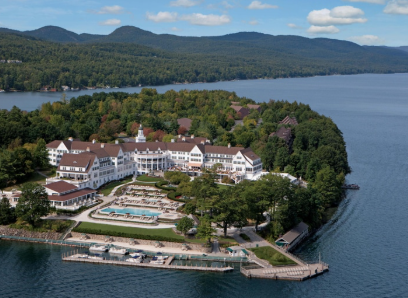
A large lakeside resort complex on Green Island in Lake George, New York, featuring white buildings with brown roofs, outdoor pools, landscaped grounds, and a long dock extending into the lake. The resort is surrounded by dense green forest and distant mountains under a clear sky.

Growing Up a Resort Town Kid

Here we go again, falling down the nostalgia rabbit hole.

A friend of mine posted some vacation photos on Instagram, and one of them was captioned Sagamore Hotel. I immediately dropped him a note: Is that the Sagamore on Lake George? The one on Green Island in Bolton Landing?

When he said yes, they were vacationing there, I of course responded, That’s my hometown! Not the Sagamore itself, of course, but Bolton Landing. To this day it still surprises me when anyone says they know where it is. Everyone has heard of Lake George, but not Bolton Landing.

But I’m getting off track.

The Sagamore was a big convention hotel when I was growing up. They catered to business conferences, and then came the “social season,” when the rich folks from New York City arrived to enjoy the lake. That’s how us locals thought of them. After all, we couldn’t afford to stay at The Sagamore — so obviously the people who did must be rich, right? It was just one of those unspoken small‑town truths.

A spacious hotel lobby with rustic décor, featuring a large round wooden table with decorative vases, comfortable seating areas with earth‑tone armchairs and sofas, stone tile flooring, framed photos on the wall, and a mounted deer head creating a cozy lodge‑style atmosphere.


I had a summer job working with the local photographer. Mostly it meant sitting in the lobby next to a display board of photos and taking orders, but occasionally he’d bring me along for banquet night as his assistant. My job was simple: keep the film cartridges loaded and ready to hand over fast. This was especially important when the banquet started.


All the diners would be seated, and then the kitchen doors swung open. White‑suited chefs and waiters paraded in with huge trays balanced on their shoulders. And coming up the rear was the pièce de résistance — the flaming Baked Alaska. It was always quite a spectacle.

  
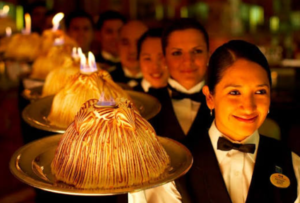
A row of formally dressed servers carrying dome‑shaped Baked Alaska desserts with browned meringue and small blue flames on top, presenting them in a coordinated procession during a banquet. The warm lighting and flames create a dramatic, celebratory atmosphere.

I had no idea then what Baked Alaska actually was, except that it was a dessert that made a grand entrance in flames. Imagine my surprise when I eventually learned it was basically ice cream. What? Doesn’t it melt?

I’m older now and a bit more kitchen‑wise, but I still don’t know if I’m brave enough to try this retro dessert.

Are you?

A Little History Before We Get to the Recipe

Baked Alaska goes all the way back to the mid‑1800s, when chefs were experimenting with the science of heat insulation. The idea was almost comical: wrap ice cream in a thick layer of meringue, then blast it with high heat. The meringue acts like a fluffy winter coat, protecting the frozen center.

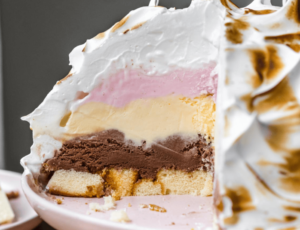
The dessert became famous at Delmonico’s Restaurant in New York City, where chef Charles Ranhofer originallyA close-up slice of Baked Alaska showing layers of sponge cake, chocolate, vanilla, and strawberry ice cream, all covered in a thick coating of toasted meringue with golden-brown peaks. called it Alaska, Florida — cold inside, hot outside. Over time the name evolved into Baked Alaska, and restaurants began presenting it with full theatrical flair: dimmed lights, flaming rum, and waiters parading it through the dining room like royalty.

That’s the version I saw at the Sagamore — the classic banquet‑hall Baked Alaska, flaming and dramatic and absolutely unforgettable.

But the classic version is… well… a production. So here’s a simplified, home‑friendly version that gives you the magic without the stress.

🍨 Simplified Baked Alaska (Home-Friendly Version)

Ingredients

  • 1 pound cake (store‑bought works perfectly)
  • 1 pint ice cream (any flavor you love)
  • 3 large egg whites
  • ½ cup sugar
  • ½ teaspoon vanilla extract
  • Pinch of salt

Instructions

  1. Prepare the base: Cut the pound cake into a circle or square slightly larger than your ice cream dome. Place it on a parchment‑lined baking sheet.
  2. Add the ice cream: Scoop the ice cream into a rounded mound on top of the cake. Freeze for at least 1 hour so it’s firm.
  3. Make the meringue: Beat egg whites and salt until foamy. Gradually add sugar and vanilla. Continue beating until stiff, glossy peaks form.
  4. Cover completely: Spread the meringue over the ice cream and cake, making sure it’s sealed with no gaps. This insulation is what keeps the ice cream from melting.
  5. Bake quickly: Bake at 500°F for 3–5 minutes, just until the meringue is golden. (Or use a kitchen torch for even easier browning.)
  6. Serve immediately: Slice and enjoy the magic — warm meringue outside, cold ice cream inside.

A dome-shaped Baked Alaska covered in toasted meringue with golden-brown peaks, sitting on a decorative plate with fresh strawberries blurred in the background.

Final Thoughts

So there you have it — a little Baked Alaska nostalgia. It’s one of those retro desserts that deserves a comeback. Meringue and ice cream? Yes, please.


Lake Monsters of the Adirondacks: My Family’s Monster‑Free Record


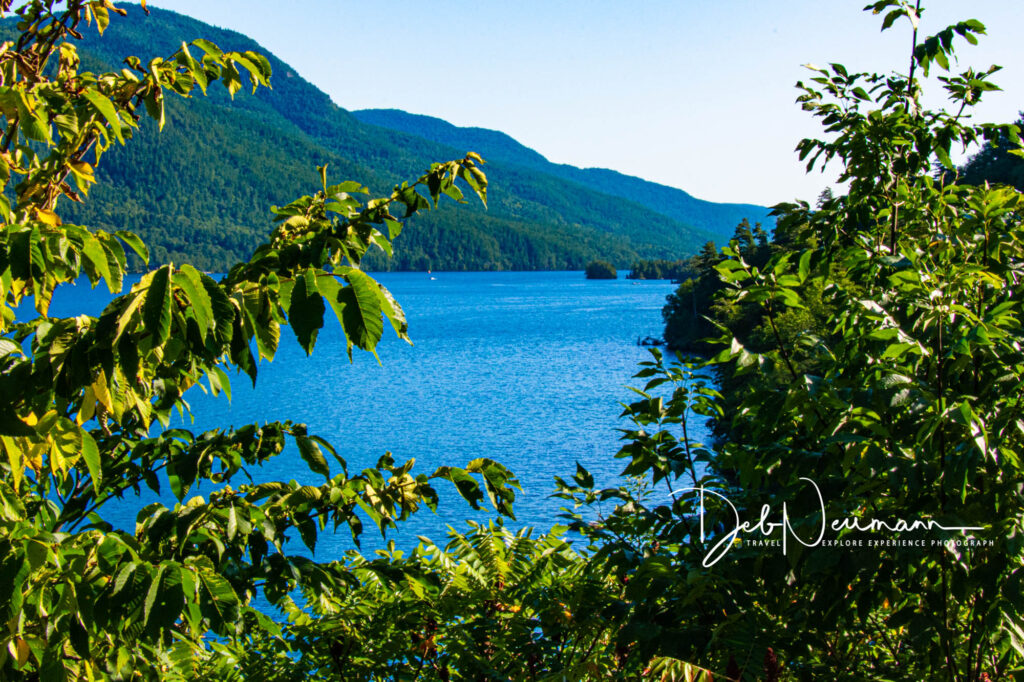
Beautiful Lake George surrounded by lush green hills, framed by leafy branches in the foreground, with a small sailboat visible on the water under a clear sky.

Growing Up Between Two Monster Lakes
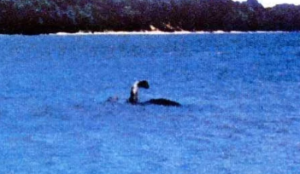
My family has spent a lot of time on the two Adirondack lakes most famous for monster sightings. My mother grew up in Ticonderoga, right between Lake George and Lake Champlain, and I spent my childhood on Lake George. We used to road‑trip to Vermont and often took the ferry across Lake Champlain. If Champ was going to make an appearance, we were giving him every opportunity.

He never did. My mother never saw him either. Not even a suspicious ripple.

Champ is the celebrity cryptid of the region — the Adirondack Nessie — and people have been reporting sightings since the 1800s. Meanwhile, my family crossed that lake so many times we practically deserved a loyalty punch card, and still: nothing. Not even a polite bubble.

Champ: The Famous Monster Who Never Showed Up
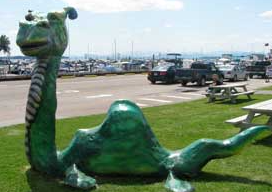
Champ gets all the attention. Books, documentaries, blurry photos, breathless eyewitness accounts — he’s the star of Lake Champlain. And yet, despite all those ferry crossings, neither my mother nor I ever saw anything that even hinted at a lake monster.

Plenty of waves. Plenty of logs. Zero monsters.
Georgie: The Lake George Monster We All Joked About

Lake George has a monster too, though it’s a much quieter legend. Growing up, we kids always joked about “Georgie,” the Lake George lake monster. I assumed Georgie was just the local version of Champ — a long‑necked creature lurking in the deep water, ready to pop up and terrify boaters.


I never knew Georgie had an actual origin story. Apparently most people don’t, because Georgie tends to get lumped in with Champ and Nessie as if he’s part of the same folklore family.

He isn’t.

The Wild, Forgotten Origin Story of Georgie

Georgie was a hoax — and a spectacular one.

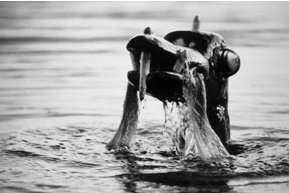
Back in 1904, painter Harry Watrous built a ten‑foot lake monster out of a cedar log, complete with a skinny neck, big eyes, a wide mouth, and hemp‑rope whiskers. He created it to get revenge on a newspaper editor who had tricked him with a fake giant trout.

Watrous anchored his monster in Hague Bay and rigged it with a pulley system so he could make it rise dramatically out of the water whenever he felt like causing chaos.

And he did.

Panicked boaters, screaming passengers, parasol attacks — Georgie caused absolute mayhem. Watrous revived the monster again in 1934 just to “spoof the world” one more time. The original Georgie still exists and lives at the historical museum in Hague.
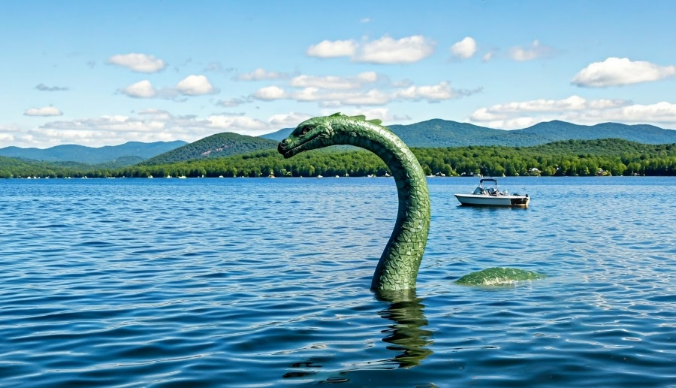
None of this made it into the version of Georgie I grew up with. To us, Georgie was just the Lake George monster — the one we joked about while swimming or boating, the one we pretended might be lurking under the dock. The prank faded, but the idea stuck.

My Family’s Real Lake Sightings (Everything Except Monsters)
And despite all that time on the lake, I never saw Georgie. My mother never saw Georgie. And my brother — who has spent more time on Lake George than anyone I know — has never seen Georgie.

This is impressive, because my brother has seen everything else.

He’s seen rattlesnakes swimming across Lake George. The lake’s had rabid beavers. He’s seen deer swimming across the lake like they’re training for a triathlon. He’s seen strange wakes, odd shadows, weird currents, and fog that makes the lake look like a horror movie set. There have even been water spouts!
Island Camping: Prime Monster Hours, Still No Monsters

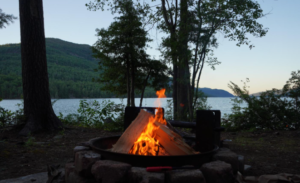
My brother also camps out on the Lake George islands during the summer, which means he’s out there at night — prime monster hours. If Georgie were real, my brother would have had front‑row seats.

But no. Not a single monster sighting.

If Monsters Exist, They’re Avoiding Us

Between Champ and Georgie, the Adirondacks are supposedly home to two lake monsters. My family has spent generations swimming, boating, camping, ferrying, and occasionally dodging rabid beavers — and we’ve never seen one. Not even a hint.

If the monsters are out there, they’re clearly shy… or they’ve decided my family isn’t worth the trouble.
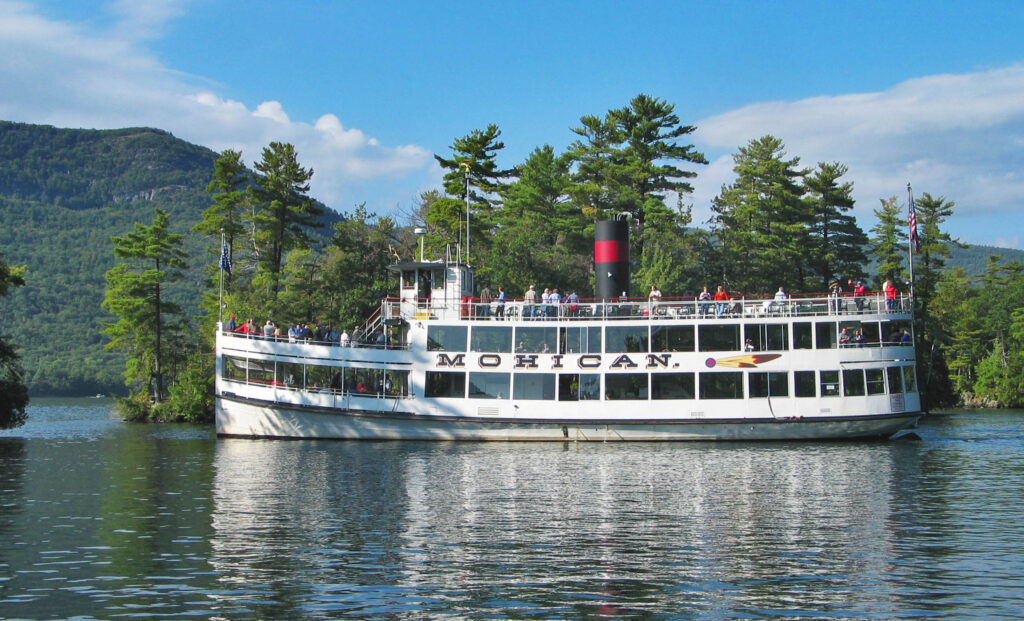
Mohican-Paradise-Bay-
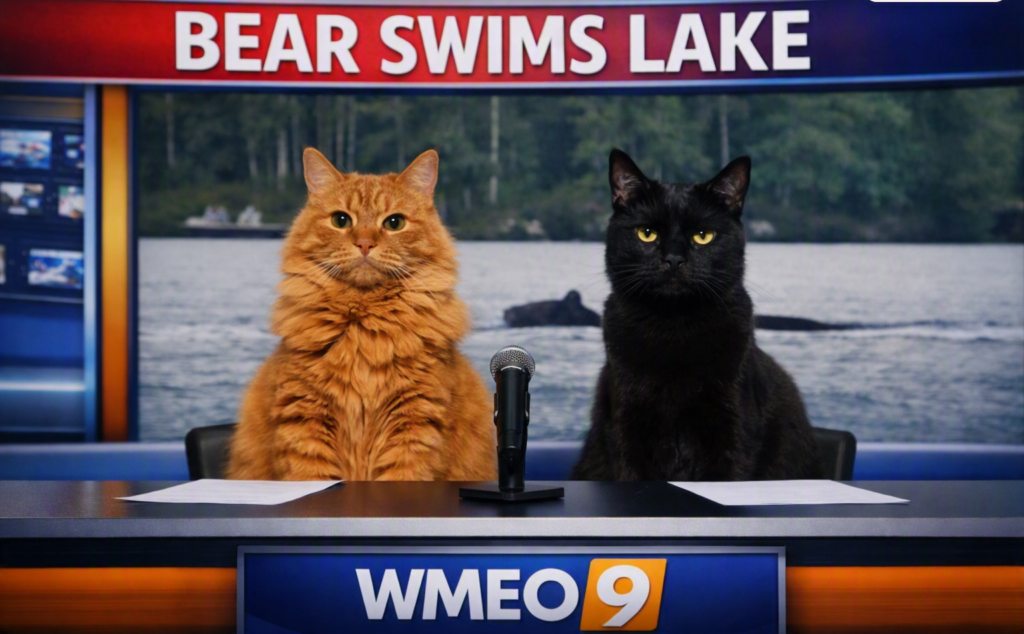

 

WMEO Breaking News Alert: Rabid Beaver at Lake George

Now from the feline news desk at WMEO 9 — We Meow, You Listen — we bring you the latest update on the rabid beaver situation in beautiful Lake George, NY.

Dateline: Turtle Island, Lake George, New York The WMEO newsroom is issuing an urgent wildlife safety alert after a rabid beaver attacked swimmers on July 4th. The victims fought off the animal and were transported for hospital treatment, including post‑exposure rabies shots.

A dead beaver was later recovered . The beaver subsequently tested positive for rabies.

Story credit: WPTZ NewsChannel 5.

Rabid beavers are extremely rare. Cape Cod has had rabid raccoons in the past, and officials believe this beaver may have contracted rabies from a raccoon. Rare doesn’t mean impossible — and this incident is a reminder that wildlife can behave unpredictably when sick.

WMEO Newsroom Reaction

Banner’s Response

Banner immediately leapt onto the anchor desk, puffed up like a tiny orange emergency beacon, and announced:

“I knew beavers were suspicious! This is why I don’t swim. Water is plotting things.”

He then attempted to draw a “danger map” of Lake George using a paw dipped in tuna juice. It was… interpretive at best.

Balboa’s Response

Balboa froze mid‑snack, eyes wide, tail tucked, and whispered:

“Rabid… beavers? Deborah, I’m staying inside forever. I’ll just live in my box.”

He checked the WMEO garden cam three times to ensure no beavers were approaching the house.

WMEO Safety Bulletin

While the newsroom cats are spiraling, here’s the real takeaway:

  • Never approach wildlife, even if it looks calm or curious.
  • Leave swimming animals alone — especially if they’re behaving strangely.
  • Report unusual or aggressive behavior to local authorities.
  • Rabies is fatal if untreated, so post‑exposure shots are essential.
  • Any mammal can carry rabies, even species we don’t normally associate with it.

Nature is beautiful — but it’s also wild, and sometimes dangerous.

WMEO Closing Note

Banner has issued a formal statement demanding “protective floaties for all cats.” Balboa has requested “a beaver‑free perimeter around Turtle Island.” Both requests have been denied.

Stay safe out there, friends. Respect wildlife. And remember: if a beaver starts swimming toward you with purpose… exit the water immediately.

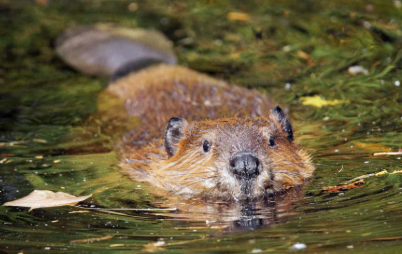
A beaver swimming in calm water with its wet head and upper body visible above the surface, surrounded by ripples and floating leaves.

End of bulletin. Please resume your regularly scheduled scrolling.

This has been a WMEO 9 New Update!


Echoes Over Water: The Enchanting World of the Common Loon

A Song That Haunts the Lakes

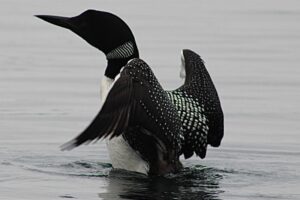
If you’ve ever spent a quiet evening near a northern lake, chances are you’ve heard it—that eerie, tremolo call drifting across the water like a ghost of the wilderness. The common loon (Gavia immer) is more than just a bird; it’s a symbol of solitude, wildness, and the deep stillness of nature. Their calls range from mournful wails to yodels that echo across the surface, each one a language of territory, courtship, and connection.

They Wear Drama Like a Cloak

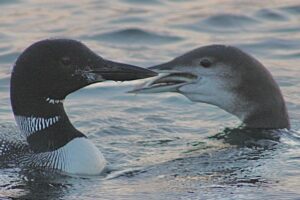
In summer, loons dazzle with black heads, dagger-like bills, and checkerboard backs that shimmer under sunlight. Their red eyes pierce the water as they dive for fish. Built for swimming, loons push through lakes with powerful strokes, thanks to legs set far back on their bodies. On land, they waddle awkwardly—but in water, they reign. You’ll rarely see a loon on land unless it’s nesting.

Photo Credit Jim Neumann

Parenting on the Water

Loons nest close to shore, often on small islands or floating vegetation. Both parents share the duties, and once the chicks hatch, they ride on their parents’ backs to stay warm and safe. It’s one of nature’s most endearing sights—tiny fluffballs hitching a ride across the lake.

Photo credit Jim Neumann

A Shout-Out to My Brother

This post wouldn’t be complete without a huge shout-out to my brother, Jim, whose loon photography captures their mystique with breathtaking clarity. His lens finds the soul of these birds—the shimmer of water, the intensity of their gaze, the quiet power of their presence. His photos remind us that loons aren’t just birds; they’re storytellers of the wild.

Photo Credit Jim Neumann

Where to Spot Them

In Massachusetts, loons are more common in the Berkshires and northern lakes. They have been spotted in places like Quabbin Reservoir.  During migration you might even find them near coastal waters. Keep your ears open and your binoculars ready—these birds are worth the wait.

Photo credit Jim Neumann

My brother’s Photos were taken on Lake George, NY


Happy Memorial Day Weekend

It’s Memorial Day Weekend

The three day, aka long Memorial Day Weekend, is here.  You, service men and women,  gave, not just weekends, but your sometimes your lives, so that we can have the lifestyle we enjoy today. Things would be much different if not for you and your sacrifices. Thank you. 

Memorial Day is Different this year

No More Masks! COVID restrictions are in the past!  There’s a new   level of freedom to Memorial Day after a year plus of lockdown.  Time for the Family Bar B Ques and celebrations, except mother nature isn’t cooperating.  Looks line rain in the forecast for the whole weekend  making  the unofficial start of summer  a bit of a dud. 

Are We Traveling?

The American Automobile Association (AAA) is predicting that more than 37 million people will travel at least 50 miles over the weekend, representing a 60% increase over last year.

I’d say travel this weekend is back with a vengeance. Even I had plans to dust off the camera and head out. I was thinking about going into Boston. The Flag Garden is back on the Common this year. It’s made up of 37,000 small flags  each one representing a fallen service member dating to the Revolutionary War. I think that must be an awesome sight and I’d like to have some photos of it. 

And Speaking of Traveling

Lake George, NY 2020

I am getting restless. I said I’d wait until next year but I’m not so sure about that now. Time to pull out a suitcase to get the cats used to seeing it.


Colorado is a definite and maybe Branson,  Missouri.  I think I will do a quick day trip or two to New Hampshire and maybe a long weekend to Lake George. I guess I need to get planning! Travel is back!