Growing Up a Resort Town Kid
Here we go again, falling down the nostalgia rabbit hole.
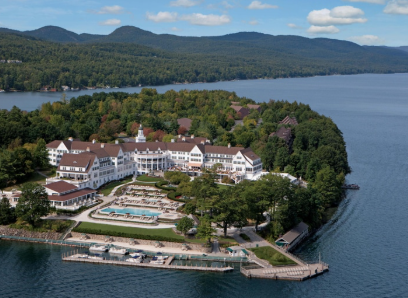
A friend of mine posted some vacation photos on Instagram, and one of them was captioned Sagamore Hotel. I immediately dropped him a note: Is that the Sagamore on Lake George? The one on Green Island in Bolton Landing?
When he said yes, they were vacationing there, I of course responded, That’s my hometown! Not the Sagamore itself, of course, but Bolton Landing. To this day it still surprises me when anyone says they know where it is. Everyone has heard of Lake George, but not Bolton Landing.
But I’m getting off track.
The Sagamore was a big convention hotel when I was growing up. They catered to business conferences, and then came the “social season,” when the rich folks from New York City arrived to enjoy the lake. That’s how us locals thought of them. After all, we couldn’t afford to stay at The Sagamore — so obviously the people who did must be rich, right? It was just one of those unspoken small‑town truths.
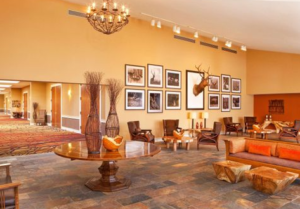
I had a summer job working with the local photographer. Mostly it meant sitting in the lobby next to a display board of photos and taking orders, but occasionally he’d bring me along for banquet night as his assistant. My job was simple: keep the film cartridges loaded and ready to hand over fast. This was especially important when the banquet started.
All the diners would be seated, and then the kitchen doors swung open. White‑suited chefs and waiters paraded in with huge trays balanced on their shoulders. And coming up the rear was the pièce de résistance — the flaming Baked Alaska. It was always quite a spectacle.
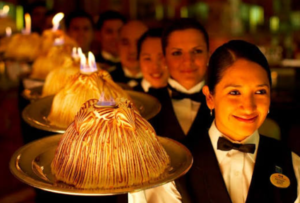
I had no idea then what Baked Alaska actually was, except that it was a dessert that made a grand entrance in flames. Imagine my surprise when I eventually learned it was basically ice cream. What? Doesn’t it melt?
I’m older now and a bit more kitchen‑wise, but I still don’t know if I’m brave enough to try this retro dessert.
Are you?
A Little History Before We Get to the Recipe
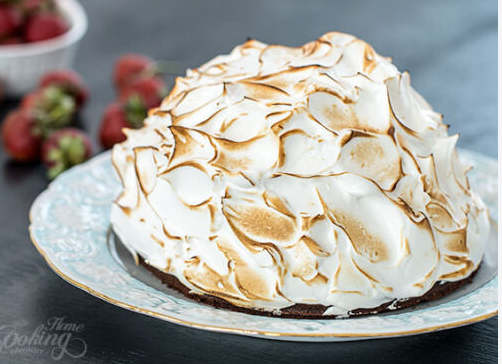
Baked Alaska goes all the way back to the mid‑1800s, when chefs were experimenting with the science of heat insulation. The idea was almost comical: wrap ice cream in a thick layer of meringue, then blast it with high heat. The meringue acts like a fluffy winter coat, protecting the frozen center.
The dessert became famous at Delmonico’s Restaurant in New York City, where chef Charles Ranhofer originally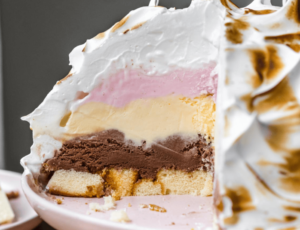 called it Alaska, Florida — cold inside, hot outside. Over time the name evolved into Baked Alaska, and restaurants began presenting it with full theatrical flair: dimmed lights, flaming rum, and waiters parading it through the dining room like royalty.
That’s the version I saw at the Sagamore — the classic banquet‑hall Baked Alaska, flaming and dramatic and absolutely unforgettable.
But the classic version is… well… a production. So here’s a simplified, home‑friendly version that gives you the magic without the stress.
🍨 Simplified Baked Alaska (Home-Friendly Version)
Ingredients
- 1 pound cake (store‑bought works perfectly)
- 1 pint ice cream (any flavor you love)
- 3 large egg whites
- ½ cup sugar
- ½ teaspoon vanilla extract
- Pinch of salt
Instructions
- Prepare the base: Cut the pound cake into a circle or square slightly larger than your ice cream dome. Place it on a parchment‑lined baking sheet.
- Add the ice cream: Scoop the ice cream into a rounded mound on top of the cake. Freeze for at least 1 hour so it’s firm.
- Make the meringue: Beat egg whites and salt until foamy. Gradually add sugar and vanilla. Continue beating until stiff, glossy peaks form.
- Cover completely: Spread the meringue over the ice cream and cake, making sure it’s sealed with no gaps. This insulation is what keeps the ice cream from melting.
- Bake quickly: Bake at 500°F for 3–5 minutes, just until the meringue is golden. (Or use a kitchen torch for even easier browning.)
- Serve immediately: Slice and enjoy the magic — warm meringue outside, cold ice cream inside.
Final Thoughts
So there you have it — a little Baked Alaska nostalgia. It’s one of those retro desserts that deserves a comeback. Meringue and ice cream? Yes, please.
Share this:
- Share on Tumblr (Opens in new window) Tumblr
- Print (Opens in new window) Print
- Share on X (Opens in new window) X
- Share on Facebook (Opens in new window) Facebook
- Share on Pinterest (Opens in new window) Pinterest
- Share on Reddit (Opens in new window) Reddit
- Share on LinkedIn (Opens in new window) LinkedIn