DINOSAURS IN NEW ENGLAND- IT’S A JURASSIC WORLD

A group of large, long‑necked dinosaurs walk through a dense prehistoric forest lit by warm golden sunlight. Tall trees rise around them, ferns cover the ground, and distant mountains fade into the background. Several pterosaurs glide overhead, adding depth to the ancient landscape.

⭐ Dinosaurs Always get my attention

The other night, as I was browsing through my streaming services for something new to watch, I stumbled across a documentary about how feathers developed in dinosaurs. I really enjoyed it — lots of AI‑generated dinos racing across prehistoric landscapes, parallels to modern birds, and a fresh twist on the whole “bird brain” idea. Turns out they were pretty intelligent.

Anyway, that got me thinking about dino digs, trackways, and all that good stuff. I actually visited a dinosaur dig in South Dakota once, and there’s that show Dino Hunters set in Montana, Wyoming, and South Dakota. And of course there’s the famous dinosaur trackway in Texas. It always feels like we’re headed west to find the remains of these creatures.

Nope. If you’re New England born and raised, you can see dinosaur tracks right here in the Northeast. We have our share too. Not that a western trip isn’t a great vacation option — but let’s think about what’s closer to home.

Once you start looking into it, you realize New England has some genuinely amazing prehistoric secrets tucked between its forests, highways, and old mill towns. One of the best examples is right in western Massachusetts:

🦕 Dinosaur Footprints Reservation — Holyoke, MA

This place is a gem. It’s an 8‑acre stretch of sandstone along Route 5 where hundreds of Early Jurassic dinosaur tracks are preserved exactly where the animals walked about 190 million years ago. No casts, no replicas — the real deal.

It’s incredibly easy to visit:

  • Location: 1099 US‑5, Holyoke, MA
  • Open: April 1–November 30, sunrise to sunset
  • Cost: Free
  • Walk: A short 0.2‑mile path from the parking area

Once you’re there, you can wander along a simple trail and see:

  • Tracks from four distinct types of dinosaurs
  • Fossilized ripple marks from ancient pools
  • Plant impressions and invertebrate traces
  • Layers of sandstone that literally hold the footsteps of creatures who lived long before New England had forests, colonists, or even mountains in their current shape

A couple of rules keep the site safe:

  • No crossing the railroad tracks
  • Dogs must stay leashed
  • No mountain biking

If you want to make a day of it, the Amherst College Museum of Natural History is nearby and has the world’s largest collection of dinosaur tracks — over 1,700 specimens, many from the Connecticut River Valley. Granby, MA also has additional track sites if you’re in full dino‑detective mode.

And here’s the funny part…

Even when you’re in western Massachusetts, you’re still kind of “going west” for dinosaur tracks — just not that far west. Holyoke, Granby, Amherst… they all sit along the Connecticut River Valley, which turns out to be one of the richest dinosaur trackway regions in the entire country.

Follow that ancient rift basin south, and you hit one of the biggest dinosaur track discoveries in North America.

🦖 Dinosaur State Park — Rocky Hill, Connecticut

If Massachusetts gives you a taste of New England’s prehistoric past, Connecticut serves the full entrée.

Dinosaur State Park is home to over 2,000 dinosaur footprints, most attributed to a three‑toed carnivore called Eubrontes. The tracks were discovered in 1966 during construction work — imagine being the person who looked down and realized the bulldozer had just uncovered a dinosaur highway.

Only a portion of the site is visible under the geodesic dome, but thousands more tracks remain buried for preservation. It’s one of the largest trackways ever found, and it’s only a short drive from anywhere in southern New England.

The park also has:

  • A museum with exhibits on the Triassic/Jurassic world
  • Outdoor trails through the rift‑valley landscape
  • A casting area where kids (and adults, no judgment) can make their own plaster track replicas

It’s the perfect example of why this post had to become Dinos in New England, not just Dinos in Massachusetts. The whole region is part of the same prehistoric story.

Closing

So go west, you dino hunters of today — just don’t go as far as you thought. Explore western Massachusetts and the Connecticut River Valley. Wander the sandstone, follow the ancient rift, and let those fossilized footprints pull you straight back into the age of dinosaurs. All of it waiting right here in our own backyard.

One More Thing

If you’re craving something a little more fantastical after all that real science, you can also check out Dino Safari at CambridgeSide. It’s a walk‑through adventure featuring life‑size animatronic dinosaurs, hands‑on fossil digs, a scavenger hunt, and even a virtual‑reality experience. It’s a limited‑time exhibit, closing on September 7, so don’t wait too long to visit.


Happy Birthday to Balboa, Age 6, Professional Diva

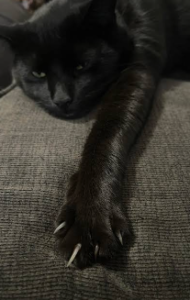
Black house panther cat with striking yellow eyes lounging on a blanket, showing his diva personality.

A House Panther’s Sixth Year: Drama, Treats, and Tiny Claw Pokes

Six years ago, I adopted a “shy, skittish” cat. They said you’d hide. You’d be nervous. They did not say you’d become the CEO of the household and union leader of the Treats & Cat Grass Department.

You were never shy with me — but strangers? The door opens and you perform a disappearing act that would make Houdini proud. Banner might try to escape for adventure; you vanish to avoid conversation.

You’ve grown from a tiny lap kitten into a full-grown house panther who still needs pre‑appointment medication just to survive a vet visit. It’s a checkup, Balboa, not an assassination attempt. No one is plotting your demise; they just want to look in your ears.

Fireworks remain your mortal enemy. Banner watches them like he’s waiting for popcorn, but you hear one “pop” and immediately enter Witness Protection. This year’s barrage was especially bad; you’re still decompressing in your safe zones like a little furry war veteran, tucked into your kitty condos and behind the headboard. Can cats have PTSD?

But when the world is quiet? Balboa, you strut. You rule. It’s snacks on demand with the confidence of a cat who has never once paid rent. You boss your brother, you boss me, and you poke me with those tiny claws when you feel I’m not paying proper tribute.

Happy Birthday, Balboa. May your next six years be filled with treats, naps, and minimal explosions. You will always be my baby kitty.


Banner’s Closing Statement

“Yeah, yeah, Happy Birthday, Balboa. I’d have gotten you a present, but every toy I buy somehow becomes your toy anyway. Also, please stop screaming when the vet calls — you’re embarrassing both of us.”


WMEO Breaking News Alert: Rabid Beaver at Lake George

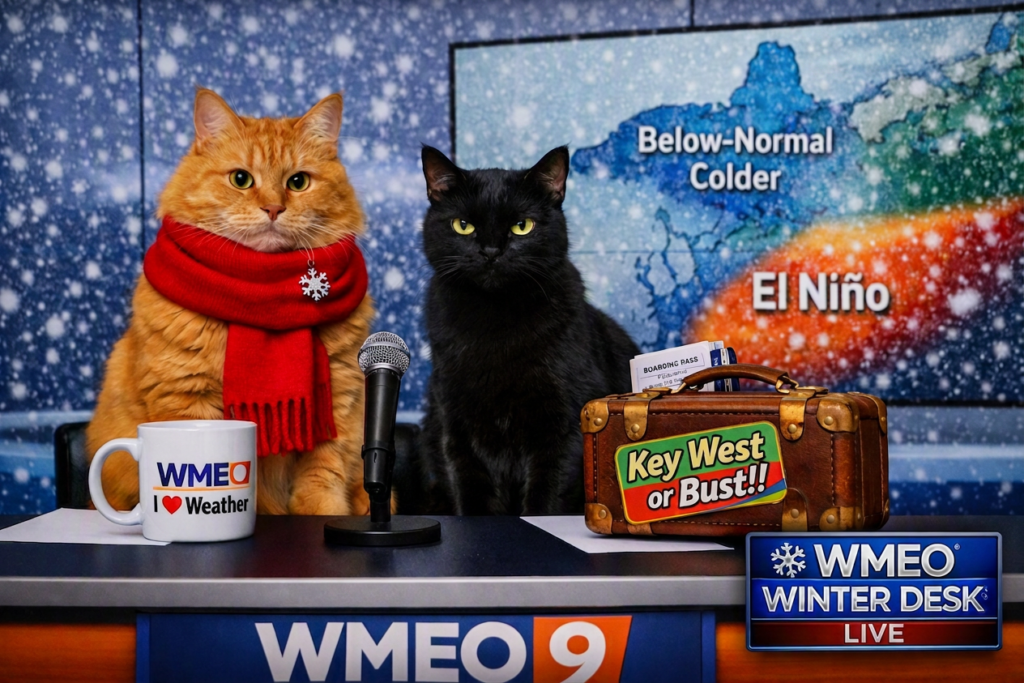
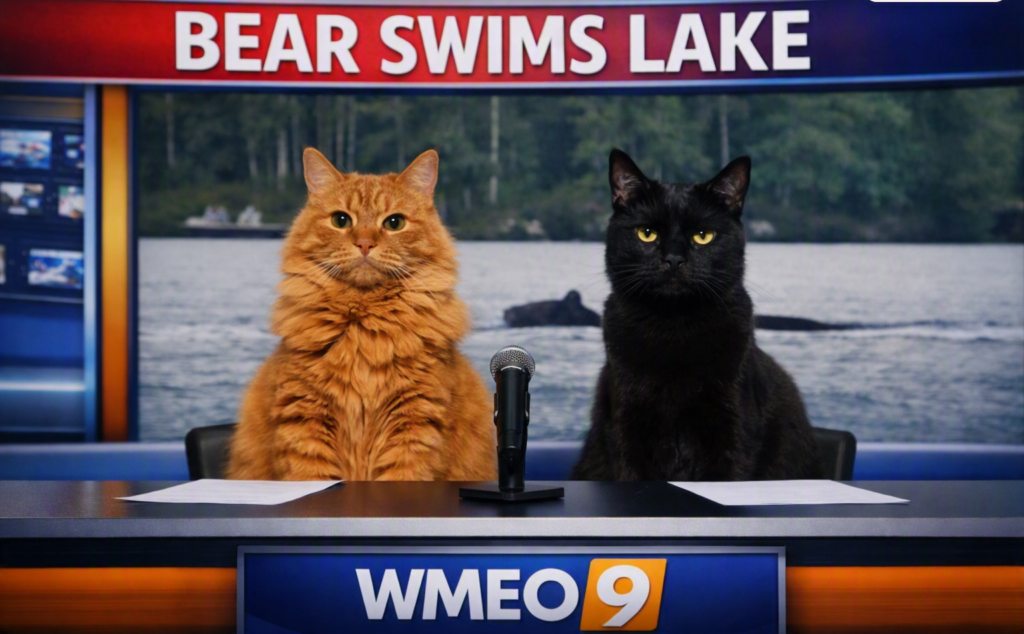
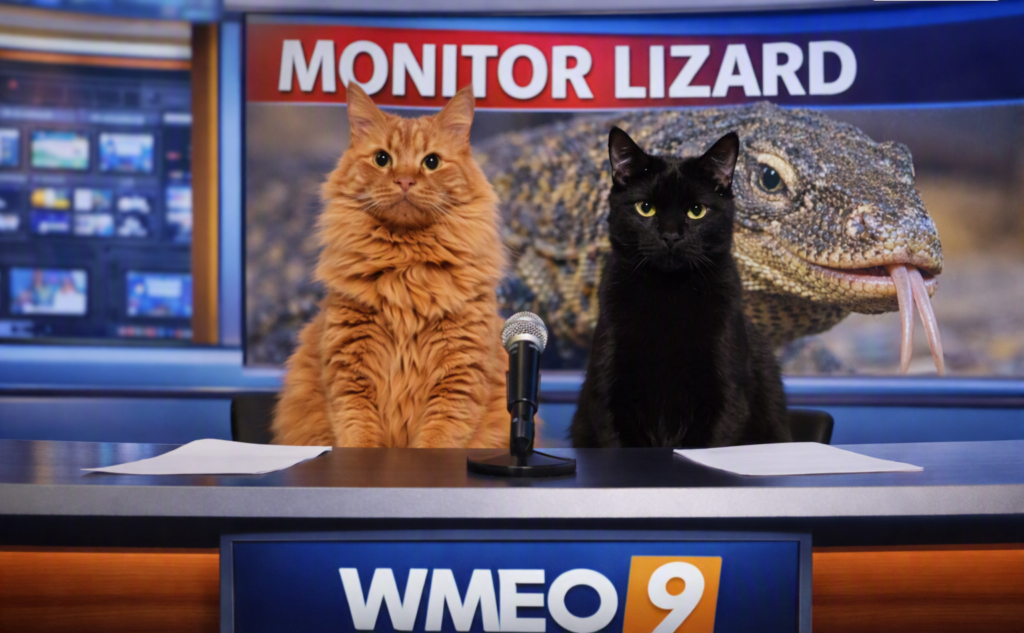
Now from the feline news desk at WMEO 9 — We Meow, You Listen — we bring you the latest update on the rabid beaver situation in beautiful Lake George, NY.

Dateline: Turtle Island, Lake George, New York The WMEO newsroom is issuing an urgent wildlife safety alert after a rabid beaver attacked swimmers on July 4th. The victims fought off the animal and were transported for hospital treatment, including post‑exposure rabies shots.

A dead beaver was later recovered . The beaver subsequently tested positive for rabies.

Story credit: WPTZ NewsChannel 5.

Rabid beavers are extremely rare. Cape Cod has had rabid raccoons in the past, and officials believe this beaver may have contracted rabies from a raccoon. Rare doesn’t mean impossible — and this incident is a reminder that wildlife can behave unpredictably when sick.

WMEO Newsroom Reaction

Banner’s Response

Banner immediately leapt onto the anchor desk, puffed up like a tiny orange emergency beacon, and announced:

“I knew beavers were suspicious! This is why I don’t swim. Water is plotting things.”

He then attempted to draw a “danger map” of Lake George using a paw dipped in tuna juice. It was… interpretive at best.

Balboa’s Response

Balboa froze mid‑snack, eyes wide, tail tucked, and whispered:

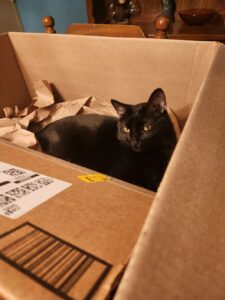
“Rabid… beavers? Deborah, I’m staying inside forever. I’ll just live in my box.”

He checked the WMEO garden cam three times to ensure no beavers were approaching the house.

WMEO Safety Bulletin

While the newsroom cats are spiraling, here’s the real takeaway:

  • Never approach wildlife, even if it looks calm or curious.
  • Leave swimming animals alone — especially if they’re behaving strangely.
  • Report unusual or aggressive behavior to local authorities.
  • Rabies is fatal if untreated, so post‑exposure shots are essential.
  • Any mammal can carry rabies, even species we don’t normally associate with it.

Nature is beautiful — but it’s also wild, and sometimes dangerous.

WMEO Closing Note

Banner has issued a formal statement demanding “protective floaties for all cats.” Balboa has requested “a beaver‑free perimeter around Turtle Island.” Both requests have been denied.

Stay safe out there, friends. Respect wildlife. And remember: if a beaver starts swimming toward you with purpose… exit the water immediately.

A beaver swimming in calm water with its wet head and upper body visible above the surface, surrounded by ripples and floating leaves.

End of bulletin. Please resume your regularly scheduled scrolling.

This has been a WMEO 9 New Update!


The Reality Behind the Shot- Wildlife Photography Tales

A large brown bear moves through dense autumn foliage, its head visible among branches covered in bright orange leaves.

The Truth About Wildlife Photography (As Told by a T‑Shirt)

Red fox baby on MondayEvery once in a while, something comes along that perfectly sums up an entire hobby. For wildlife photography, it isn’t a dramatic eagle shot or a fox leaping through golden light — it’s a T‑shirt. A T‑shirt that insists photography is simply “being in the right place at the right time”… followed by a dozen more “right” things, from the lens to the batteries to the background to the angle. It’s funny because it’s true, and every wildlife photographer knows it.

Why This T‑Shirt Gets It Right

People love to say, “Wow, you must have been lucky to get that shot.” Luck plays a part, sure, but it’s the smallest slice of the pie. Wildlife photography is mostly patience, persistence, and a willingness to stand in uncomfortable places for long stretches of time while your subject does absolutely nothing. It’s waiting for the light to cooperate, adjusting settings on the fly, and hoping your batteries don’t die at the exact moment a squirrel finally decides to pose. (Click Here for my squirrel Story)

The wildlife itself adds a whole extra layer of unpredictability. Animals don’t care about your perfect composition or your carefully chosen lens. They wander off, turn around, hide behind rocks, or stare at you like you’re interrupting their day. Sometimes they give you the “I might charge you” look, and suddenly the shot doesn’t seem quite so important anymore.

And yet, we keep doing it. Because every once in a while, everything lines up — the light, the moment, the subject, the settings, the batteries, and your own stubborn determination. You get the shot that makes all the waiting, sweating, freezing, and gear‑lugging worth it. (Having the right gear is very helpful too)

That’s why this T‑shirt is so perfect. It doesn’t glamorize wildlife photography. It doesn’t pretend it’s easy. It simply tells the truth with a wink: it takes a whole lot more than being in the right place at the right time. It takes all the “right” things coming together at once — and a photographer who’s willing to chase them.

Disclosure:

Some links in this post are affiliate links. If you decide to buy something through them, I may receive a small commission — it helps support the site and my photography adventures, at no extra cost to you. Team Arounddustyroads thanks you


Lost in the Photo Mines: My Mid‑Summer Report from the Tagging Front

A grid of small photo thumbnails from my digital photo library, showing a mix of desert landscapes with red rock formations, blue skies, and close‑up shots of colorful flowers and plants.

Checking In on My Mid‑Summer Projects

I’ve been plugging along, blogging my little heart out, sharing whatever thoughts drift through my head, and since we’re smack in the middle of summer, I figured it was a good time to stop and take stock. Have I made any progress on the projects I’ve been yammering about?

Six Months Deep Into the Great Photo Tagging Project

The biggest one, of course, is the Great Photo Tagging Project — and yes, I’m still at it. I may skip a day here and there, but I always come back like a determined little homing pigeon. I started this madness in March, which means I’ve been working on it for almost six months now. (Six months at the end of August, but who’s counting? Oh right… me.)

To keep myself from getting lost in the digital swamp, I’ve learned the magic trick: keep a log. My photos are organized by month and year, and each page holds 20 pictures. So if a month has 40 photos, that’s two pages to tag. Simple math, but it keeps me from wandering off into the weeds.

I started with the newest photos first, and any time I add a picture, I tag it right away. My once‑humble 10,000‑photo library has now ballooned to 11,700, and I’m currently working on April 2017 — a month in which I apparently lived with my camera glued to my face, because I added 149 photos.

The WordPress Tagging Surprise That Changed Everything

But then I discovered something the other day that made me want to flop onto the floor like a fainting Victorian heroine. I was searching for a photo I knew I had tagged… and it wasn’t coming up. After much stumbling, muttering, and clicking around like a confused raccoon, I finally found it.

That’s when I realized the problem: WordPress only searches the file name, not the tags I’ve been adding inside the media editor.

Which means — brace yourself — if I tagged a photo but didn’t also put that tag in the actual file name, WordPress won’t find it. The tag might as well be written on a sticky note taped to my monitor. Completely useless.

So here’s the rule I learned the hard way: I can add tags to the file name if I separate them with commas, and that’s the only way WordPress will recognize them in a search. All those beautiful, carefully chosen tags I added the “normal” way? WordPress politely ignores them like a cat ignoring a $40 toy in favor of the cardboard box.

Which means that once I finish tagging all 15 years, 180 months, and 11,700 photos… I’ll need to go back and refine the file names so the tags actually work. Because if the tag isn’t in the file name, WordPress pretends it doesn’t exist.

Now, WordPress updates constantly, so maybe someday they’ll give us a better filtering system. Or maybe I’ll get better at tagging. Either way, I’m not giving up. Even with my bungling, I can see a major improvement in my organization.

Tips for Anyone Tackling Their Own Photo Library Cleanup

So that’s my mid‑summer update. If I’ve inspired anyone else to tackle their photo library, I hope you’re having better luck than I am — or at least learning from my mistakes.


Here are a few tips I’ve picked up along the way:

  1. Put commas between tags in your file name.
  2. Make sure your tags match your file names. Add a general tag and a specific one (example: waterfall, Niagara Falls or birds, gulls).
  3. Track your progress. It keeps the overwhelm monster at bay.
  4. Take breaks. It took years to create the mess; it’ll take time to fix it.

Share your progress — and any tips — in the comments. I’d love to know if I’m the only Dummkopf lost in a photo‑archaeology dig, or if there are other brave souls out there with dust-covered digital archives of their own.

Sea lion holding a fish in its mouth near the water’s edge.