
Those Silly Kitty Cats Are at It Again


And a Four‑Year Mystery Is Finally Solved

Banner and Balboa, those silly kitties,  have a talent — not just for finding things, but for finding the exact things I don’t want them to find. Rubber bands, paper clips, bottle caps, the occasional bug… and yes, even my car keys. (If you missed Banner’s infamous key‑hiding caper, you can read the full story here: Tale of the Lost Keys — October 3, 2021.)

Their preferred playground is the middle of my tiny kitchen floor. Runner‑up: the bathtub. At least in the bathroom they’re out from underfoot.

Anyway, there has been a mystery in my house for more than four years. It only ever annoyed me when I wanted to use my food processor — and only when I wanted to grate carrots — so you can see why it wasn’t exactly top of mind.
The Food Processor Era Begins

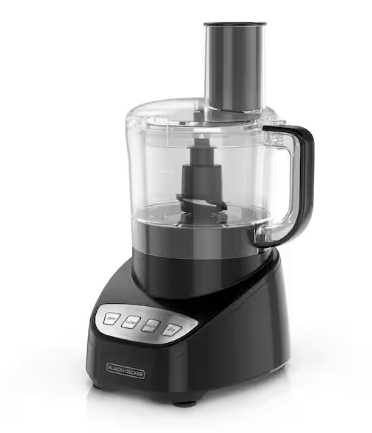
I bought that food processor in a moment of weakness. A literal one. I had just shredded a five‑pound bag of carrots by hand for a carrot cake, and my arm was about to fall off. My thought was “There has to be an easier way.” I watch the Food Network. I watch the cooking shows. You drop ingredients in, press a button, and voilà — shreds, purées, grinds, blends. It was time to modernize.

I brought it home, plugged it in, dropped in a carrot or two, and it worked beautifully. Perfect shreds. Coleslaw here I come. I gave it a place of honor on the counter.

The Carrot Catastrophe

Now, I’m not always the most mechanical of people, and the next time I tried to shred carrots… mush. Tiny bits. Sand. What was going on?

I ran to my computer and watched YouTube videos. Looked simple. Tried again. Same result. Back to the old‑fashioned hand grater I went, but the food processor was still great for bread crumbs, crushing crackers, and grinding honey grahams for pie crusts.

Over the years I kept reviewing how‑to videos and giving carrots another try. No success.

Then one day, I had an epiphany. I Googled the parts of a food processor.

And there it was. The answer to my question. The missing part. The center shaft.
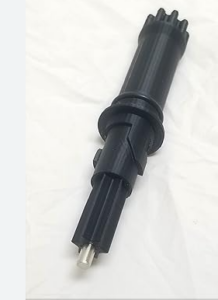
 

I only had the shaft with the blade. So when I put carrots in, they got shredded by the disc and then immediately chopped to bits by the blade underneath. I couldn’t remove the blade without having the center shaft to put in its place.

Head‑slap. Duh.


Enter: The Culprit

Okay all you culinary experts, stop laughing. I can explain.

Not long after I got Balboa, I found the little culprit in the kitchen playing with a plastic thing. I had no idea what it was — I thought it was something he found under the sink. He used to go in and out of there all the time, and I figured it was leftover from when the workers replaced the countertops.

Now that I realize what I’m missing, I recognize the thing as the shaft from the food processor.

Needless to say, it’s long gone. It was tossed even before the Great Kitchen Declutter.
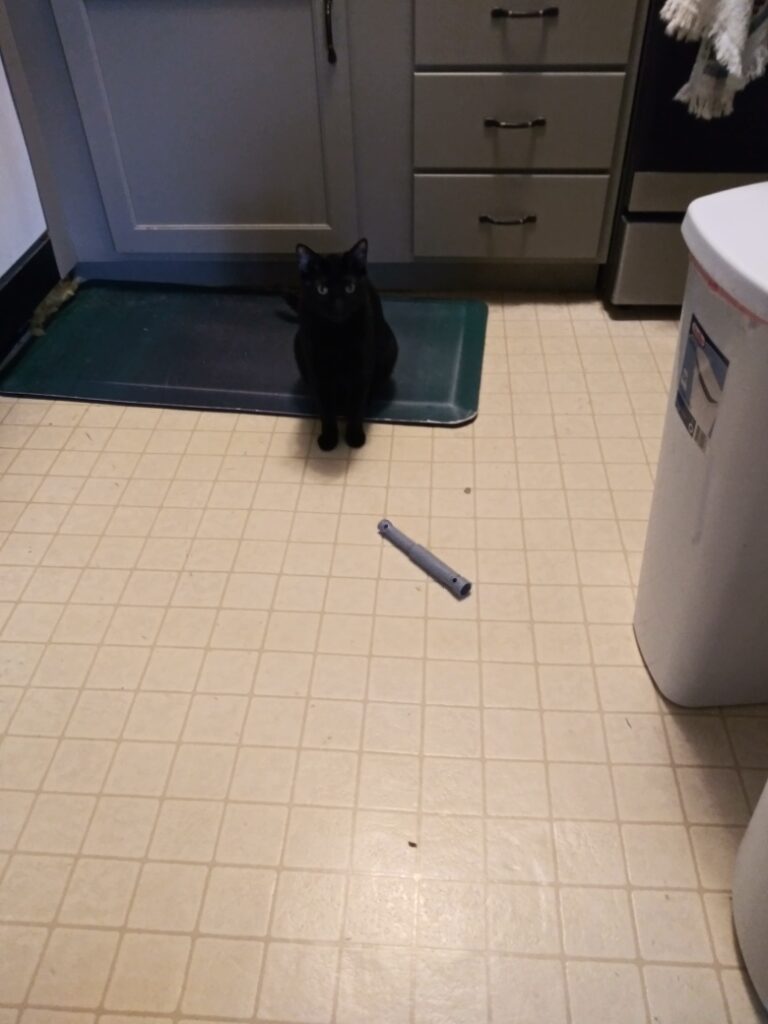
Balboa posing in the middle of the kitchen with the food‑processor shaft he ‘liberated,’ looking very satisfied with himself.

The Wallet‑Smacking Finale

The worst part? That tiny plastic thingy costs almost as much as a new food processor to replace. Can you believe that.

One small moment of stupidity… one big bang on the wallet. But at least I finally know why I couldn’t shred carrots with my food processor.

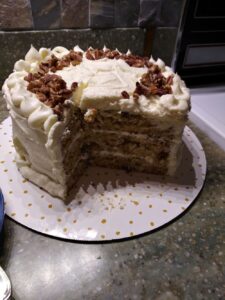
When that part gets here, I may have to make a carrot cake to celebrate.
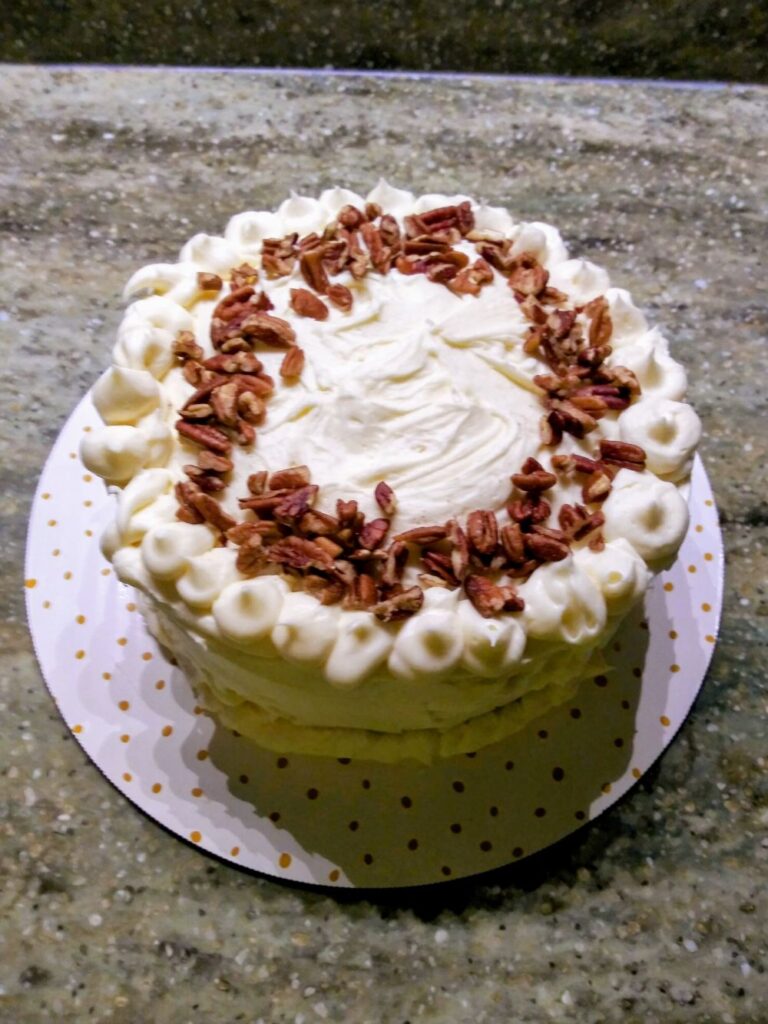
 

Pillsbury Cruffins

The Cruffin Man, Pop ‘n Fresh’s Cousin

Do you know the Cruffin Man,
The Cruffin Man, the Cruffin Man?
Oh, do you know the Cruffin Man
Who lives on Drury Lane?

The cruffin has been floating around culinary circles since at least 2013, when Kate Reid of Melbourne, Australia, started making waves with her version. So I suppose we can safely blame the Aussies for adding one more calorie‑packed breakfast treat to our diets.

The word cruffin is exactly what it sounds like — a croissant–muffin hybrid. Traditionally, it’s made by baking laminated dough in a muffin tin. Sounds fancy, but there’s a wonderful shortcut thanks to our old friend, the Pillsbury Dough Boy.

One of the best things Pillsbury ever did, in my opinion, was to take their crescent roll dough and turn it into sheets. No more trying to patch little triangles together to make one larger piece. Now you just pop the tube and roll it out.

I’m a latecomer to the cruffin game. I hadn’t even heard of them until a couple of months ago. Intrigued, I dug around and found a simple, no‑baking‑skills‑required recipe. The original makes 12, but you absolutely don’t have to go that big. You can make just four very easily — perfect for a single person. I’ll give you those tips after the recipe.


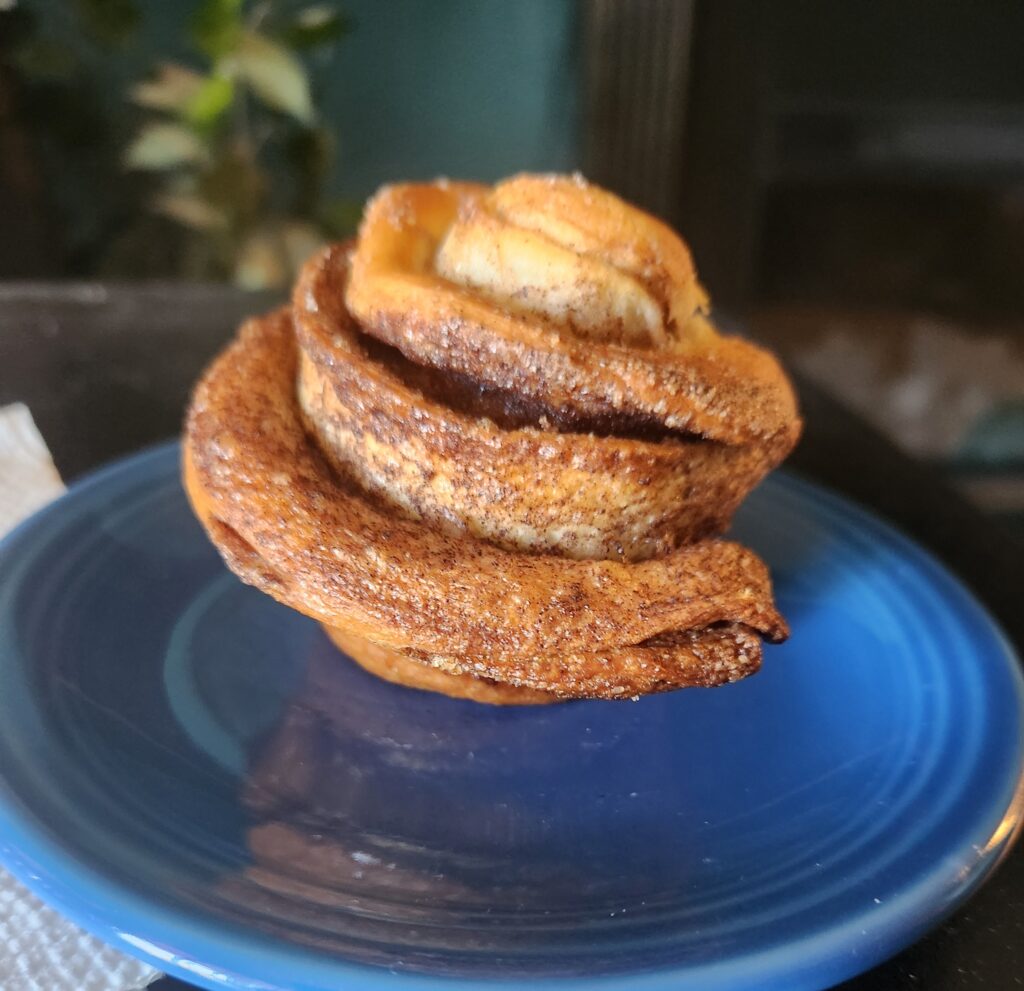
Freshly baked cruffin with crisp, swirled layers and cinnamon sugar on a blue plate.

Pillsbury Cruffins

Ingredients

  • ¾ cup granulated sugar
  • 1 tablespoon ground cinnamon
  • 3 cans (8 oz each) refrigerated Pillsbury Original Crescent Dough Sheet
  • 6 tablespoons butter, softened

Instructions

  1. Heat oven to 375°F. Grease 12 regular‑size muffin cups with shortening or spray with cooking spray. Place a large piece of heavy‑duty foil on the lower oven rack to catch any butter‑sugar drips. In a small bowl, mix sugar and cinnamon; set aside.
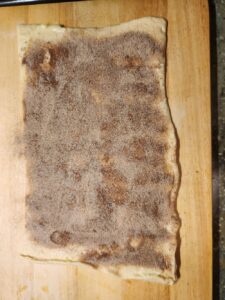
  2. Unroll 1 dough sheet on a lightly floured work surface. Using your fingers, pat the dough to even out the edges and flatten it into a 13×8‑inch rectangle.
  3. Spread 2 tablespoons softened butter evenly over the dough. Sprinkle 2 tablespoons of the cinnamon‑sugar mixture over the butter and gently press it in.
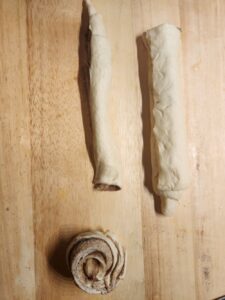
  4. Starting with the long side, roll the dough up tightly. Pinch the seam to seal so you have one long log.
  5. With a sharp knife, cut the log in half crosswise to form 2 shorter logs. Then cut each short log in half lengthwise to make 4 pieces.
  6. To shape each cruffin: hold the dough piece with the cut sides facing up. Starting at one end, wrap it into a spiral.
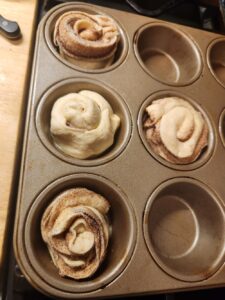
  7. Tuck the tail underneath and place in a muffin cup. Repeat with the remaining 2 dough sheets. Set aside the remaining cinnamon‑sugar mixture for rolling after baking.
  8. Bake 18–21 minutes or until golden brown. Using a fork or small icing spatula, immediately remove the cruffins from the muffin cups and roll them in the remaining cinnamon‑sugar mixture. Place on a cooling rack. Serve warm.

Notes

As you can see in the above picture I rolled 2 of the cruffins backward (or inside out by mistake) they still baked up beautifully. This resipe is very forgiving

  • Granulated sugar gives the classic cinnamon‑sugar flavor, but brown sugar works too.
  • Mix powdered sugar with a splash of milk to drizzle over the warm cruffins.
  • If you’re cooking for one (like me), you don’t need all 12. Use one dough sheet to make four cruffins and grease only four muffin cups.

And that’s the joy of these little cruffins — a fancy bakery moment without any of the fuss. They’re quick, they’re fun, and they make an ordinary morning feel just a little more special. If you give them a try, let me know how your spirals turn out. I’ll be over here humming the Cruffin Man song and brushing cinnamon sugar off my counter.


Meet Carter: The Five‑Year‑Old Chef Who Stole My Heart (and My Popover Loyalty)

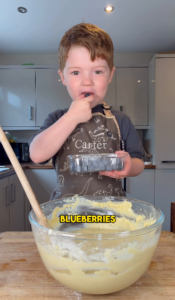
Kid chef Carter in a dinosaur apron at the kitchen counter, happily declaring ‘Yummy, yummy, yummy’ during one of his cooking videos.


A Tiny Chef With Big Talent

I’ve made a wonderful discovery! If you like cooking, children, and British accents, have I got a treat for you. You know those kids’ baking shows where the contestants are 10 or 12 and already more skilled than most adults? Well, move over, junior chefs — I’ve fallen head‑over‑heels for a little five‑year‑old who could give the Pillsbury Doughboy a run for his money.

His name is Carter, and you have to watch his cooking videos.

Confidence, Charm, and “Yummy, Yummy, Yummy”

This tiny chef has confidence, presence, and technique that seem impossible for someone who still probably needs help tying his shoes. His signature phrase — delivered in the sweetest little British accent — is “Yummy, yummy, yummy.” And trust me, when he says it, you believe him.

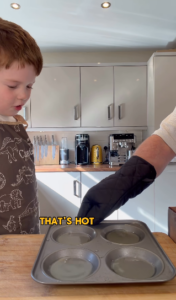
He’s basically the Gordon Ramsay of the toddler set, minus the yelling. He narrates his steps like a pro, glances off‑camera to his dad for the occasional assist, and announces things like, “My Dad’s going to place this tray in the oven now,” as a pair of adult hands swoops in. It’s adorable and impressive all at once.

The Sizzle Heard ’Round the Kitchen

One of my favorite moments was when his dad poured batter into the hot tins and Carter leaned in with pure wonder and said something like:

“Ooooh, listen to that sizzle!”

It was such a small moment, but it captured everything that makes him so delightful — the curiosity, the excitement, the joy of discovery. You can’t watch him without smiling.

A Lesson in Yorkshire Pudding (From a Five‑Year‑Old!)

Believe it or not, I even learned something from him.

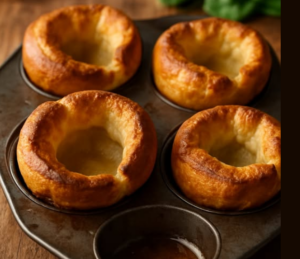
As you may know from previous posts, popovers are my thing. In the U.S., popover recipes often say “for popovers or Yorkshire pudding,” and I always assumed they were basically the same. Well, Little Carter set me straight. The difference isn’t the batter — it’s the pan.

In the U.S., popover pans are deep and cylindrical.
In the UK, a Yorkshire pudding tin is shallow and wide — more like a flattened muffin tin.

Carter showed how you pour the batter into smoking hot fat (his dad handled that part — safety first!) and the heat makes the batter sputter and climb the sides, forming that classic bowl shape. Same batter, different pan, totally different result.

Why You Need to Watch Him

I honestly don’t have the right words to fully describe this little chef. I’m amazed by his skill, his knowledge, and his on‑camera charm. You don’t have to like cooking shows to get a kick out of him — he’s pure joy in a tiny apron.

Do yourself a favor and check him out on Facebook.
Cooking With Carter.
You’ll be smiling before the video even ends.


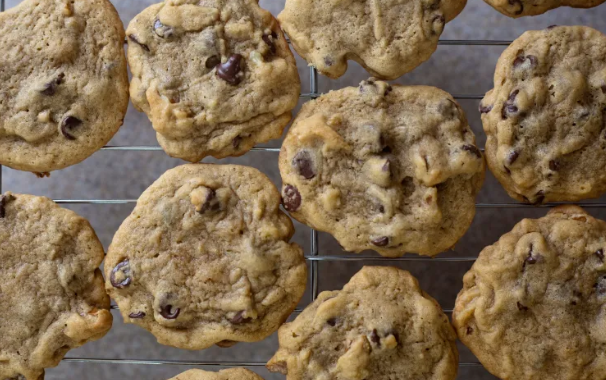
Freshly baked chocolate chip cookies cooling on a wire rack

Cookies- And they all Started in Massachusetts

CoooKies! Nothing like a good chocolate chip cookie to put a smile on Cookie Monster's face. And it all started in Massachusetts


Massachusetts: The Unsuspecting Cookie Capital

Ah, food. Is it any wonder I write about eating so often? Sure, we all need food to live, but that’s not the real reason. The real reason is simple: I love sharing recipes and little bits of cooking lore.
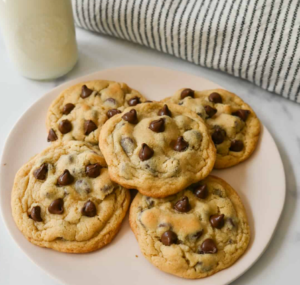
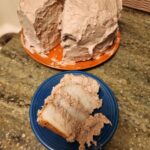
I’m not turning Around Dusty Roads into a cooking blog — don’t worry — but while I’m enjoying a slice of my angel food cake (it’s pretty yummy), I want to share a little tasty Massachusetts baking history.

Because believe it or not, this state didn’t just give the world one iconic cookie.
It gave us two.


The Toll House Cookie: A Massachusetts Original
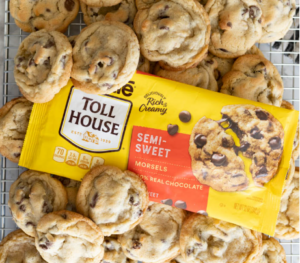

Let’s start with the queen of cookies: the classic chocolate chip — or as we call it around here, the Toll House Cookie.

We can thank Ruth Wakefield for this masterpiece. People have tried every variation under the sun — M&M’s, butterscotch, pretzels, sea salt — but nothing beats the original. Warm, melty, simple perfection.

I haven’t been to Faneuil Hall lately, but they used to have an entire kiosk devoted to chocolate chip cookies. Warm from the oven, wildly overpriced, and absolutely irresistible. It was always my first stop.

Where it all began

The Toll House Inn in Whitman, Massachusetts opened in 1930, run by Ruth and her husband Kenneth Wakefield. The building itself dated back to 1817, but Ruth’s cooking was what made the place famous.

One day she served a butter‑drop cookie studded with chopped chocolate. Customers went wild. Ruth, being a smart cookie herself, realized she had something special.

So she struck a deal with Nestlé — a lifetime supply of chocolate in exchange for printing her recipe on their semi‑sweet chocolate chip bags.


A sweet deal indeed.

The original Toll House Inn sadly burned down in 1984, but you can still visit the historical marker at 362 Bedford Street, Whitman, MA, where the world’s favorite cookie was born.


The Fig Newton: Massachusetts’ Other Claim to Cookie Fame

So what’s the second cookie?
That would be the humble, beloved Fig Newton.

You don’t usually find people casually baking Fig Newtons at home — these are very much a commercial cookie. Maybe not as universally adored as the chocolate chip, but they’ve earned their place in the cookie hall of fame.

A cookie named after Newton

The Fig Newton was created in 1891 at the Kennedy Biscuit Works in Cambridgeport, and named after the nearby town of Newton. It was one of the very first mass‑produced baked goods in the United States.

Originally, Fig Newtons were made of a soft, cake‑like dough wrapped around a thick fig jam. They were so popular that the brand eventually shortened the name to simply Newtons, and added flavors like strawberry and raspberry.

Still, the fig version remains the classic.

If you’re a truly determined baker, you can find recipes for homemade Fig Newtons. And if you ever make them, I want the full report.


Final Crumb

Massachusetts may be famous for its history, its coastline, and its questionable driving habits, but it deserves a little credit for its contributions to the cookie world too.

Two iconic treats — one homemade, one commercial — both born right here.

Now if you’ll excuse me, I’m going back to my angel food cake.

Rhubarb: -The Original Sweet‑Tart Rebel

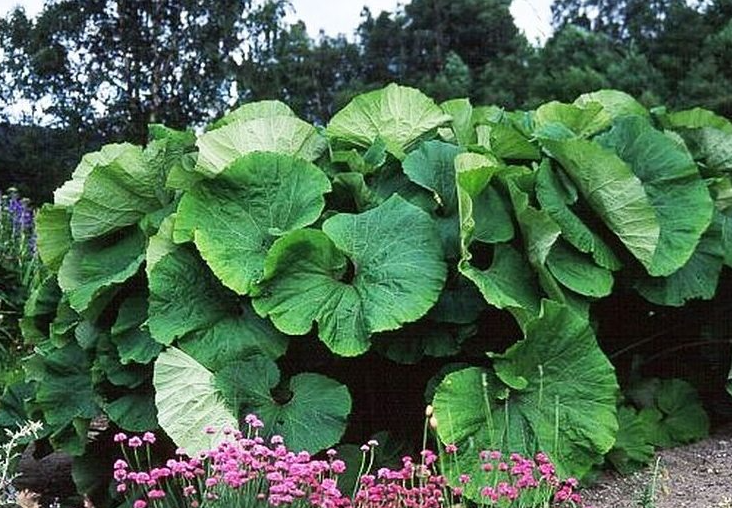
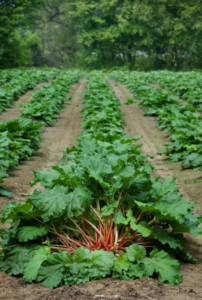
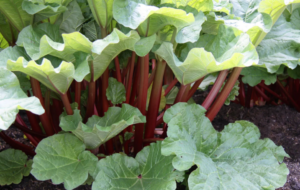
Wild Rhubarb gowing a a profusion of leaves and begging to make into a pie. A beautiful memory from my childhood

Wild Rhubarb Patch


🌿 Rhubarb: The Tart, Wild, Wonderful Spring Ritual

I grew up with a wild rhubarb patch — the kind that came back every year without being asked, without being watered, without being pampered. We’d wander out, snap off a few sturdy stalks, and head back inside to make sauce or pie. No ceremony, no measuring, just that sharp green‑red crunch and the promise of something tart and sweet bubbling on the stove.
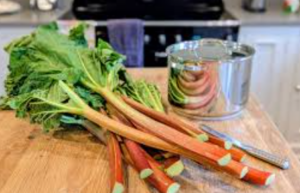
Once I became an adult, though, I don’t remember making many rhubarb pies at all… or many pies, period. That was my mom’s skill set, not mine. But I did make the sweet‑tart rhubarb sauce — the kind you drizzle over warm biscuits for breakfast or dollop onto vanilla ice cream. It was simple, bright, and tasted like spring in a spoon.

But the funny thing about getting older is how the staples of your youth start tugging at you. Out of nowhere, you miss the things you didn’t even realize were woven into your childhood. And just the thought of those rhubarb pies — the tart filling, the soft pink juices, the smell drifting through the house — started my mouth watering.

So I did it.
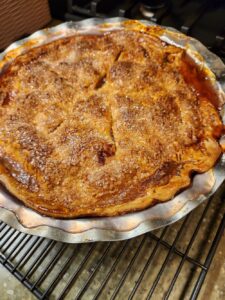
I made a rhubarb pie.

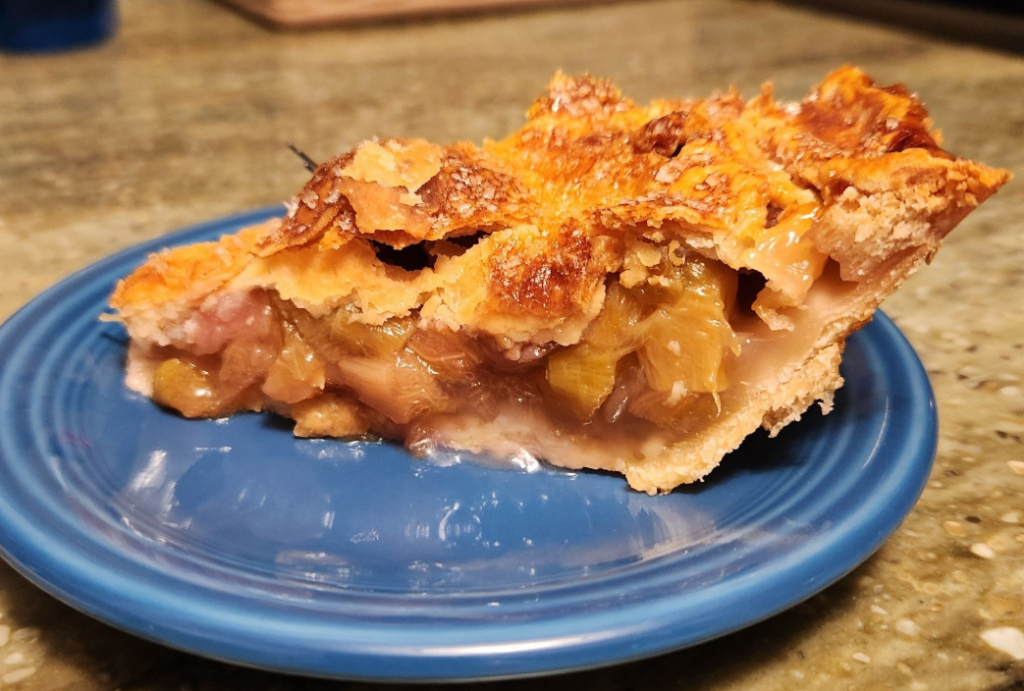
After all, I’ve mastered apple… why not rhubarb? And you know what? It worked. It was everything I remembered: tart, rosy, fragrant, and just a little wild.


🍓 Is rhubarb a fruit?

Botanically, rhubarb is a vegetable — a cousin of buckwheat and sorrel.
Culinarily, it’s treated like a fruit because it shines in pies, jams, and sauces. In 1947 the U.S. even reclassified it as a fruit for import tariffs because everyone was baking with it.


☠️ Are the leaves really poisonous?

Oh those huge, waving glorious leaves.  Tough and green they are the crown of the the red stalks. But are they really poisonous? Yes — the leaves contain high levels of oxalic acid, which can be harmful if eaten.
The stalks, however, are perfectly safe and delicious. Just chop off the leafy tops and compost them. Or if you’re a kid, run around the yard waving those leaves like flags, pretending they were shields or capes. I had no idea they were the “don’t eat this” part of the plant.

Most gardeners simply cut the leaves off and toss them in the compost. The plant knows what it’s doing — it protects itself with a built‑in warning label.


🎨 Color: Rhubarb’s Great Plot Twist

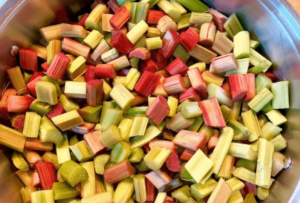
Rhubarb comes in every shade from deep ruby to streaky pink to full‑on green.
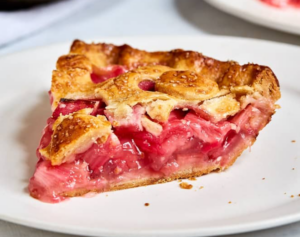
And here’s the secret: color has nothing to do with flavor. Green rhubarb can be just as tart and bright as the reddest stalk. Once it cooks down with sugar, the juices turn rosy anyway — sometimes ruby, sometimes golden‑pink, sometimes a warm sunset shade. Real rhubarb pies rarely look like the neon‑red photos online, and that’s part of their charm.


😋 The Taste: Tart, Bright, and Completely Addictive

Rhubarb doesn’t pretend to be sweet. It comes in bold, tart, and unapologetic — the kind of flavor that wakes you up and makes you pay attention. Add sugar and heat, and it softens into something lush and nostalgic, the taste of early spring before anything else is ready to harvest.


🌱 A Few Fun Rhubarb Facts

  • Rhubarb plants can live 20+ years in the same spot.
  • Forced rhubarb (grown in dark sheds) is so tender it’s harvested by candlelight.
  • The stalks get more tart as the season goes on — early spring is the sweet spot.
  • Some varieties are bred for color, not flavor, which is why your pie might not be red even if the stalks were.
  • Rhubarb was once prized as a medicinal plant long before it became a dessert star.

🥧 And now… the pie

Once I decided to finally make one, I kept it simple. There are countless variations online, but this recipe is tested, reliable, and friendly enough that even a novice baker can make a successful treat. If you try it, let me know — I’d love to hear how yours turns out.


Here’s the recipe I used:


Rhubarb Pie 

Ingredients

  • 2 lbs rhubarb, cut into 1‑inch pieces (about 7 cups)
  • 1 ½ cups granulated sugar
  • ¼ cup cornstarch
  • 1 Tbsp lemon juice
  • ¼ tsp kosher salt
  • 2 batches pie dough (homemade or refrigerated)
  • All‑purpose flour, for rolling
  • 1 Tbsp cold butter, cubed
  • 1 large egg + ½ tsp water (egg wash)
  • Sanding sugar, for sprinkling

Directions

  1. Mix dry ingredients
    Combine sugar, cornstarch, and salt in a large bowl.
  2. Prepare crust
    Roll each dough round to 12 inches. Fit one into a 9‑inch pie plate.
  3. Layer filling
    Sprinkle ⅓ of the sugar–cornstarch mix over the bottom crust.
    Add rhubarb and lemon juice.
    Sprinkle remaining sugar mixture on top.
    Dot with butter.
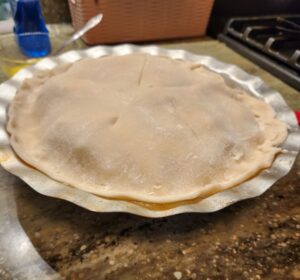
    Add top crust; trim and crimp edges.
  4. Vent and chill
    Cut 5 slits in the top crust.
    Freeze assembled pie for 30 minutes.
  5. Bake
    Preheat oven to 375°F.
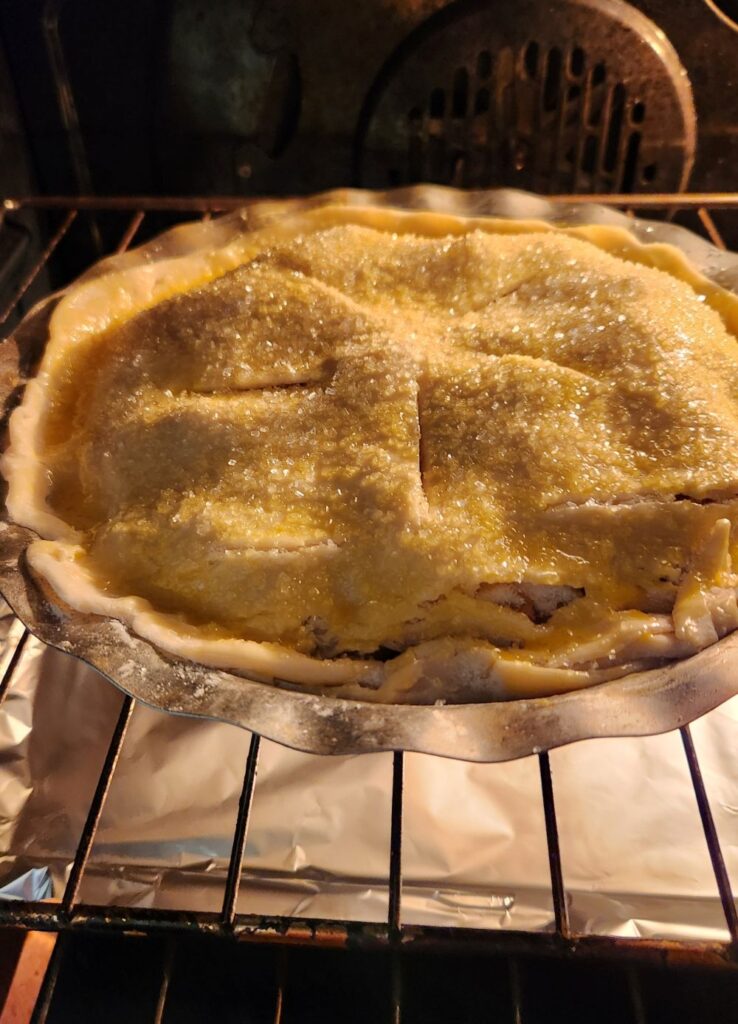
    Brush with egg wash; sprinkle sanding sugar.
    Bake on middle rack with a foil‑lined sheet on the lower rack.
    Bake about 1 hour, tenting if browning early.
    Continue baking until filling bubbles in the center and vents (about 30 minutes more)
  6. Cool completely
    Cool on a rack 3–4 hours for clean slices.

Notes

  • Peeling: Optional; peel only if stalks feel tough or stringy.
  • Cutting: Kitchen shears or a sharp knife both work.
  • Color: Red or green rhubarb both bake normally; color doesn’t affect flavor.
  • Doneness: Fully baked only when bubbling in the center.
  • Cooling: Full 3–4 hours helps the filling set.


MMM