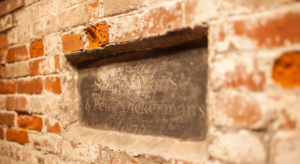
Historic memoir bound in the skin of highwayman James Allen, displayed under glass at the Boston Athenæum

The Book That’s Literally Skin‑Deep

Rare 1837 book bound in human skin at the Boston Athenæum, shown with its Latin‑inscribed cover inside a display case.”


Boston’s Most Macabre Treasure

Massachusetts has no shortage of historic firsts — the first lighthouse, the first subway, the first chocolate chip cookie, even the first telephone call. But tucked away on Beacon Street, inside the quiet, book‑scented halls of the Boston Athenæum, sits an artifact that makes all those milestones feel downright ordinary.

It’s a book.
Bound in human skin.
And yes, you can actually see it.


A Highwayman, a Deathbed Confession, and One Very Unusual Request

The story begins with James Allen, also known by several aliases, including George Walton — a 19th‑century highwayman who spent his life robbing travelers along the Boston Post Road. He wasn’t a glamorous outlaw; he was a gritty, stubborn one, constantly in and out of prison, and eventually mortally wounded during an escape attempt.

On his deathbed in 1837, Allen dictated his life story — a short memoir titled Narrative of the Life of James Allen. But he didn’t stop there. He made a final request that would cement his place in Massachusetts lore:

He wanted copies of the book bound in his own skin.

One copy was to be given to a man who had once fought him off during a robbery attempt — a man Allen respected for his bravery. Another copy went to the Boston Athenæum, where it remains today.

On the cover, stamped in gold, is the Latin inscription:

“Hic Liber Waltonis Cute Compactus Est.”
This book is bound in the skin of Walton.

Subtle? No.
Unforgettable? Absolutely.


Anthropodermic Bibliopegy: A Real (and Rare) Practice

As bizarre as it sounds, binding books in human skin — anthropodermic bibliopegy — was a real, if extremely uncommon, practice in the 18th and 19th centuries. Most examples come from:

  • Medical schools (anatomy students memorializing cadavers)
  • Criminal confessions
  • Personal mementos with a macabre twist

But Allen’s book stands out because it wasn’t done to him — it was done at his own request. A final act of control? A strange attempt at immortality? A criminal’s version of a legacy? Historians still debate it.

What’s certain is that the Athenæum’s copy is one of the most famous examples in the world.


Behind the Red Doors of the Boston Athenæum

The Athenæum itself is a treasure — one of the oldest independent libraries in the United States, founded in 1807. Its reading rooms feel like stepping into a different century: marble busts, oil portraits, polished wood, and the soft hush of serious book lovers.

The human‑skin book isn’t on open display. It’s kept in a secure, climate‑controlled room, brought out only for researchers or curious visitors by appointment. Staff are used to the request — it’s one of the most asked‑about items in their collection — but they treat it with the same respect as any rare artifact.

In recent years, scientific testing confirmed what the inscription claimed: the binding is, in fact, human skin.

Boston history is full of surprises, but this one still manages to raise eyebrows.


A Story That Sticks With You

What makes this such a compelling Massachusetts tale isn’t just the shock factor. It’s the layers:

  • A criminal who wanted his story preserved — literally.
  • A library that has safeguarded it for nearly two centuries.
  • A piece of history that blurs the line between the macabre and the meaningful.
  • A reminder that Boston’s past isn’t just revolutionary — it’s downright strange.

You can walk past the Athenæum’s iconic red doors a hundred times and never guess that one of the rarest, most unusual books in the world sits quietly inside.

But that’s Massachusetts for you.
Just when you think you’ve heard every story, it hands you one bound in human skin.


A Tale of Two Lighthouses

Graves light takes a pounding from the sea at the entrance to Boston Harbor's deep water channel


Graves Light: Boston Harbor’s Outer Sentinel

Lighthouses have always been the quiet guardians of the coast — part warning, part welcome, standing where the sea turns unpredictable. In my last post, Boston Light played the role of the harbor’s warm lantern, guiding ships safely home. Just a few miles away, though, another tower tells a very different story. Graves Light, perched on a scatter of ledges at the edge of the deep‑water channel, wasn’t named for sailors’ graves at all, but for Rear Admiral Thomas Graves, an early Massachusetts figure. Its job has always been the opposite of Boston Light’s: not to beckon ships inward, but to warn them away from danger.


A Lighthouse Built for the Hard Work

Completed in 1905, Graves Light is the tallest lighthouse in Boston Harbor and by far the most exposed. Its granite blocks were quarried in Rockport and pinned into the ledge like a stone corkscrew — because anything less would have been torn apart by the Atlantic. This tower wasn’t built for charm. It was built to take a beating.

And it still does.


Still Active — Even in Private Hands

In 2013, Graves Light made headlines when it was sold at auction for $933,888, becoming one of the most expensive lighthouse sales in U.S. history. The new owners restored the tower itself — floors, windows, dock, solar power — but the light and fog signal remain federal property.

The U.S. Coast Guard still operates:

  • the modern beacon
  • the fog horn
  • the official charted signal: Fl (2) W 12s

So yes, Graves Light is still an active aid to navigation, even though the building is privately owned. The tower belongs to people; the warning still belongs to the sea.


Two Lights, Two Jobs

Graves Light and Boston Light sit on opposite sides of the deep‑water channel — only about 3.5 miles apart, but doing completely different work.

  • Graves Light stands on the outer edge, flashing its stern warning:
    “Danger here — avoid the ledges.”
  • Boston Light waits farther in, offering the softer message:
    “Safe water ahead — welcome to the harbor.”

Mariners once treated them as a sequence: clear the danger, then follow the welcome home.

Boston Light and Graves Light, two guardians of Boston harbor


The Zoo Ship Wreck of 1938

One of the strangest events tied to Graves Light came in 1938, when the steamer City of Salisbury ran aground near the ledges in thick fog. Its cargo?
A traveling zoo shipment — monkeys, parrots, pythons, cobras, and other exotic animals.

Most survived, and newspapers gleefully reported “snakes loose in Boston Harbor.” Graves Light has seen its share of storms, but that day it witnessed a circus.


A Hollywood Cameo

Graves Light even had a moment on the silver screen. It appears in the storm sequence of the 1948 film Portrait of Jennie, where the tower is cast as a brooding, windswept sentinel. Even if you’ve never seen the movie, it’s a fun bit of trivia — one of the few times this rugged lighthouse slipped into Hollywood’s imagination.


A Sentinel You Can Still See Today

If you take one of the harbor or lighthouse cruises, you’re almost guaranteed to see both Boston Light and Graves Light in a single sweep of the horizon. Coming out from the harbor, you first pass the civilized silhouette of Boston Light, with its keeper’s house and outbuildings tucked neatly on Little Brewster Island. And just beyond it, rising straight from the gray Atlantic, stands Graves Light — taller, starker, and far more ominous. One welcomes you in; the other warns you away. Seen together, they tell the whole story of Boston Harbor in two towers.


Boston Light: Still Standing, Still Shining

Located on Little Brewster Island, Boston Light: America’s Oldest Lighthouse is Still on Duty


Oh What a Light

(A little wink to the 1960s classic “Oh, What a Night”)

Boston Light is like an old war hero — weathered, stubborn, and full of stories it never quite shares. It has guarded the entrance to Boston Harbor for more than three centuries, and those stones have seen everything from calm seas to cannon fire.

Built in 1716, Boston Light is the oldest continually used lighthouse in the United States. Its history reaches straight back to the Revolutionary War.

The first tower stood about 60 feet high and was made from rough island stones. Workers stacked unshaped rubblestone into a tapering tower and held it together with early mortar. It wasn’t fancy, but it worked.

That original lighthouse didn’t survive the war. In 1776, British forces retreated from Boston Harbor and set explosives that destroyed the tower. (Those darn Redcoats!)  Boston rebuilt quickly. By 1783, the Commonwealth raised a new lighthouse using the island’s rubblestone once again. This version had thick 7.5‑foot walls and reached 75 feet into the air.

In 1859, the tower needed more height to hold a massive 4,000‑pound Fresnel lens. Builders added another 14 feet, giving the lighthouse the profile we recognize today.


The Modern Boston Light

Boston Light glows bright while Graves Light keeps its quiet watch beyond

The lighthouse on Little Brewster Island blends the 1783 rebuild with the 1859 expansion. It rises 89 feet (102 feet above sea level) and still contains the old rubblestone core, now reinforced with brick. Only the bottom 9 to 14 feet include stones from the original 1716 tower, but that small section connects the modern beacon to its earliest days.

Not bad for a lighthouse that once relied on candlelight.

Today, Boston Light is a National Historic Landmark. By law, it remains permanently manned, even with modern automation. The island isn’t open to the public, but several harbor cruises pass close enough for great views.

At night, the beam reaches 27 miles into the Atlantic. After 300 years, it still calls sailors home.


Looking for Cherry Blossoms?

Boston's cherry blossoms with those lovely brownstones in the background


Where to See Cherry Blossoms in Boston: A Springtime Stroll Through the City

Cherry blossom season in Boston is one of those blink‑and‑you‑miss‑it treasures. The blooms don’t linger long, but while they’re here, the city feels softer, sweeter, and just a little more magical. We may not have a national cherry blossom festival like Washington, D.C., but we do have pockets of pink that are every bit as lovely — and far easier to reach.

If you’re already in a spring mood (and who isn’t by late March?), here are the best places to catch Boston’s cherry trees in full blush.


🌸 Arnold Arboretum — Jamaica Plain

The Arboretum is the crown jewel of Boston blossoms. Everyone knows about the lilacs — and yes, they deserve their fame — but the cherry trees quietly steal the show in late April.

Winding paths, rolling hills, and clusters of cherry trees make this a perfect spot for a slow, fragrant wander. The Arboretum’s size means you can always find a peaceful corner, even on busy weekends.


Why go:

  • Gorgeous cherry trees scattered throughout the landscape
  • Peak bloom usually late April to early May
  • A serene alternative to D.C.’s crowds
  • Taiko drumming by Odaiko New England and KASA Taiko, a celebration of Japanese culture

If you want to stroll under a canopy of petals, this is the place to start.


🌸 Charles River Esplanade — Back Bay

The Esplanade is a springtime dream. Cherry trees line the river, creating postcard‑worthy views with the water sparkling behind them. On a sunny day, the blossoms practically glow.

Why go:

  • Stunning river views
  • Great for photos
  • Perfect for a walk, bike ride, or quiet sit on a bench

This is one of those spots where you suddenly remember why you put up with New England winters.


🌸 Boston Public Garden — Downtown

The Public Garden is iconic year‑round, but in cherry blossom season it becomes downright romantic. Blossoms frame the lagoon, swan boats glide by, and the willows add their own soft green curtain to the scene.

Why go:

  • Blossoms near the water
  • Classic Boston scenery
  • A perfect spot for a leisurely loop

It’s the kind of place where you can sit on a bench and feel like you’ve stepped into a painting.


🌸 Back Bay Fens — Fenway

If you prefer your blossoms with a quieter, more local vibe, the Fens is your spot. Cherry trees bloom along the paths and near the historic stone bridges, giving the whole area a gentle, early‑spring charm.

Why go:

  • Less crowded
  • Lovely morning light
  • Blossoms mixed with early greenery

A great choice for people who like their spring strolls peaceful.


🌸 Brookline’s Amory Park & Hall’s Pond Sanctuary

Just outside Boston proper, but absolutely worth the short hop. Brookline always feels like a softer, quieter cousin to the city, and the cherry blossoms fit right in.

Why go:

  • Cherry trees along the park edges
  • A tranquil pond setting
  • Easy to pair with a visit to Coolidge Corner

It’s a perfect “bonus stop” if you’re already exploring the area.


🌸 When to Catch the Blossoms

Boston’s cherry blossoms typically bloom late April to early May, though Mother Nature likes to keep us guessing. A warm spell can hurry things along; a cold snap can slow them down.

If you’re local, the best strategy is simple:
Take a walk. Let the trees surprise you.


Spring in New England


Ah Spring: A Season That Arrives When It Feels Like It

Daffodils are a sure sign spring is upon us

A Poem From the Past

Every now and then, a memory from childhood pops up and refuses to leave. Recently, I found myself thinking about a play we did in school — a bunch of hillbillies, a lot of flannel, and one truly unforgettable poem. It went something like this:

Spring has sprung,  
The skunks air out.  
Spring has sprung — just sniff about.  
Mating time is drawing near,  
You can smell it in the air.

Not exactly Shakespeare, but it captured something very real about spring in New England: you don’t need a calendar to tell you it’s coming. Your nose will do the job just fine.

The Calendar Says Spring… But New England Has Other Plans

Technically — officially — scientifically — spring begins on March 20 this year. The equinox arrives, the sun crosses the celestial equator, and somewhere far away, flowers bloom on cue.

But here in New England?
We don’t buy it.

Around here, spring doesn’t start when the calendar says so. Spring starts when the Red Sox take the field at Fenway Park. That’s the moment the region collectively thaws, stretches, and decides maybe — just maybe — winter is finally loosening its grip.

And since Opening Day at Fenway is April 3 this year, I guess true spring will be running a little late. Again.

Local Wildlife Confirms the Delay

If you need further proof, just ask the skunks. They’ve already begun their annual “perfume tour,” leaving unmistakable reminders that love is in the air — whether we want it or not. Nothing says spring quite like cracking open a window for fresh air and immediately regretting it.

Even the Cats Know Spring Is a Moving Target

Banner and Balboa have their own opinions about the season. Banner has already begun his warm‑weather routine of turning on lights with his teeth — a helpful service at 3 a.m., apparently. Balboa, meanwhile, has resumed his post by the sliding door, watching for birds, squirrels, and anything else that might signal the world is waking up.

They’re not convinced it’s spring yet either. And honestly? I trust their instincts more than the meteorologists.

Spring Will Get Here… Eventually

So while the rest of the country celebrates the equinox, we’ll be here in New England waiting for the crack of the bat, the roar of Fenway, and that first warm day that doesn’t immediately get followed by a frost warning.

Spring comes late here.
But when it finally arrives, it’s worth the wait.