
Plymouth Rock: America’s Most Disappointing Tourist Attraction?
“That’s It?”
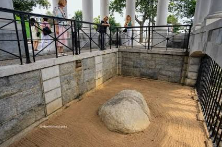
Every American knows about Plymouth Rock. It’s in textbooks, documentaries, and Thanksgiving lessons. Growing up, I imagined something impressive, perhaps on the scale of Devils Tower or Half Dome. Then I finally visited it and discovered what may be America’s most famous underwhelming tourist attraction: a rock.
Two words inevitably cross the lips of first-time visitors to Plymouth Rock:
“That’s it?”
Yes, Plymouth Rock never fails to underwhelm, leaving tourists struck by disappointment rather than awe.
The Pilgrims Didn’t Even Land There First
To make matters even more confusing, the Pilgrims didn’t first land at Plymouth at all. Their initial landfall was at the tip of Cape Cod, and it was about a month before they sailed across the bay to establish a settlement at Plymouth.
Adding to the mystery, there is no contemporary record or historical evidence that the Pilgrims used a large steppingstone to disembark when they arrived.
How a Boulder Became a Legend
Let’s jump forward in time.
It wasn’t until 1741, 121 years after the Pilgrims arrived, that a 10-ton boulder in Plymouth Harbor was identified as the spot. That’s right, 10 tons. Hardly the little rock visitors see today.
So what happened to that boulder?
In the 1770s, local residents feared a planned wharf would bury or damage the boulder, so they decided to move it to safety.
I bet you know what’s coming.
Just like Humpty Dumpty, all the king’s horses and 20 teams of oxen couldn’t put the rock back together again. You guessed it, the rock split when they tried to move it.
The bottom portion of Plymouth Rock remained embedded near the shoreline while the upper half was moved to the town square.
Breaking the Rock… Again
 In 1834, the rock was moved again and, once again, the journey ended badly. As it passed the courthouse, the stone fell from the cart and broke apart.
The rock continued to shrink over the years as souvenir hunters chipped off pieces to take home.
Meanwhile, back at the harbor, a protective canopy was erected over the lower section. Unfortunately, the stone was too large to fit comfortably inside the structure, so workers cut part of it away.
By the time preservationists were finished protecting Plymouth Rock, they’d managed to break it, move it, chip it apart, and cut it down to size.
The Famous “1620”
 In 1880, the upper portion of Plymouth Rock was returned to the waterfront and reunited with the lower section.
That’s when the famous “1620” was carved into it.
No, the Pilgrims didn’t carve it. The inscription was added more than two centuries after their arrival.
Historians estimate that today’s Plymouth Rock may be only one-third to one-half of its original size, and much of what remains is still buried beneath the surrounding ground.
Its current home looks a great deal like either a Roman temple or a zoo enclosure, depending on your point of view.

Why People Still Come
Historians may debate whether the Pilgrims ever stepped on Plymouth Rock, but that debate hasn’t stopped generations of visitors from making the pilgrimage.
For a rock that may not be the right rock, it certainly attracts a crowd.
Every year, people travel to Plymouth to see a battered piece of stone that has become one of America’s most enduring historical symbols.
More Interesting Than the Rock Itself
So, is Plymouth Rock disappointing?
Absolutely.
But the history of Plymouth Rock is far more interesting than Plymouth Rock itself.
Over the years it has been identified, moved, broken, repaired, chipped away by souvenir hunters, engraved, and relocated again. Whether or not a Pilgrim ever stood on it, the rock has become part of the American story.
The actual stone may leave visitors wondering, “That’s it?”
The story behind it is what makes the trip worthwhile.