Newport: Where History, Glamour, and the Atlantic All Collide

Newport didn’t become America’s summer capital overnight. In the mid‑1800s, it was still a quiet coastal town with colonial bones — whaling ships, weathered shingles, and a salty breeze that never quite left your clothes. But as industrial fortunes exploded, the country’s wealthiest families began looking for a place to escape the heat, the noise, and the social obligations of New York and Boston.
They found Newport.
At first, the arrivals were modest: wooden cottages, seaside porches, simple retreats. But modesty wasn’t a long‑term trait of the Gilded Age. By the 1870s and 1880s, the families who came to Newport weren’t just wealthy — they were dynasties. And they didn’t come to blend in. They came to build monuments.
The Migration of the Millionaires
Newport became a summer migration pattern for America’s elite:
- The Astors, guardians of old‑money respectability
- The Vanderbilts, railroad titans with something to prove
- The Berwinds, coal magnates with European tastes
- The Oelrichs, social climbers with flair
- The Wetmores, early adopters who set the tone
They arrived with architects, landscapers, imported marble, and a determination to outdo one another. What began as “summer cottages” quickly became palaces — each one larger, grander, and more theatrical than the last.
The Rivalries
Newport’s social season was short — barely eight weeks — but the rivalries were year‑round.
Old money vs. new money. Who threw the best parties. Who had the grandest cottage.
The Breakers became the ultimate symbol — a 70‑room palace that made every other mansion look like a guest house. And Marble House, dripping in gold leaf and French opulence, was Alva Vanderbilt’s declaration that she intended to rewrite the social rules.
A Night in the Gilded Age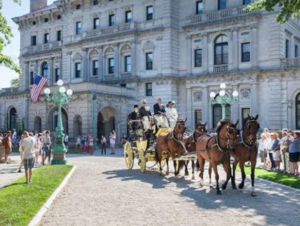
Every so often, Newport lets you step right back into that world.
I once attended the Dead of Winter Ball, held in one of the great mansions — the kind with a sweeping staircase and a ballroom built for spectacle. Guests arrived in horse‑drawn carriages, their breath visible in the cold air, just as they would have at the height of the Gilded Age. My friend Joe was my escort, and neither of us cared which mansion it was — the moment the carriage wheels crunched over the gravel, it felt like we’d slipped into another century.
The Cliff Walk — Newport’s Backstage Pass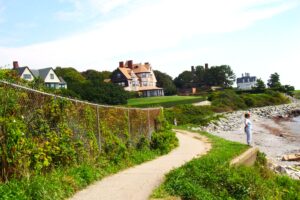
I’ve walked the Cliff Walk in the summer, when the Atlantic is in a gentler mood and there’s less chance of being swept away by a rogue wave. It’s one of the best ways to see the backside of the mansions — the part the Gilded Age families never meant the public to admire, but which ended up being the most breathtaking view of all.
Drive down Bellevue Avenue and you might catch a glimpse of a mansion or two peeking out from behind high stone walls or over broad lawns. But from the Cliff Walk? It’s a different world.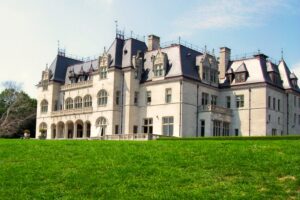
The mansions stand wide open to the sea, their terraces and lawns stretching right to the edge of the cliffs. The mighty Atlantic is at your feet the whole time, and the houses rise above you like silent witnesses to a century of summer seasons, scandals, rivalries, and glittering parties.
The America’s Cup — A Day I’ll Never Forget (Though I’ve Tried)
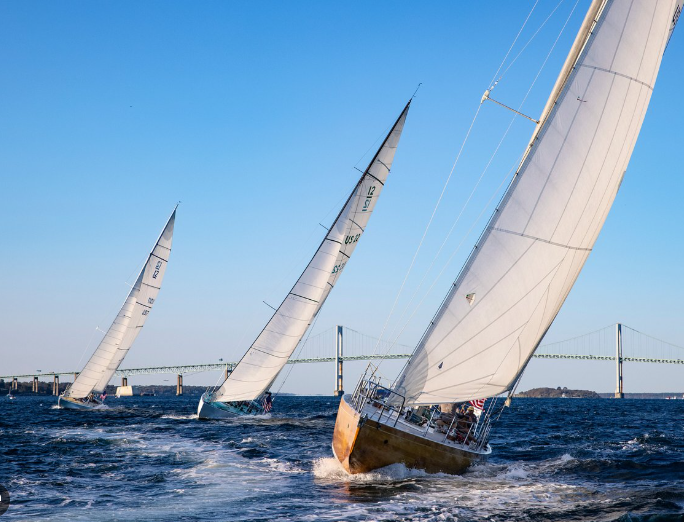
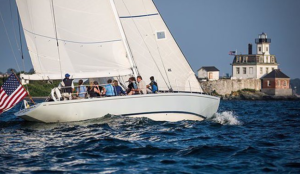 In the 1980s, Newport was the beating heart of the America’s Cup. For more than a century, America had dominated this iconic sailing race, and Newport was where the world came to watch sleek racing yachts slice through the Atlantic.
I’m not much of a sailor — I’d be utterly lost on a racing yacht — but I do enjoy a day on the ocean with cocktails and good company. So when a friend invited me to an America’s Cup viewing party on his boat, I jumped at the chance.
What they neglect to tell you is that attending an America’s Cup event does not mean calm seas.
The water gets kicked up into a wild, relentless chop from the wakes of dozens of spectator boats all jostling for position. I never found my sea legs. Not once. We were tossed one way, then the other, then back again like a cork in a blender.
I had a very hearty conversation with “Rachel and Ralph” before I was gently escorted to a bunk on the lower level. It was bad enough that the host offered to call the Coast Guard to take me back to land. Mortifying. But no — I stuck it out and tried to make myself as inconspicuous as possible so I wouldn’t disturb his other guests.
I wish I could say it was a highlight of my Newport years, being at the America’s Cup. But honestly? It was unforgettable for reasons best forgotten.
The Newport Tower — Mystery, Myth, and My Favorite Version of the Truth
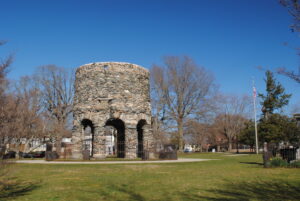 Back on land, there’s one more landmark that is purely Newport, and it’s the one that has always pulled me in: the Newport Tower.
For years, I heard people whisper that it was proof the Vikings made it to New England long before anyone else. They built it, they used it — for what, no one knew. That mystery was half the fun.
But now historians say it’s not Viking at all (bummer). According to them, it’s just an old stone windmill, the wooden parts long since rotted away. Practical. Sensible. Historically tidy.
And absolutely nowhere near as romantic.
Still, the tower stands there in Touro Park, weathered and stubbornly enigmatic. Even with the “official” explanation, I can’t help myself. I’d still rather think of it as the Viking Tower of Newport, a little piece of Old Norse legend tucked into a New England seaside town.
Some places are better when you let the mystery win.
Wrap‑Up
Newport is one of those rare places where every era leaves a footprint — colonial streets, Gilded Age palaces, roaring Atlantic cliffs, and the ghosts of racing yachts skimming across the bay. I’ve danced in its mansions, walked its cliffs, braved its seas, and stood in front of its mysteries.
And every time I go back, Newport feels like it’s waiting to tell me one more story.
Share this:
- Share on Tumblr (Opens in new window) Tumblr
- Print (Opens in new window) Print
- Share on X (Opens in new window) X
- Share on Facebook (Opens in new window) Facebook
- Share on Pinterest (Opens in new window) Pinterest
- Share on Reddit (Opens in new window) Reddit
- Share on LinkedIn (Opens in new window) LinkedIn